The good quantum room
by Tully Mahoney in conversation with Alissa McFarland and Michael Reilly
The future is now. Step into the ultra-precise, high-stakes world of quantum research.

Step into the ultra-precise, high-stakes world of quantum research with Page experts Alissa McFarland and Mike Reilly. Poised to transform every industry—advancing national security, accelerating medical breakthroughs, and unlocking the mysteries of the deep sea—quantum computing demands environments engineered for stability and control. From nanofabrication cleanrooms, where a single particle can derail progress, to quantum labs sensitive to the slightest environmental fluctuation, these spaces demand exacting standards. They demand Performance by Design.


/
Science and Technology Director Alissa McFarland and Project Director Mike Reilly join host Tully Mahoney in The Good Room.
To kick us off, Mike and Alissa, could each of you please share some about what sparked your interest in designing facilities for quantum research?
Almost all of my projects over the past ten years have touched quantum science and technology in some way. My deep dive into the field really took off when I was working on quantum focused labs for groups like the experimental and computational physics and microelectronics and multi-functional materials at JHU APL Building 201 about ten years ago, that led me to projects at the National Labs, the Laboratory for Laser Energetics, and then the Quantum Information Science Cluster team at Syracuse University.
But more recently at Page, I've been collaborating with Northeastern's Quantum Materials and Sensing Institute. I've been working on multiple commercial R&D buildings for top semiconductor and quantum computing companies, and one of the coolest opportunities I've had since I've joined Page, has been to attend the Quantum World Congress here in DC with our research and innovation team.
Let's see. I've been introduced to quantum through work at CU Boulder. I've been working on campus there pretty continuously since 2018, and through those projects and relationships, I've worked on a number of complex microscopy projects and materials research projects that are primarily laser and optics focused.
And I think before I even knew that I was working on a quantum project, I was. So most recently, I've had the opportunity to work on the National Quantum Nanofabrication Facility at CU Boulder. It's a really exciting addition to a building that will be a projection of the research going on within that.
So they will bring together researchers from around the world to collaborate in fabricating or manufacturing quantum chips. And then in parallel to that, I also have an opportunity to work on the Quantum Commons campus at Colorado School of Mines. So this is a brand new campus that the School of Mines has purchased, and they have commitments from industry partners and the state of Colorado to develop the entirety of that campus for quantum research.
So we're working on two projects right now. One is similar vein to the CU Boulder project of fabricating quantum chips, and the other is a laboratory that will do some of that materials research. And also the actual computing or quantum computing for a quantum computer.
So since today, we'll be exploring the design of spaces that supports quantum research and that technology development, I think it might be important to build some grounding on what quantum mechanics means.
Sure, Tully. I'm not a physicist, but I am an enthusiast, so I'll do my best to keep it simple. So quantum physics, as I like to call it, also known as quantum mechanics, describes the behavior of matter and energy on very small scales at the level of atoms and subatomic particles.
I'd like to speak about it more through the lens of quantum computing, which of course is technology that we're all really focused on and really a race to get to a commercial application.
So quantum computing is built upon several fundamental principles of quantum physics that distinguish quantum computers from classical ones and provide the basis for their potential power. So there's a couple key features that relate to quantum states that really give quantum computing this potential power.
And that's superposition for one. The best way to describe that is really to think about classical bits that store information with a value of either 0 or 1, and quantum bits, otherwise known as qubits, which can store a 0 or 1 or combination of both values simultaneously.
So that's going to allow computers to process a vast amount of data exponentially as we increase the qubits. So and this even can mean that it's going to be faster. Right now it's more about being more powerful to do things that classical computers can't do. But certain problems are much faster, like factoring and unstructured database searching.
The other feature is entanglement. And this is where things get really kind of weird. So a particle can behave both like a particle and a wave, and qubits or subatomic particles can become linked so that the state of one instantly influences the other, meaning that their properties are correlated. And this can even happen across really large distances.
But entanglement really allows the information to spread throughout a quantum computer, in a simple way of thinking about it. And it also plays a really crucial role in quantum error correction.
So one of the things about these states is that quantum information is highly susceptible to environmental noise and experimental error. So these states are really hard to maintain over long periods of time. And that's where a lot of the research is focused. So not only do we need better qubits and more qubits to unlock the power of quantum computers, but we need better architectures. We need better error correction. So all of those are posing the challenges to develop reliable and universal quantum computers at scale.
It's fascinating that scientists have understood for a very long time that the laws of physics change at subatomic scale, and now we're just starting to understand how to control that, how to measure it, how to implement it. And we don't know what that will unlock yet, which is why it's a bit of a race at the moment to capture this technology and understand it and implement it, because I think everyone understands in that world that it will unlock possibilities in a similar way that before a computer was invented, a normal computer, people couldn't quite understand how it would fundamentally change everyday life.
Now there's a next technological revolution that people think we are right at the crest of understanding, you'll see announcements of a quantum computer breakthrough that now quantum computers are 1 trillion times more powerful or faster than a classical computer.
The risk there is—risk and opportunity—is real of when you think about something like security and encryption really relies on creating more and more complex encoding, it will eventually be able to [de]encrypt just about any encryption methodology that's created.
The sensing side of things is really interesting. I mean, if we think about what GPS did for us and now we are going to have the capability with sensors to enhance navigation in areas that GPS can't reach. And so what that means for space missions and underwater missions, I mean, just underwater exploration, that is, you know, there's things about our universe and our own oceans and marine environments that we don't know now. And this type of sensing capability is going to create so much more discovery.
I think another very promising field is medicine. Our kind of medicine research has been moving towards personalized treatment strategies. And those have some limitations, just in terms of the complexity of analysis and computations that are needed. And the hope is that our ability to create novel drugs and treatments is going to be nearly infinite with the amount of computing power that a quantum computer can provide.
It's really interesting how many different perspectives come together with this, because it is truly like a new science that is being invented, and it's hard to kind of think about when that has ever happened in modern society. I mean, it's as if chemistry is invented for the first time and trying to think like, who's interested in chemistry? Like, every industry is fully invested in it. It's not just chemistry or chemical companies, it's drug makers. It's those aerospace companies. It's the national labs. It's every single entity.
Let's dive into some of the design and the space types related to quantum. So can you give us a tour of the kinds of quantum research spaces and what each one of those is for?
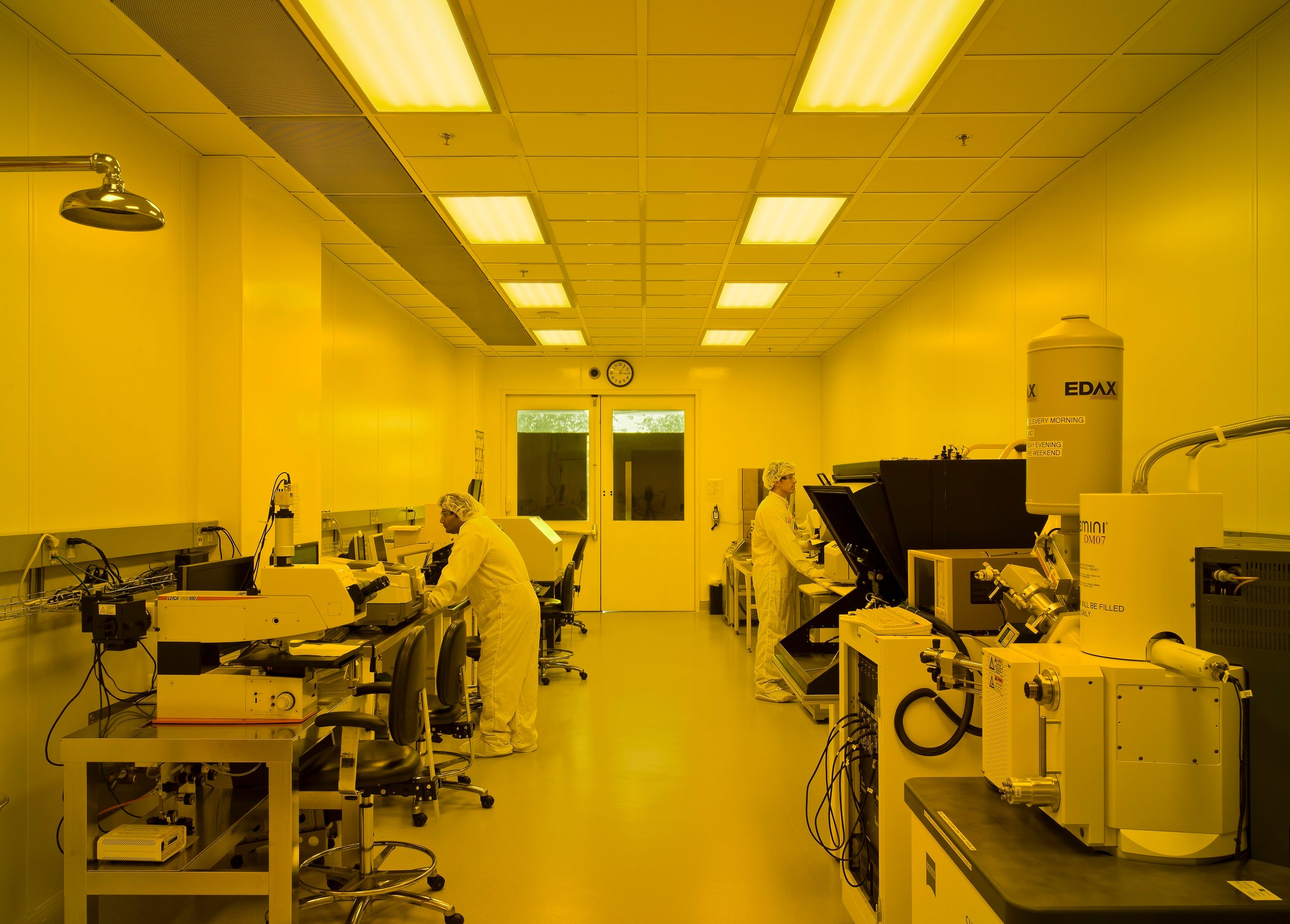
There is the actual quantum computer that requires one specific space to operate. But there's also the making of that computer chip. So the qubits that Alissa was talking about and new technologies are being invented and deployed for how to create those chips. And part of that making or fabrication of the chips is an iterative process. So they're making small batches of chips, generally, that's called a nanofabrication lab, at a much bigger scale it’s a semiconductor facility. But that's kind of the first step. I suppose in the process is fabricating the chips.
The second is a microscopy or characterization lab, and that's generally where they're studying those chips before kind of circling back yet another option or iteration of that. And then from that point, they're generally ready to test or deploy those chips in a quantum computing lab. And that's kind of the exciting part of the whole process. That's where the quantum science actually happens.
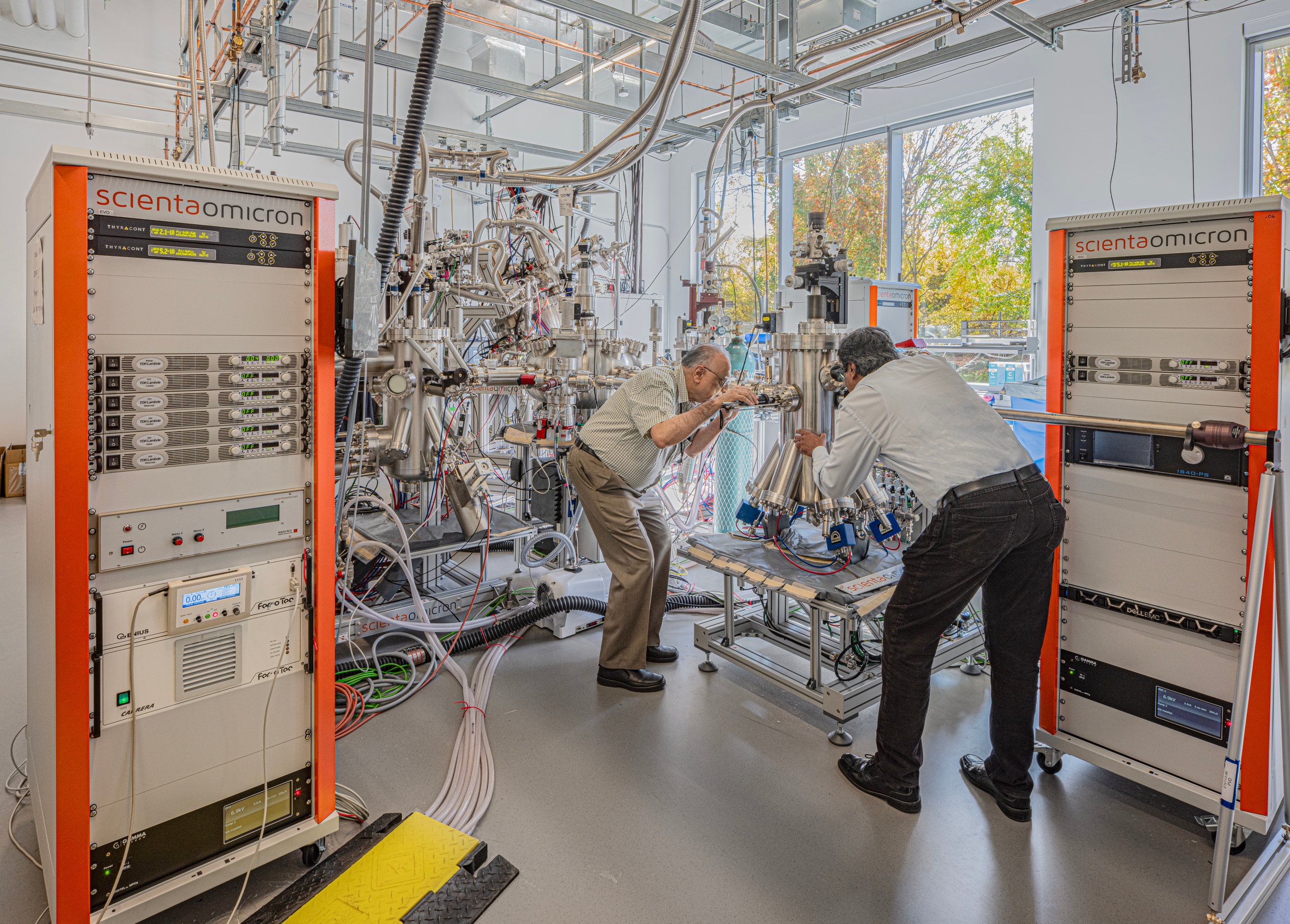
There's a lot that goes into a quantum computing lab, but a big component of it is called dilution refrigeration, which means to remove the noise that Alissa was talking about before and the potential errors of quantum computers. Right now, those qubits need to be cooled to the same temperature as like outer space. I mean, colder than anything on our Earth. And that requires special equipment and special processes to make something that cold.
Just to help frame this from an application standpoint, I actually just saw an announcement this morning that a company called [Quantum] eMotion has just basically commercialized their chips for quantum random number generator, and they are 65 nanometers long. To give listeners here a frame of reference, a human hair is 80,000 to 100,000 nanometers. So the things that are being created right now are at such a small scale. There's a precision of manufacturing that. But then, you know, we've got to inspect these items. We've got to be able to look at them with atomic force microscopes that can image, you know, fractions of a nanometer here so that we can see if they're working, we can test them. We can make sure that we didn't mess up in the fabrication process, that they didn't get contaminated.
And then those small items, those nano devices go into a vacuum jacket of the cryostat, these dilution refrigerators or adiabatic demagnetization refrigerators that are in these low temperature labs to do further testing. Maybe it's control, maybe it's measurement. Looking at things from a characterization standpoint. And then all these elements that are created then go into a system within a quantum computing lab to take it that next step towards actually making it viable for commercial applications, and then studying additional technology that's going to make these systems more practical.
So you mentioned that the nanofabrication labs need a high level of precision. In what other ways do these labs differ from other types of laboratories that you've designed in the science and technology field?
It's really interesting. They're very specific spaces. As Alissa was describing, they're working and creating products at such a small scale that the tiniest particulates in the air are disrupting or ruining the product that they're making. So a nano fab space requires a pretty much like a sterile environment. So it is a clean room, which means if the space that you're in right now a normal office has like one or two air changes per hour, meaning all of that air gets recirculated within an hour. A normal laboratory might have six or eight air changes an hour. Most of these spaces, even at the lower end, could have three to 400 air changes per hour.
And it's it's kind of an intense manufacturing space, even at a smaller scale, that is filtering that air. So the purpose of all of those air changes is every time the air leaves and comes back, it is filtered at a very small or fine particulate count. They're also very environmentally controlled, which means that there is a range of temperatures and humidity, air and vibration that is required to produce the precision needed. And it's all driven by the product that they're creating and the tools that they're using to fabricate those.
And, you know, using humidity as an example, there will be a range of humidity that's required. And anything outside of that means the product is expanding or contracting just enough that the next time, the next process that's done to that product isn't done precisely enough. And you've now ruined that chip.
Those spaces also are very chemical intensive. It's going through kind of a layering process. So they're generally putting what's called a mask onto the chip and then putting a film over it and then washing away the mask so that you're left with kind of a waffle pattern, and then putting a new mask over that in a different orientation and a new film on it, and then washing it again.
And if you do that, hundreds of times, you build a 3D network of communications all at that nanometer scale that Alissa was describing. But every time you go through that process, you're trying to add conductive materials. And the only way to do that right now is with very harsh acids and chemicals that are just aggressive, I'd say like highly toxic chemicals and pyrophoric chemicals, which means they spontaneously combust when they are introduced to air.
It requires just a very talented team, both on the ownership side and the design side, that understand the limitations of every step.
And what I've really learned recently is how critical working with the building controls and all kinds of aspects of the HVAC to get all of these things tuned just perfectly when they're working with these chemicals.
Yeah, I think one thing we're learning right now at CU Boulder is most universities are not very familiar with these highly intense chemicals. As they should, they're very cautious about it because they have students, they have researchers that are learning in this space. And it's not a manufacturing floor where someone is highly trained and doing the same task over and over again.
They need to plan for the future, which is not fully defined, and they want to be sure that they're designing a facility that is safe for all of their students and all of their researchers, and anyone that may use that space for what they plan to do today and what they hope to do in the future.
So part of that, like Alissa was saying, is the building management system. It's the alarming, it's understanding what happens. How does the system operate when things are operating as they should, and what are the failsafe mechanisms if there is a worst-case scenario to keep everyone safe.
And as you can imagine, Tully, not only are we working really closely with the research teams, the building facilities management teams, and the EHS facilities teams, but also directly with the equipment manufacturers, because this equipment is so sensitive and it's usually operated in a process as Mike's describing. So we've got to make sure we're optimizing the facility for every aspect of the equipment.
That's probably the biggest thing to be mindful of when you're designing a space like this—is that understanding all of the tools, both at the very beginning and as the project progresses, is critical. What we see more often than not, or always, is that we’re given a preliminary equipment or tool list, and we know with certainty that that tool list will change during design. It's just the nature of how quickly things are evolving.
The researchers will introduce another step in their process that requires a new or different tool, and that new or different tool can have enormous impacts on the building design. If that one tool requires vibration criteria that is more strict than every other tool that's already been designed for, then the building now has to be designed for a new vibration criteria.
Managing that process is critical because we need to be in a position where we can quickly react and adapt to those changes, and help these researchers and institutions stay on schedule and on track and meet the commitments that they have throughout. But it takes a constant dialog between the researchers, decision-makers, and the design team to make everyone aware that, yes, we can absolutely accommodate this piece of equipment, but to do that, we need to reevaluate this, this, and this.
Before we move on to thinking about quantum computing environments, I'm curious, what's the relationship between the nanofabrication labs and the microscopy labs?
This will be a lot simpler of a conversation. In general, users like to co-locate these within, you know, some proximity. It's a different type of space that most of these microscopes work within. And they're very large. They're very complex.
There are many different types of microscopes used for different things, but generally they also have vibration and temperature and humidity control requirements. Because these microscopes may take a long exposure of a single chip. And when I say long exposure, it may go for weeks of a single image that it maps or creates. And that product cannot move or flex during that time.
But it's generally, I'd say, a simpler process-ish in that the users generally know what type of equipment they need to do that imaging, and they don't plan to change that very often because those microscopes can be in the tens of millions of dollars each.
And then it's that back and forth process we talked about before of studying and understanding why. Why did the chip we made not perform the way we thought it would? And how can we try to do that again? And that's where it goes back to the fabrication side to make the next version of that.
So let's say that the making and the testing part is complete, and we're ready to use that chip in the quantum computing lab. How might the design of the quantum computing lab differ from the requirements we were discussing in the nanofabrication?
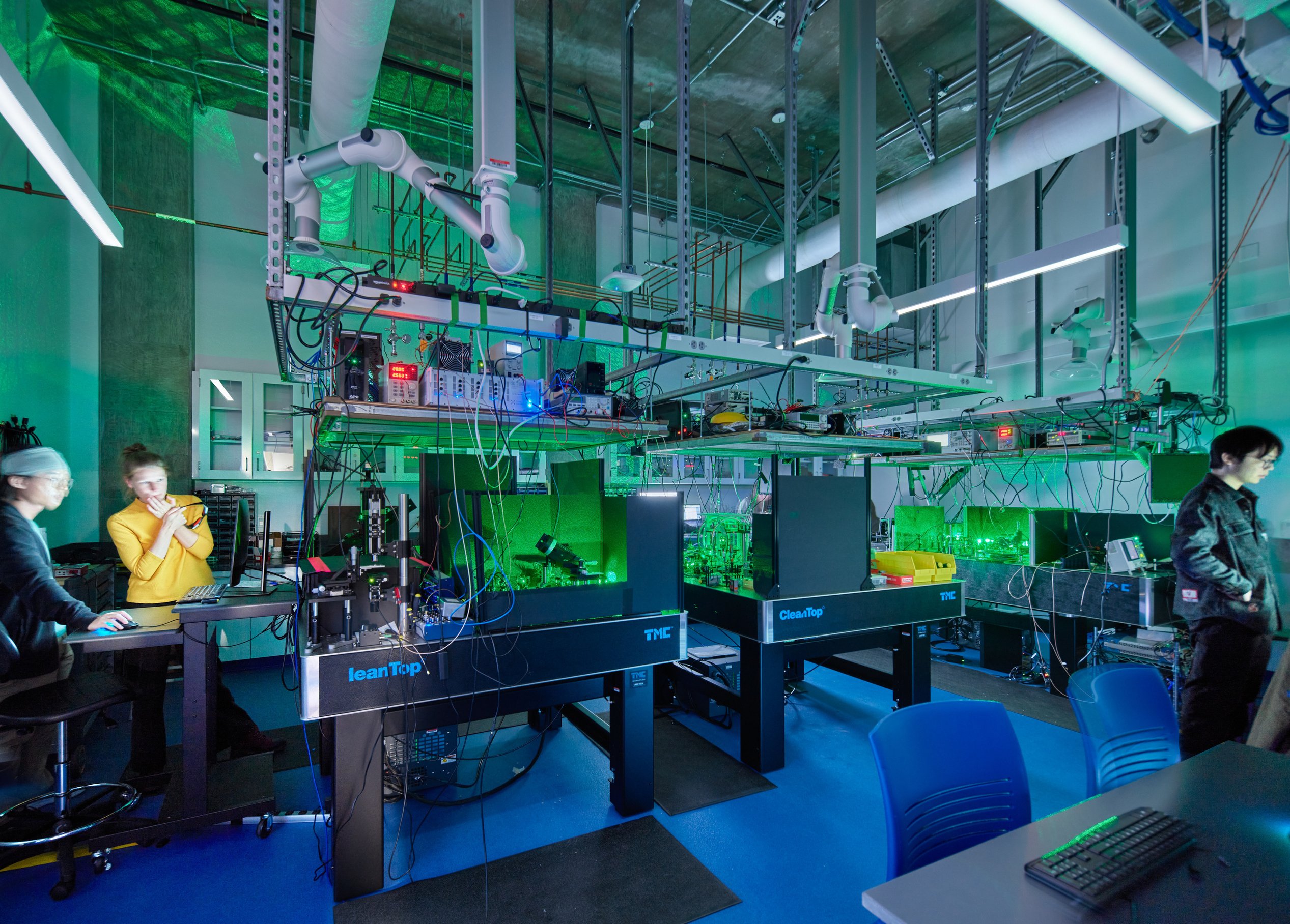
I think it has a lot of the same elements, Tully, and it really just depends on the exact modality that we're looking at—what the requirements are. In a quantum computing lab, we're looking at the integration of systems. So that could mean a combination of optics, lasers, cryogenics to support that isolation that I was talking about, and Mike mentioned, to get things down to a stable environment.
So there's the element of the equipment providing that isolation, but then also the room. So it's really similar to some of the aspects of the nanofabrication and the imaging spaces, in that we've got really tight vibration criteria—sometimes even up to VC-E—and temperature stability down to half a degree or less that we can fluctuate within over the course of an hour, and in a clean room environment that is very similar.
These labs typically are a clean room environment, as Mike was just describing, with the amount of air changes that are required. That really is a feat to keep that level of temperature and humidity stability. With the humidification, we're typically worried about electrostatic dissipation. So we've got a special floor material in these spaces, and we're really trying to keep the humidity constant so that we're not introducing interference with the electronics.
We've got shielding that we're looking at—electromagnetic shielding, lab groeunding, sometimes clean power—trying to minimize anything that can influence the experimentation.
And am I right in thinking the stability is so important here because it is doing such large and mission-critical functions that it would be almost as if you're doing a math problem, and at the beginning you do two times four incorrectly, and it messes everything else up at a much larger scale? Is that why stability is so important?
That's exactly it, Tully. This equipment is super sensitive, but the research takes place over a long amount of time, potentially. So if anything interrupts, it can basically lose them a large amount of research.
There are owners that are potentially looking at even providing redundancy—N+1—into their systems so that they can maintain those temperature stabilities. They don’t want to deal with disruptions or power loss that throws systems out of whack. And that’s in addition to emergency power and UPS systems, just because of how critical the research is and how expensive it is to run all of this equipment—and basically redo anything.
Also important to the protection of equipment and the research is the fire suppression systems. A lot of owners would look at dry fire suppression—sometimes gaseous—but sometimes just dry pipe, because we’re worried about the effects of a gaseous system on the research and the equipment in the event that the sprinklers are triggered.
So in the nanofabrication labs, we were talking about safety in terms of the chemicals that are used. How do you need to address safety in the quantum computing lab?
A lot of the research that we're describing here requires that ultralow temperature that Mike was requiring—basically to isolate the environment we’re manipulating quantum features and nano devices within. And so that could be cryogenic gases like liquid nitrogen and liquid helium.
When we work with cryogenic gases, there are a lot of safety considerations—not just freezing and pressure issues of the vessels these gases are stored within, but also oxygen deficiency hazards. So with leaks, there’s potential for displacing oxygen. We’ve got to plan and work with our engineering team to make sure we’ve got multiple oxygen sensors within the labs that would go to a building monitoring system in the event of a leak, and allow people to leave the space safely.
Other aspects of safety considerations can be things like fall protection. In these labs, we’ve got potentially tables of optics that might have a superstructure above to hold equipment to bring fan filter units directly above these tables. And oftentimes there are people on top of those. So not only do they have to be designed to carry the weight of personnel and equipment, but they’re up high—we’ve got to provide that element of safety.
The lasers that are in use here are typically class four and above, and there’s a lot of safety features that we’ve got to build in for the lasers, including anterooms—basically a mantrap—and laser interlock control systems. We've got laser safety barriers at the point of use, and then control rooms and different aspects of monitoring each of these types of spaces to make sure they’re operating in a safe way.
So my understanding of quantum computing is there are only a handful of functional computers. So I imagine there’s a whole slew of emerging trends in the design of these spaces. What are some of those that you’re seeing?
There’s a few things I’m investigating right now, Tully, to try to prepare us for future projects. After working through the construction administration phase on several, I’ve found that the actual materials we’re planning are typically long-lead items.
We often work with modular clean room wall panel systems that are aluminum honeycomb design, and the aluminum can be quite expensive and take a long time to get. Of course, as we see different aspects in shipping and procurement of materials, it’s constantly changing. So we’re looking at that carefully.
There’s a first-cost aspect in planning the right kind of material here as well. But what I’m looking into is the ability to plan modular, prefabricated clean rooms. These might get developed in a factory off site and take that modularity one step further—basically get delivered almost turnkey to a site and be connected to create the size lab we need.
So that’s something that would be critical to explore early in the design process to see if it brings a benefit—speed to construction, basically helps clients with their schedule, gets a project opened up faster than either a traditional stick-built type clean room or even a modular panel system.
It’s often a discussion of upfront cost versus schedule. We’re always debating—“Is this project better set up for a turnkey prefab solution or a site-built, stick-built solution?” They can both perform equally, but they have different cost and schedule implications.
There’s also a misperception, I think, that if we go the prefab route, we can just let them do everything. The reality is clean room vendors do an amazing job at designing and building a clean room. They do not design and lay out the equipment within the clean room, and they do not design the systems that serve that equipment.
So there’s still a big integration that needs to happen between the owner, the architect, the engineer, and the prefab clean room vendor in both scenarios. And I think that could probably be its own Good Room episode in itself, because there’s a lot that goes into clean room design.
I was just going to say, what’s cool about the prefabricated kind of modular idea also is that if an owner were to change sites or expand and want to move things or change things, it’s almost like a piece of furniture that could be disassembled and relocated.
But I think what this affords is the ability to control some of the contaminants introduced during the normal construction process. That’s one of the most challenging aspects of building these projects—there’s a whole procedure for cleanliness during construction that is both time-consuming and expensive.
Well, just to close this out here, I'm curious—what excites you about the future of quantum technology and how design can help shape it?
You know, all the things that Mike was describing—the applications and really what we've seen in our lifetime—you know, we are really a generation that has realized so much transformative technology of the first quantum revolution. And now we're at the dawn of the second.
Things that are coming out of this will fundamentally advance the technology that we're using today. It has the potential to transform every part of our society and economy and solve problems that previous generations couldn't even imagine.
And the development of quantum technology—I think what's really exciting is how much participation and collaboration it's going to require across so many diverse groups. I mentioned getting to attend the Quantum World Congress. That brought leaders in quantum technology and innovators across the globe together. This has been the third year that has happened, and I’ve gotten to witness the partnerships and the announcements of real breakthroughs.
I think we're talking a lot about the future, but there's so much that's happening right now. Even here in our backyard—in DC—and the state of Maryland is investing so much to really create the capital of quantum. Maryland has invested in research. There are so many resources within our area here, as well as the recent announcement that both the state of Maryland and DARPA have invested in the Quantum Benchmarking Hub, which will support DARPA's Quantum Benchmarking initiative. So that’s going to happen right here in our nation’s capital. They're really working to determine what technologies have the potential to be commercially viable.
Yeah. And I think, Alissa, I would add that it's fascinating to see all of the developments and announcements that are made. And the reality from our perspective, being architects and engineers, is that we don't necessarily shape the trajectory of that research, but we facilitate it. And we design spaces that can improve the research that's done.
You know, we're really driven as high-performance designers to help these researchers deliver the extraordinary experiences and solutions that they need to be successful. Our team—or our kind of value proposition—is that we have a deep bench of experts across every sector, and we're able to tie higher ed to national labs, to mission critical to semiconductor, together in cohesive teams that can have conversations with clients that need to both fabricate these chips and test these chips and run these chips.
And individually, every space can kind of be put into its own category. But collectively, you need many top-class experts in order to have a continuous or connected conversation about all of them. Our team does an amazing job meeting those demands with the knowledge and questions and rigor that we bring to the table.
Hosts

With expertise in crafting compelling narratives that engage diverse audiences, Tully blends creative flair with a keen eye for detail to develop impactful content across platforms. Her work includes award-winning podcast production, content development, and copyediting large-scale documents, all while enhancing brand voices and driving audience engagement. Tully also supports data visualization efforts by transforming complex information into clear, actionable insights through engaging storytelling.

Talk with us
Complex challenges need fresh perspectives and deep expertise. Connect with our team to explore how we can help you create spaces that make a real difference.