What makes a room good? Answered.

After two years of conversations, The Good Room returns to the question that started it all: what makes a room good?
From energy performance and human health to housing, technology, and urban resilience, this episode brings together insights from across the series to explore how design performs at every scale.
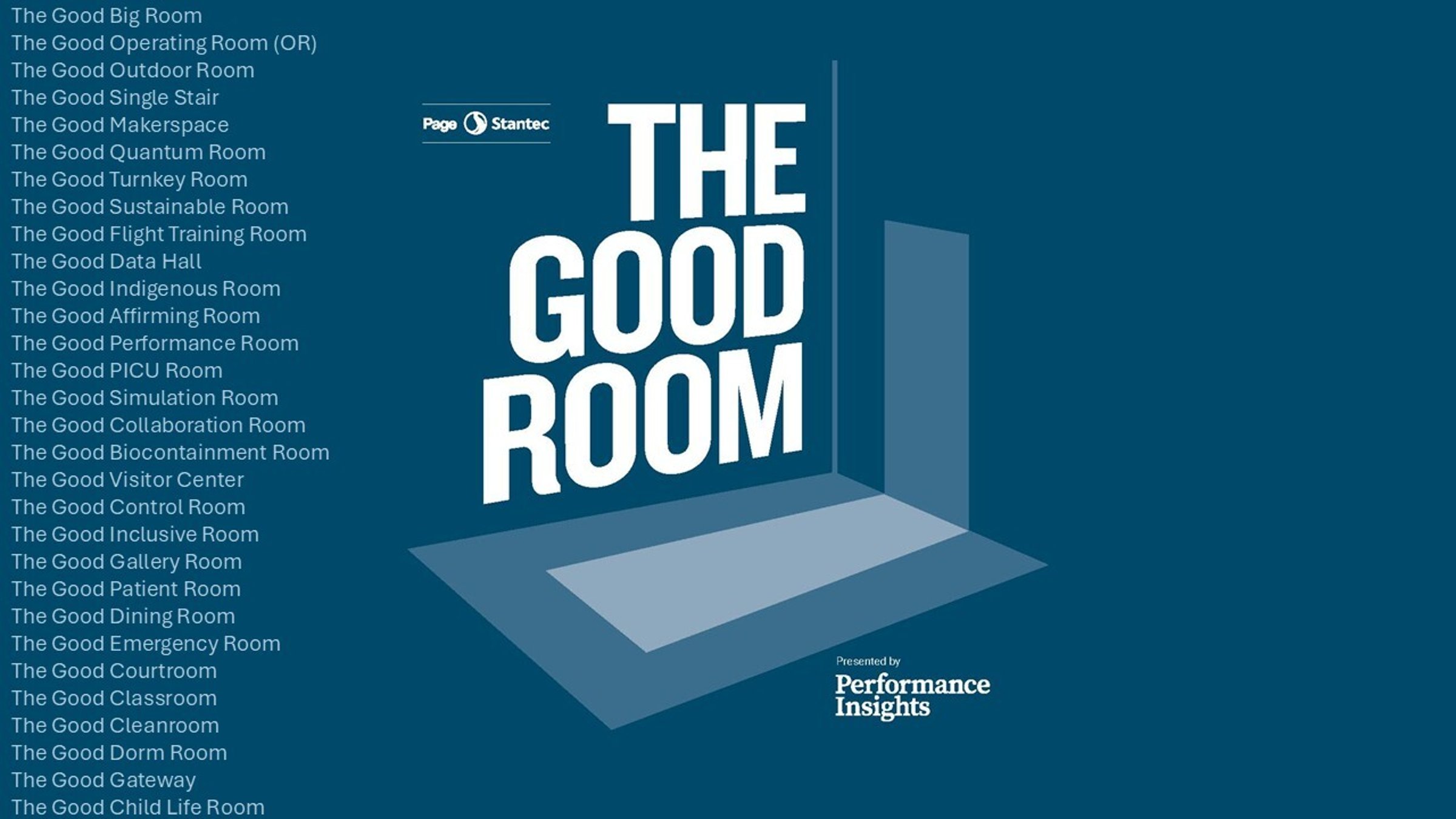
For the last two years, we've explored a deceptively simple question. What makes a room good? Across data halls, emergency rooms, classrooms, and more, we found that the answer uncovers the essence of Performance by Design, where a good room is measurable, it's human. It's intentional and it's innovative.
But that raised another question: How do we actually measure performance?
We'll start with a common proof point: energy. As regional sustainability lead Justin Schulz explained in The Good Sustainable Room, energy performance gives us a clear and comparable metric for understanding how buildings operate.
A number of clients have a goal related to energy savings, and so it's either a percent savings from a energy code baseline, or it might be an energy use intensity or EUI. And that is an annual energy consumption of the building divided by the square footage. It's basically a nutritional label for our building so that we can compare them apples to apples.
And that's the number one metric we look at when it comes to energy. Everyone wants a lower energy use intensity building. The lower the energy use intensity, the less energy it consumes and the less PV or renewable energies or other offsets you need to make it a carbon neutral building. Everyone wants a percent reduction from a baseline. Many of our clients actually have requirements to be 30% better than energy code, and that's a really great initiative to put that line in the sand and say, we need to do better than current energy codes.
Those are the two primary metrics. We also look at things like peak heating and cooling, especially when it comes to buildings with really large loads. Some of our clients are charged more for the peak loads than they are for keeping the lights on regularly, so we're constantly looking at various metrics to bring down loads, as well as total energy consumption.
Design also shapes our health and well-being. Jill Kurtz explained that one of the biggest predictors of health is the environments where we live and work, sharing three ways design can measurably support well-being.
One thing I learned when I got into this field is one of our biggest predictors of health is not our genetics, which I often like to blame. It's actually where we live and who we're friends with. And so where we live has a huge impact or where we work. You know, what our commute is like? How much time are we spending indoors? Are we active?
That actually has a bigger impact on some of our health and well-being than some of those other factors that we like to think about. And so just the role of the built environment can't be underscored enough as it relates to how we as humans function and elevating our well-being. That kind of abstract topic translates back to building solutions in three ways. One is we want to make sure that people aren't getting sick or the negative effects of buildings. We used to have a lot of that sick building syndrome in the past, when we didn't really understand the proper ventilation and how to manage humidity and mold and all that kind of stuff.
So we definitely core to any project should be how do we make sure that that's not not happening? The second is then how do we promote practices that encourage wellbeing, and how do we create movement within our buildings and activity, thinking through the spaces we need for healthy daylight. You know, what are those things that then elevate wellbeing and the predictive strategies for that? And then the third is how do we also make sure we connect with people? Part of our wellbeing is also connection to others.
And some buildings encourage that more than others. You know. So what does that look like. And how do we make sure that all three of those things are happening in a really meaningful way for that project is how I like to help people understand what that looks like in our work.
Zooming out from the building scale to the city scale, performance also shapes equity and resilience. Urban designer Ryan Losch points to the urban heat island effect as one example.
I think within any given city, there's an equity issue neighborhood to neighborhood of how we are protecting people from extreme events. You can map redlined areas of cities and see that there's no or much more limited tree canopy compared to other areas of the city. There's less park open spaces.
You know, we're talking about the outdoor room. Do they have, do they even have an outdoor room to go to? Do they have a place to be in the shade when they're outside? And then, you know, this connectivity of spaces doesn't have to be a formal room or anything. But how are we treating the streets, as Nico's saying, with the tree canopy so that I can get from one space to another in a comfortable environment without having to find air conditioning or questioning whether I even have access to it.
Equity also plays out in the way we design and regulate housing. In The Good Single Stair, Shivanthi Carpino explained how the housing crisis is fundamentally a problem of supply.
So when you talk about housing affordability, it's easy to focus on prices like your rent or mortgage or interest rates. But at the core, affordability is the supply issue. It's about abundance. The more housing options there are, the more stable and accessible the market becomes.
So right now in the U.S., we don't have enough homes, not for sale and not for rent. And research shows that the U.S. is really short anywhere from like three and a half to 5 million homes, and that's just to meet existing demand. It's not even anticipating future growth. But it's not just that we're short on housing in general. We're short on the right kinds of housing. We're short on smaller, more affordable rental units in cities and walkable communities. We're short on homes for people who don't need or can't afford a single family house on a quarter acre lot.
And this is where the term the missing middle comes in. Most residential land is zoned for single family use only, so in the few places where multifamily housing is allowed, zoning rules and financing tend to favor big buildings. That's usually 50 or more units. So even though there's a strong demand for smaller, more affordable housing options, the zoning regulations make these mid-scale multifamily housing typologies nearly impossible to build. And if you can only build two types of housings, you leave out a huge portion of the population.
If urban heat and affordable housing show us performance at the largest scale, quantum clean rooms show us performance at the smallest. Mike Reilly explains the environmental controls required to support quantum research, where performance is measured in humidity ranges and vibration levels.
They're working and creating products at such a small scale that the tiniest particulates in the air are disrupting or ruining the product that they're making. So a nano fab space requires a pretty much like a sterile environment.
So it is a clean room, which means if the space that you're in right now a normal office has like 1 or 2 air changes per hour, meaning all of that air gets recirculated within an hour. A normal laboratory might have 6 or 8 air changes an hour. Most of these spaces, even at the lower end, could have 3 to 400 air changes per hour. And it's, it's kind of an intense manufacturing space, even at a smaller scale that is filtering that air.
So the purpose of all of those air changes is every time the air leaves and comes back, it is filtered at a very small or fine particulate count. They're also very environmentally controlled, which means that there is a range of temperatures and humidity and vibration that is required to produce the precision needed. And it's all driven by the product that they're creating. And the tools that they're using to fabricate those.
And, you know, using humidity as an example, there will be a range of humidity that's required. And anything outside of that means the product is expanding or contracting just enough that the next time, the next process that's done to that product isn't done precisely enough. And you've now ruined that chip.
Performance also evolves alongside innovations and changing expectations. In The Good Patient Room, Joan Albert and Zac Hillyard describe how healthcare environments are integrating ambient intelligence to support both patients and clinicians.
For me, it's about giving the patient control and autonomy, as Zac said, and really customizing it to the patient as well. So you're showing up to your room and it's really like a hotel experience. Your name is up on the screen, you know. Hello. John Smith welcome. You're here today.
You know, to have such and such procedure. To me, that's a really wonderful experience. It goes further in allowing the patient to really control everything. The lighting, the air, the shade, being able to call for help or just call for a glass of water. That control when you're in an experience as a patient, that's extremely stressful, scary, and you feel completely out of control in a lot of ways, that little bit of control can make a big difference.
Absolutely. And then expanding up on that, there's features like I talked a little earlier about services and clinical skills that maybe are outside that space that are going to serve that space. So when you think of telehealth and the example that we're pretty familiar with these days, the downturn of the pandemic, everybody needed that additional care but couldn't go anywhere. So there was this new barrier. Those really changed kind of the landscape in the lens of how we look at these spaces and almost amplify them even more.
Nurses and clinicians are really in short supply and like, they're not as simple as you may think. So using the best of their type of license skills to serve a bigger population is kind of a challenge. And natively in the design, the terminology really is ambient intelligence. How can you put ambient intelligence and virtual nursing as components of our room? Where would you put those mediums, the cameras themselves, because it's really about having that line of sight, eye to eye contact. But then what's happening in that environment. And so they're looking at a whole lot of factors, and they're using that to give you better care.
And sometimes innovation comes from questioning assumptions. The Good Gateway asks whether security always has to look imposing to be effective.
I hadn't thought of this till now, but it's interesting to imagine what an airport would be like if it, if you didn't actually see the security components. And I don't know if it's good or bad, but the thing that's interesting about the thought exercise is, like we did a state hospital and it was really, really important to the leadership that bringing somebody into the hospital was there was no barrier to actually getting somebody into the building, because the success of their care depends on them not perceiving the building as a threat, which is kind of counterintuitive to security in an airport.
Like in some ways, you want the role of security to be imposing, that it's a serious thing that's taking place. And that in a way, a deterrent if the airport, said, actually, this is should be a thing that is secondary to everything else. It would be I think it would be very different. Like you could see airports, you could distribute it. Right. Like if instead of it being concentrated into a thing where there's a crowd, it would just be this thing that you'd be like, you get your coffee and like, oh yeah, by the way, could you step through this?
And there was this sort of automatic moment where you don't even know that you've just been scanned. And that serendipity of security is something that takes place when we're taking care of one another anyway. And I wonder what that would look like if it was integrated into more public spaces. Maybe we wouldn't worry about having to be delayed for three hours because we wouldn't even perceive it. It would just be like, you're on this beautiful walk that happens to be this interior space. I don't know, but it's, it's a funny thing to, to consider because, it doesn't have to look like that.
Innovation also changes how people engage with spaces. In The Good Makerspace, Rob McClure describes how makerspaces are integrating transparency and campus connections to invite new users to these spaces. He describes this new model as academic retail.
One of the things we've been seeing recently is the audience isn't a specific group, it's the entire campus. And in some cases, it's not just the campus, it's the community.
A lot of these maker spaces are great places to take, you know, kids that are in grade school and walk them through and have them see, you know, someone building a robot, what happens is you get that spark, right? All of a sudden, someone, you know, it's almost like retail. It's like when you're walking through a city and you're window shopping. That's what these spaces are becoming. And it's like academic retail. You're like walking through and you're seeing things. You're seeing just students having fun or building something or doing like a pitch to an industry partner.
These spaces have become a great recruitment tool, kind of get the next generation of people to really engage in fabricating and making and pursuing a career that they might not otherwise have thought about. Getting people in the door, it's almost like a gateway drug or catnip where you get the bug right, you build something and you get that bug, and all of a sudden it's like it just sparks all these other ideas, and students keep coming back to do more things. So as the popularity of these spaces rises on all these campuses is, how do you actually accommodate the population that's trying to, trying to access, access these spaces?
So at Seattle, their makerspace, the one that we design, you know, again, is front and center on their campus. One of the things they've done is they've actually been able to tie that to other spots on campus. So you could do more things in different things, right, and work with the different colleges and majors on the campus. So an example at Seattle is you know they have a costume shop as part of the theater department, and they have a lot of sewing machines.
And, you know, someone may go to that, the makerspace that we designed and want to do more and the equipment's not there, but then they can find out the resources and then access those resources across the campus. So it's almost like a hub and spoke kind of diagram, right? Like, you know, you have that kind of the makerspace is front and center, that is, you know, very visible, super accessible. And then the students go in there, they do one thing and they realize they want to do something else, and then they can start to access and really leverage the campus wide resources.
So that's something that, you know, maybe we'll start to see is these spaces are going to be sprinkled throughout campuses, not just centrally located.
Where maker spaces are being intentionally designed to invite new users, Daisy Houang reflects on how performing arts venues are doing something similar, bringing people together around shared experiences that foster connection.
One of our clients said something to us that was just very wonderful. She basically said that performing arts venues, whether they're theaters or other types of spaces, their value is not only as a place of joy and community connection, but they also bring a community together in times of turmoil. She had noted an example of during 911, for example, in New York City, people were looking to the arts and the arts community to put something out that would help to connect people and also use these spaces to help connect people. And I think that's a really powerful thing that these spaces for the arts can do.
And they also can be incredible outreach or educational facilities. A lot of our clients, they open their spaces to high school students, host summer programs. They do things like that to really engage with the younger generation. The arts and that type of training is really training you to creatively solve problems. It's not just about expression that you're using a process or iteration or different kinds of creative skills that you've developed to really try to solve problems.
And by these spaces opening up to the community, you have the potential also to start to connect people in the arts with people who might not be in the arts, such as scientists or business people or, you know, all sorts of different types of disciplines and people with different types of focus. And that's when you get those moments of real creativity and collaboration.
Taken together, these conversations reveal that performance in the built environment can take many forms, and in many cases, we already know the answer to good design. As Jill Kurtz explained in The Good Sustainable Room, the real challenge now is making those solutions part of how we design every day.
From my perspective, what I've loved about being in this field for the last 20 years is just seeing how much it really has matured. We're no longer wondering, well, what should we do? We know what we should do.
We know what the right solutions are, that it's not as matter of defining what are those best practices. The task now is making sure that they get implemented. And I love this quote from James Clear, that he wrote in Atomic Habits that you do not rise to the level of your goals, you fall to the level of your systems. And I think the challenge we have right now is a lot of our building systems and processes just don't make this a core part of decision making. And they're not core to the budgets we're setting or the goals that we define.
And so I think part of our task and what I'm excited about is this next phase where those systems, those processes that like just collective understanding of what needs to happen, also evolves along with the technology that we've seen. And so sometimes I feel like my job is more around change management than it is always around the technical data side, because I think those sometimes end up being the things that keep a project from moving forward, is, is making sure we're all aware of what needs to happen and working through those barriers of familiarity of systems, or how do we factoring in these costs from the beginning so that we can move those solutions that we know need to happen forward.
After two years of these conversations and stories, we come back to that question that started it all. What makes a room good? We've seen that the answer can be measured in many ways, in energy use, in air quality, in access to housing, in the precision of a clean room, or in the comfort of a patient room.
But again and again, the best room shared something deeper. They were designed intentionally, they performed measurably. And most importantly, they worked for people.
That's what performance by design really means.
And that's what makes a room good.
So at the end of the series, I want to thank you for listening to The Good Room and for joining us on this journey.
As Page joins Stantec, I want to take a moment to direct you to their podcast, The Design Hive, which focuses on the design trends shaping the sustainable, equitable, and resilient communities of today and tomorrow.
Thank you. Bye.
Hosts

With expertise in crafting compelling narratives that engage diverse audiences, Tully blends creative flair with a keen eye for detail to develop impactful content across platforms. Her work includes award-winning podcast production, content development, and copyediting large-scale documents, all while enhancing brand voices and driving audience engagement. Tully also supports data visualization efforts by transforming complex information into clear, actionable insights through engaging storytelling.

Talk with us
Complex challenges need fresh perspectives and deep expertise. Connect with our team to explore how we can help you create spaces that make a real difference.