The good Indigenous room
by Tully Mahoney in conversation with Nitish Suvarna and Anjelica Gallegos
Spaces tell stories—and Indigenous design carries histories, traditions, and cultural knowledge that connect generations.

In this episode, Anjelica Gallegos and Nitish Suvarna explore how Indigenous design principles honor site histories, strengthen community ties, and create spaces that are not only sustainable but deeply rooted in identity. From land acknowledgment to architectural reciprocity, they discuss how Indigenous perspectives shape design, ensuring that built environments reflect the voices, needs, and ecological wisdom of the communities they serve.
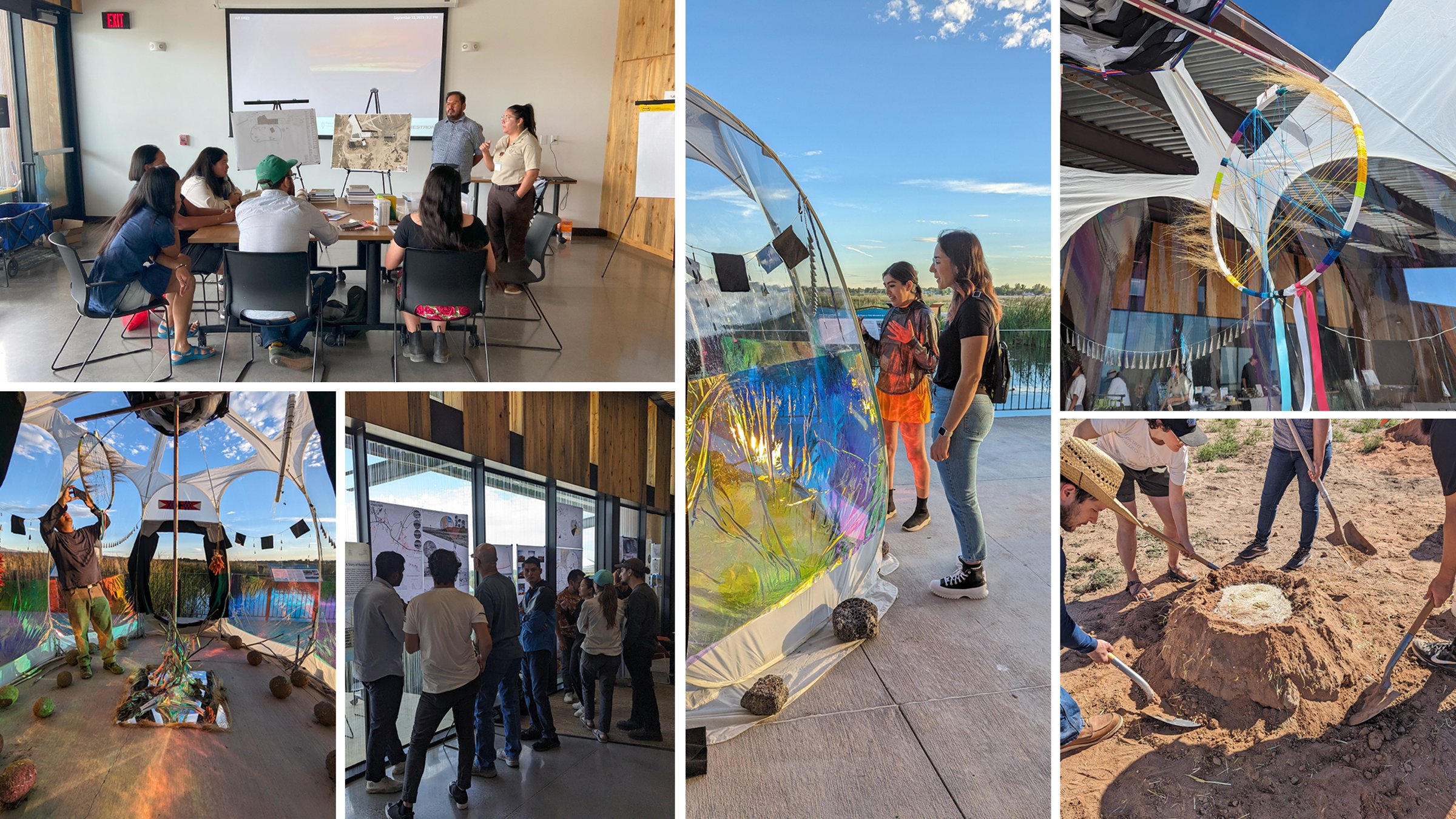
Designer Anjelica Gallegos and Operations Director Nitish Suvarna join host Tully Mahoney in The Good Room.
Hi, I'm Tully Mahoney, and you're listening to The Good Room. Today we're thinking about The Good Indigenous Room with Anjelica Gallegos and Nitish Suvarna. So, Anjelica and Nitish, can you both please share your background as it relates to indigenous design and indigenous design principles?
I'm Nitish Suvarna. At heart, I'm an architect with Page. I grew up in India, and I had the pleasure of working with a number of tribes and federal authorities that have worked with tribes over the last 12 years with prior firm, and that's where most of my experience with indigenous design and indigenous communities come from.
So, my name is Anjelica Gallegos. I'm from the Santa Ana Pueblo and Jicarilla Apache Nation. I'm an architectural designer at Page Southerland Page, and also co-founder and director of the Indigenous Society of Architecture, Planning, and Design. My interest is in systematic programing that elevates indigenous history practices and knowledge while advancing connection, building, and reciprocity in the broader architecture field.
My research and built work focuses on indigeneity and architecture, including site memory, policy, and architecture intersections like the federal Indian boarding school system and sustainable design principle application.
And Anjelica, you mentioned research. Are you able to share more about your and the Page Foundation research related to indigenous design?
I'm happy to announce that Page Foundation has funded a new research initiative that I will be leading, called Page’s Indigenous Land Acknowledgment Tool, or PILOT. This initiative is a collaboration realized with partners playing a vital role in its success, such as the Indigenous Society of Architecture, Planning, and Design, Plan Collaborative, and other entities.
The Page Foundation is a nonprofit organization that encourages innovative research related to the field of architecture and engineering. The Foundation works toward creating a more ethical, equitable, and responsible built environment by confronting myriad socio, cultural, and ecological problematics within and in the periphery of the field.
PILOT presents an innovative approach to integrating indigenous knowledge into architectural design and sustainability practices. It will enhance the recognition and application of indigenous historic and contemporary insights into modern architecture by bringing authentic and important tribal land information into the beginning stages of site research and the design process to inform and enable site specific materials.
PILOT aims to provide authentic, site specific, and culturally sensitive acknowledgments that benefit multiple communities. Its intent is to not only respect historical context, but also to contribute to the sustainability credentials of building projects by generating design elements informed by indigenous ecological and architectural data.
Thank you. I'm so glad that the Page Foundation is putting resources behind this effort, and I look forward to seeing how the project evolves. On a related note, you touched on acknowledging the history of a place. What is an architect, designer, or planner's role in acknowledging the history of a place?
Well, as designers, we do have the best intentions for our clients and want to create beautiful spaces and places. I think a foundational way to start this would be to understand the historical context of the site in the US and other countries, to create more informed spaces, and that would entail us asking more questions like whose tribal territory is this site a part of? Where are these nations today? What did architecture look like a number of years ago, and how did it interact with the landscape?
This research is important for awareness and can also be a source of insight to make the project belong to a specific site.
I'd like to add a little bit to that, too. In terms of actually, when we develop projects in tribal land as architects, we try to come as informed as possible to a project. But many times we're relying on the lived experience of the indigenous people in those areas. And a lot of these experiences come out through the process of design as we start doing projects.
It's a push and pull of we have this real project going on and how do we give importance to that indigenous context as we develop a project. And I feel the success of a project kind of really depends on how well you get that information of how you implement it in design.
Yeah. And it sounds like as you were talking, that community engagement is a really important component of this process. What does the community engagement look like when you're designing for an indigenous community?
You know, many times when we start off a project, I'm going to be in terms of reality. What happens is that BIA, the Bureau of Indian Affairs or Indian Health Services or one of these entities provide funding to start up a project. And so when we set up a project, it's about the base nature of, hey, how many square foot do you need? What kind of a project is this? What is the program of this?
As you try to develop that program, you want to set the stage for, this is also part of culture. This is also part of community. How do we get to the users and the rich culture showcased in that project of design development, right. And I think that's where as architects, it's really important to empower the community user, the tribal elder, everybody who has a seat on the table from the tribal side needs to feel empowered to give their opinion of what that project needs to look like a true tribal sense, indigenous sense.
How do you portray that project that makes it feel like it belongs to them, and not some big firm out of New York or something like that?
As far as cultural knowledge that communities want to include, it should, of course, come from them. They know their identities the most, and it's a matter of respecting them as a people and the architect being the assistant, or helping them through the process of creating spaces.
Yeah, definitely. I think it's that idea of not imposing any external values on a community and ensuring that the result is something that reflects and amplifies their values. And I think on a related note, I was listening to the podcast Building the Future and they have an episode about indigenous architecture, and one of the guests explains that indigenous culture emerges from the land and the region that they live in. I'm curious if respecting and reflecting the land is then a motivation behind indigenous design.
Yeah, so I think that goes back to land acknowledgment and really creating projects that are born from the site and very specific to that site. So there's a few different principles that I think pertain to that one being that the land has memory. And so I think in architecture, at least in academia and sometimes practice, the land is often viewed as a blank slate without standing or perhaps not being really considered a community member.
And so with that, a lot of the identity and richness I think of the land itself is not really considered in the design process, and also maybe even just the current time period and specific built environment pieces, like roads today or sidewalks. Those things are considered more important and more tangible because that's kind of what we're taught. But there's a lot of unseen things that are important to the site, like history, for example.
If we think of these specific elements like land, for example, as a community member, like how would the design change? And so I think looking deeper into those elements during our research phase would bring about a different way of approaching design, which relate back to what you're seeing about objects being from a specific bio region.
Yeah, I think that's a really strong point. I think where Anjelica comes from and the work that she's doing in identifying these various factors is something that when when I started off as an international architect here, it took a long time to understand the nuances of that. I still don't, I can't claim to understand it even now. There is so much rich and varied cultural aspects to different traits across country.
And so the work that Anjelica is doing in terms of identifying markers and high points for particular tribes and the values of that particular site, is really important as we develop nuanced solutions for tribal or indigenous land. Every architect wants to have those cultural inspirations, and we can jump to conclusions. Just because there's Shiprock in Shiprock, and you wanted the project looked like Shiprock, but that may not be sensitive enough to a particular project, right?
What you want to do is you want to go a little bit deeper, you want to find out what the people are about there. You want to care and know about what they care for their community and what that would boost of that particular site. And I think that's where it ties back into the work that Anjelica is doing in identifying what are the important elements of the site, where is the history of that site, and how do we bring this all together and develop a project that is all about that community?
And I think approaching site, at least from an indigenous perspective, those foundational principles, I think, have more to do with the certain mindset of viewing the land or your relationship to your environment differently. And so I think those ways of thinking, or method of design, can be translated to different projects. So I think it goes beyond either one project to reflect a certain place.
It can be sustainability centered, that goes beyond LEED or quantitative measures. I think it's more about a mindset of what your relationship is to the environment.
I think that's where the dialog between users community and in every project, we learn something from the other side. And I think we can teach, some things about, hey, modern architecture, modern materials, what is available within a 500 mile radius, because it's the right thing to do in terms of sustainability and so on and so forth.
But from the other side, we need to hear, well, what's important for them, I want to say is when you get involved with a community project and most times they are so receptive of you coming and helping with the design side of it, because of the knowledge that they bring you into the community and they will bring you into their community feast and they will share meals with you.
And I feel like that is where you learn the most about, hey, what is important. We've done community centers where you understand that they might have community meals, that go out from it, that their granddad or grandma would come and pick up the meals. How do you make it more comfortable for that grandad to come and pick up the meals and go or come in that meet with some of the younger members of the tribe at that community center and have that interaction between the younger folks and the older folks so that they can speak in their native language.
Because some of these problems are issues of language transfer, and things are real in some of these native communities. So setting up a situation in a project of yours to enable that is something that I would consider a success in a project.
And I agree, I think projects that strengthen community relationships, familial relationships today is very different than what Western architecture has done, at least in the US to tribes historically, especially when it comes to Federal Indian Boarding Schools, and also cultural practices including architecture not being allowed. Tribes were not allowed to do that.
And so there's been a break in terms of native peoples doing their own architecture because of colonization. And so our own architecture has been on hold in a way for quite a number of years. And there's really not a lot of practicing indigenous architectures today, even though it's growing.
I think that's another thing to consider in terms of the importance of these indigenous projects. And hopefully there will be more interest in architecture, planning and design in the future at architecture, instead of it being utilized to kind of break these patterns or relationships that you talked about earlier, Nitish and I won't go into all the details, but at least with Federal Indian Boarding schools like housing, was very much utilized as a tool to separate the family, separate the children from their family, and also separate children from the land.
And so that was their first interaction with Western architecture, which is very traumatic. And so with different projects today, like Nitish was saying, whether it's language, bringing back languages or strengthening family bonds, I think that's why architecture is important.
Yeah, I need to acknowledge the fact that, you know, it was a different time, but they're, acknowledging what happened is part of the education that leads you to how do we solve it now? I think if we don't acknowledge it, we don't educate ourselves. And there it is. There are some sites that are, are working through their acknowledgment of what happened in boarding schools.
It was a very contentious time, but I think leadership in indigenous societies are pushing that to understand what happened, acknowledge what happened, and try to do the best to mend it. Now, right. And it can make sure that it never happens again. That is like the bottom line, but it should also be a fact of the matter that they acknowledge it. We learn from it. Let's do something better about it.
You know, what can we do now that will make even the little bit of a difference? It could make a room go silent for a little bit. But if people really dwell on the fact and understand what happened and see how much of an impact it has on a community, it had the community. We all need to be cognizant when we talk dollars and you know, hey, federal funding is going here, there needs to be a flip side to that conversation.
We really needed to talk about Why has it come down to this? Why do we have to redo a boarding school after 100 years? What are the tragedies that happened at that point in time? Can we do something about it now to to change that notion and to do the best we can at this point.
Recognizing those histories, it's not just for the sake of the communities that were affected. I think it has to do. And broadly today, I think we're in a period of reflection and reflecting on historic acts, but also it's a way of processing through that and moving and maybe not moving on, but really healing from that, I think, is the goal.
I think it harkens back to the point that you were both talking about at the beginning of this conversation, when we were thinking about community engagement. But the piece that the architecture should be an enabler. This historical context really shines a light on why it's so incredibly important to not impose any values. Because there is this history of injustice previously that makes somebody be maybe hesitant towards an architecture firm coming in, because they might fear that they will impose those values.
Recently there's been at least within the last four years, and since Covid, there's been more of an interest in indigenous architecture and I think that's just that's beyond just the US. I think that's an international interest. And it has to do with historical technology and different spatial practices that those communities have done.
So there's kind of a resurgence of value of going back and valuing what these people who have known their environments for generations, what they've done before. And so I think you can see that in the US, the last few years, with different projects growing, like the National Park Service, letting more tribal peoples maintain parks and having access to those natural areas for their own cultural use and in for example, with California fires rising, there's more knowledge in terms of management of forests and terms of lowering the amount of fires you get, that type of knowledge that has, I think, historically been overlooked.
Now you can mostly see it in the US in terms of land management, but I also think that that applies to like architecture and different spatial practices. And like I said, those practices have been disturbed, but I think the knowledge is still there and supporting the communities that do have that.
I think in the long run, in terms of sustainability, that we will all benefit from it, because I think it will bring us closer to having like the ecological knowledge that we should have and live in a more balanced way, have buildings that are more reciprocal with the environment.
Totally agree with you. And I think you brought out a good point about looking internationally, globally about this. We are dealing with phenomena like global warming and other aspects of this huge industrial push we've seen. You know, that is one aspect of it, but it's really important to look at it as a balancing act of how well indigenous communities have been stewards of land by the acknowledgment of how well they have the fires.
I think there's there's a learning aspect to it that we we can do better at learning, but we're also, I feel like you mentioning we're on the right track of at least trying to acknowledge that, trying to learn from that, trying to get more exposure and how to be, you know, something that affects how we move forward from here on.
Yeah. Anjelica, I think for your note on the historical knowledge and how that might relate to architecture and spatial practices is an important one. And I'm reminded of the blog that we collaborated on about almost a year and a half ago now, titled How Indigenous Knowledge Empowers the Architecture Industry. And I think you elaborated on some more specifics related to this topic and how the architecture industry can learn from that historical knowledge. So I'll be sure to link that blog below for anybody who's interested in reading about it.
And also, while we're on the topic of education, could you tell me more about what you're doing at the Indigenous Society of Architecture, Planning and Design? Could you tell me more about what that society’s mission is, and how could somebody join if they're interested in learning more?
Yeah. So ISAPD stands for the Indigenous Society of Architecture, Planning and Design. And we're an organization focused on increasing international knowledge, consciousness, and appreciation of indigenous architecture, planning and design in academia and the professional realm.
We work towards fundamentally supporting and increasing the representation of American Indians, Alaska Natives, Native Hawaiians, Pacific Islanders, First Nations, Aboriginal Australians, Māori, and other indigenous scholars and peoples in these fields. And we do this by enabling different types of national and local architecture and indigenous conversation through publications, lectures, and events supported by a variety of sponsors and partners, including Page and Page Foundation.
ISAPD is a membership organization and we welcome indigenous folks and non-Indigenous folks or allies who work, study, or support indigeneity in these fields. And so I invite you all to become members.
Awesome. Well, with that, I think we're in a good place to wrap up this conversation. I want to thank you both for sharing these insights and thinking about what makes an Indigenous room good.
Thank you.
Hosts

With expertise in crafting compelling narratives that engage diverse audiences, Tully blends creative flair with a keen eye for detail to develop impactful content across platforms. Her work includes award-winning podcast production, content development, and copyediting large-scale documents, all while enhancing brand voices and driving audience engagement. Tully also supports data visualization efforts by transforming complex information into clear, actionable insights through engaging storytelling.

Talk with us
Complex challenges need fresh perspectives and deep expertise. Connect with our team to explore how we can help you create spaces that make a real difference.