The good outdoor room
by Tully Mahoney in conversation with Nico Wright and Ryan Losch
How can designers shape outdoor spaces that are memorable and inclusive?

How can designers shape outdoor spaces that are memorable and inclusive? Landscape architect Nico Wright and urban designer Ryan Losch discuss how boundaries define experience, why flexibility fosters connection, and the role of green space in equity, comfort, and climate resilience.
/
Landscape architect Nico Wright and urban designer Ryan Losch join host Tully Mahoney in The Good Room.
Welcome to The Good Room. I'm Tully Mahoney, and today we're thinking about The Good Outdoor Room with landscape architect Nico Wright and urban designer Ryan Losch.
So, Nico and Ryan, before we dig into the design side of this conversation, I'd love to hear some about how you became interested in urban design and landscape architecture.
My parents are archeologists in the Near East, so they actually kind of study the material culture of prior civilizations, particularly Mycenaeans, through their material remains and their architecture. And we spent a lot of time when I was a kid on digs in the Mediterranean. So I was kind of always surrounded by the idea of thinking about how our built environment, our places shape our culture and our society.
And then I went to school, undergrad, and actually got really interested in public art and like how interesting objects in the environment or environments that tap into, you know, a little bit about the day to day, and particularly kind of the minimalists in the land artists of the 60s and 70s. And I tried to do that for a little while. It's very difficult profession to succeed in. And then I went to architecture school as a way of being engaged in the rigors of building, and designing, construction.
And while I was in architecture school, I was taking a lot of courses in landscape architecture and got introduced to Lawrence Halprin's work. He has a really— I was in school in Oregon. He has a really incredible sequence of open spaces there called the Portland Sequence of Open Spaces and Halprin Fountains, and just got really excited about the potential of landscape architecture to create really transformative environments, particularly in urban places. I actually kind of talk a lot about the idea that I have the inverse profession of my parents, where they studied material culture to understand societies and culture. I build material environments to help shape our culture and society moving forward.
I can't say that mine is quite as poetic as Nico's comparison with his parents, but my early interest was architecture from a young age, kind of before I knew what architecture was. I can't really tell you why I grasp onto that. I just always been interested in kind of space and the composition of spaces, so that was pretty a clear path for me, for a long time, and did my first degree as a professional degree in architecture.
I always wanted to go to graduate school because I already had a professional degree, and I had been really at the undergraduate level, thinking of and trained by folks who were thinking of the next scale up. I decided to do an urban design program thinking, you know, this will be something different. I'll study a different scale. I'll come back and work in architecture after that with maybe a different lens on it. The more I got engaged in urban design and working at the scale of site, districts, city, the more I really grew to love that different interface, that interaction of the built environment at a broader scale.
I love that both of you started with an early interest in architecture, but then through your studies and application, were able to find this niche or space for yourself in landscape architecture and urban design.
So shifting gears to the overall concept today, I'm curious how you would define the concept of an outdoor room in the built environment.
Yeah, the idea of an outdoor room is a classic idea in landscape architecture and open space design as a way of conceptualizing how to break down exterior spaces into definable and legible environments, both from a kind of mythological standpoint in terms of design, of being like, okay, we're going to make this area this kind of experience and that area this kind of experience, and give them identities, but also in the literally physical design of how to create boundary and edge condition and enclosure and intimacy.
And I think you have to have a really creative approach and broad way of thinking about what the idea of a room is, you know, and we just talk about, okay, conceptualize the most basic dining room or room. There's a floor and there's four walls and a ceiling and an entry, but you start going off of that in interiors and a room can be all kinds of things, like an atrium is a room. A concert hall is a room. You know, these have wildly different shapes and forms and characteristics.
So the same in an exterior environment, right? A room— The most simple version of maybe an outdoor room could be like a fenced yard. I mean, that is a room. There's no ceiling, but the sky is a ceiling. You have a fence, you've defined it, you have an entry point into it. But you're going to have many more complex outdoor rooms, like a park itself. Kind of have a definition of a room.
Maybe there's like a windbreak or a cliff. On one side of the beach is a boundary, an edge condition. And so just being, having a sensitivity to all the different kinds of edge conditions and boundaries that exist in an outdoor space and how they're used, and sometimes they're as small as a six inch curb. That is the defining boundary between somewhere you can be safe as a pedestrian and vehicular area that's not safe for pedestrians. And that can be a defining room.
And so then starting to think about and consider all those edge conditions and what are the materials and elements and designs that go into creating senses of security, senses of comfort, senses of belonging for people as they are inhabiting outdoor spaces.
Building off of your point about sense of enclosure, I think in creating a good room is helping people identify that space, for one, a feeling that is defined in some way. But then it's got a whole series of components beyond that that make it a good room, one that you actually want to be in.
It's got things that make it comfortable, right, like shade, a variety of treatments of materials, soft scape, hardscape, of different ways to inhabit the space so that there can be something that's maybe more formal or informal, depending on what the spaces. And there's use. There's a reason for me to be there, and that use can vary widely, can be a very defined program. It can be recreational, it can be, you know, more passive. But there are things that make me want to be in that space.
I think it's particularly important in urban exterior environments of all sorts, but particularly parks and plazas, as a way of defining and separating it from the typical block form or the typical whatever urban form that you're in, so that you create a sense of immersion that creates a sense of difference from where you have been. Right.
So some of the great parks, Central Park, very obvious example being a place that in the middle of the great dense cities of the planet, you can be completely immersed in a natural setting, completely immersed by trees, in lawns, even with large buildings surrounding you, you feel like you're in a park. And this can be achieved in, you know, really simple ways sometimes, you know, having scale and a large space like Central Park or the Jardin du Luxembourg in Paris is a great example of very simple outdoor room space, which is mostly just DG gravel surfacing and trees that are all in a row planted at the same height with a canopy above you.
And that creates a really strong sense of immersion. But even down to a very small garden spaces like Paley Plaza in New York. Again, another great example, extremely small space that is totally immersive through the use of water and sound and articulated wall surfaces and buildings. But I even think well-designed streetscapes, if they're really given good consideration, those are corridors, can have defined identities that create a sense of immersion and a unique identity for their place.
Another way that I think about that immersion is also like providing relief, often. Thinking about, you know, any really dense city where you just have sort of a relentless— Whether it's a grid or not a grid, a more organic structure, you have this sort of relentless urban form. And then when you get to a space, one of the ones that comes to mind for me is the Maidans in Mumbai.
And Mumbai is an incredibly dense city. But then you get to these Maidans that have vast open spaces for kind of recreational and garden activities, and you just kind of feel a sense of pause, a sense of relief from the continuity of the urban form, and then that immersion that Nico's talking about just adds to that, because now I can feel like I'm in a very different environment, just steps away from the harder scape of the rest of the city.
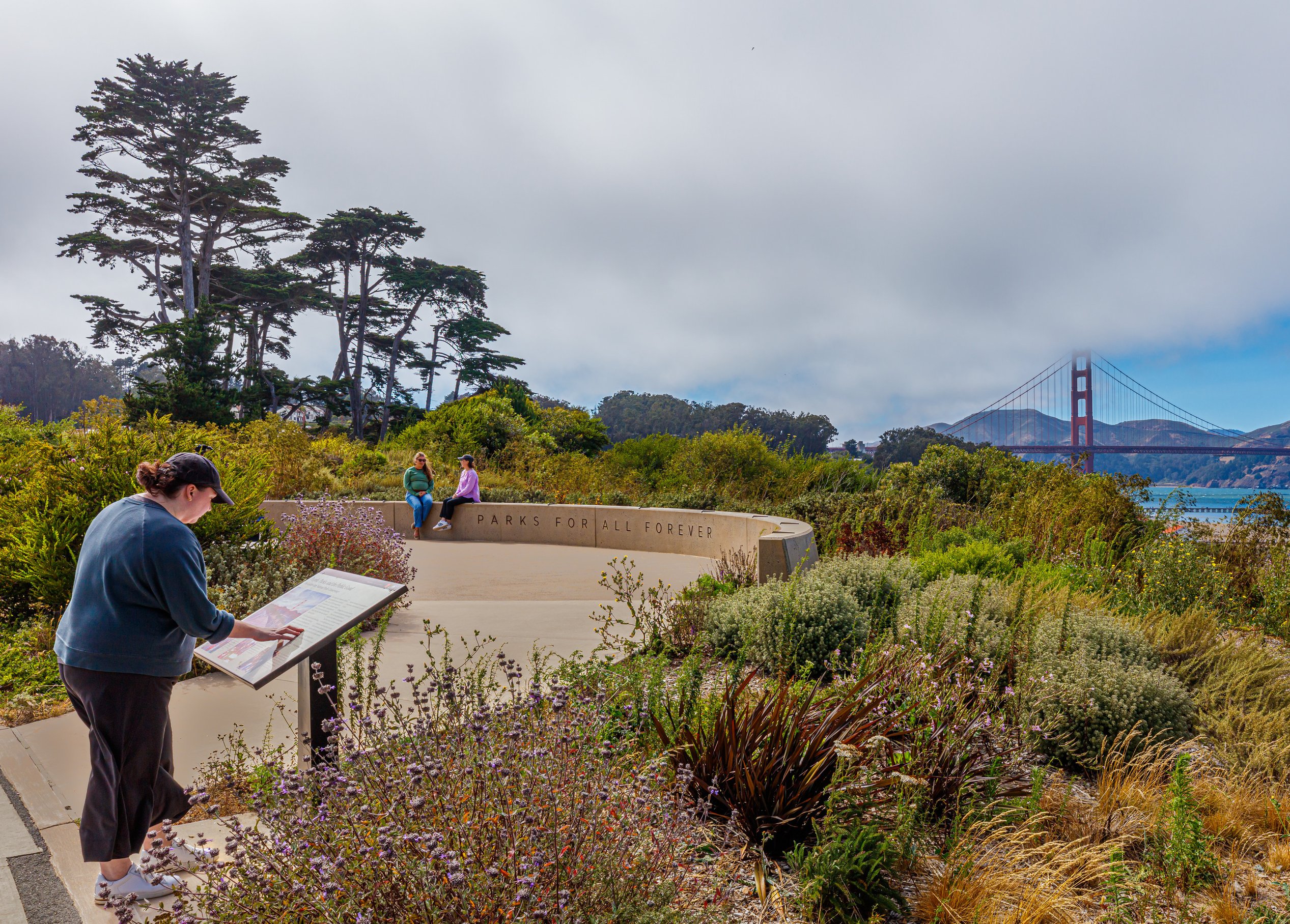
Battery Bluff in San Francisco, it’s in a really big park in the headlands, and that's just a really interesting project in the way it defines itself. It's capped over a highway, it's bounded by a cemetery and a bluff that looks out over the beach and the Golden Gate, but it actually has this edge boundary of eucalyptus trees that were thined out in a strategic way. And this is a really great park because it creates a sense of enclosure and was otherwise like a really expansive environment.
And that creates a really interesting place because there's these kind of windows between those grove of trees that create frame views, that really choreograph one's experience and give a real sense of place there that is different than other parts. And actually the other park that's nearby was entirely constructed with very little existing conditions around it on a cap over the highway. And so that one actually is just kind of like continuously expansive views where you're just like you're seeing the Golden Gate Bridge, like all the time, you're seeing Alcatraz all the time, and it's much more difficult space to create a sense of like enclosure and choreography and experience as you move through it.
I like that you use the word choreographed, because I'm sure when you're walking through that in, you're in that space. It doesn't feel as if it was orchestrated for you to see it that way. But there's just these beautiful moments of awe and views, and it feels really natural. So, like the good design, you just feel it. You don't really notice it happening.
Totally both near and far. Because you're weaving. This path is weaving between these historic military batteries, which are these big concrete bunker structures that are kind of like emerging out of the ground around you. They're quite close to you, but they're very large. And then you're seeing they were about having view sheds across the Golden Gate in a defensive measure. So then you're being exposed to the kind of view sheds as you move through this space. It's really interesting place.
Yeah. So it sounds like that space really has a historical experience as well, which makes me think about the programing of outdoor environments. And I'm curious if you need to strike a balance between offering a suggestion or some guidance on how people could use that space, but also not pigeonholing people into a single or prescribed way of using that space.
Absolutely. There’s a— And it's going to be different for every space. But balancing how do we create opportunities for transitional moments for different activities over time versus the more specific?
One of the ones I think is really successful, and our firm was participated in the development of, is Discovery Green in Houston, and they didn't really have a space like that in downtown Houston before it, but it's got large open lawns that can be used for an event, but then it's got smaller spaces. There's, you know, a defined playground for kids. There's a restaurant along a more formal walk space. There's some, you know, water features on, on one side that you can actually engage with and touch.
And so you have these different defined pieces that if I'm going to take my kid there, I'm going to go to the playground and, you know, let them play around there. There's one function for that versus the open lawn adjacent to it, which could have tents set up or can have a concert. And there actually happens to be a stage in there that is just an open kind of canopy structure when it's not being used, but when they need to set up a concert, it's got the components that you can create that type of event.
Yeah, it's one of the tricky things to negotiate in open space design and campus design is that negotiation between purpose and flexibility. Having places that have a clear like, oh, this is a place for having a picnic, sitting and enjoying this little garden, or broader places that have to negotiate many different people's uses, plazas and fields and quads and open spaces and kind of the tension between we want it to be able to accommodate many people for in a big event.
But then how do we make sure that it's also designed and usable and a good experience in every day when we're not doing something here but it's Tuesday afternoon and there's maybe four people in this 10,000 square foot area or larger? Does it still feel like it has its value consistently? And so that's always a tricky negotiation.
And usually just done through extremely subtle things and sometimes through, you know, relationships with, you know, when we talk about program, we're talking about like, you know, the purpose of the space. But the other side of programing is operations and maintenance programs and having people who are actively managing this place and saying, okay, we're going to have a program and activities that occur here to help give people a reason to come do stuff and engage with open spaces.
And when you're thinking about those everyday users of a space, how can a design prioritize inclusivity and equitable access?
You have a wide range of publicly accessible or not accessible open spaces in the urban, suburban, and campus environment. At the most public side, you have municipally owned public parks, and successful ones need a lot of management to succeed in their goal of being accessible to everybody in that community.
And we have a real challenge with negotiating the many different types of people in that community, the strata of people in the community. There's kind of an always an ongoing issue of homelessness and occupancy of public spaces and the kind of rules that we set into that and into these spaces. But when we try to resist different uses and create exclusive public environments, I think we erode the quality of those public environments significantly, because as soon as you start excluding anybody or any activities from those spaces, you're reducing its use.
And the most, I think we always see this, most high value public spaces are the ones that are used the most, I think, here in San Francisco of Dolores Park, which is a kind of hilarious, wonderful example on any given Saturday or Sunday, if it's nice out, the entire park is just packed with people doing all kinds of different things. You know, playing games, hanging out, maybe doing some things that are a little bit on the edge of like normal urban behavior.
But there's so many people and there's so much activity. They're all getting along in tandem and in concert with each other. And that's creating civic identity, civic culture and society in it. An idea of privately owned, publicly accessible spaces, there’s a whole different level of management where a lot of cities to increase the amount of publicly accessible outdoor environments in their urban cores, are requiring that developers of new developments include a publicly accessible space within or as part of their development.
This is a big drive here in San Francisco that helped to scatter a series of publicly accessible spaces of of different qualities, and also New York throughout the urban environment to different success, because the private owners get to define a lot of boundaries around how those spaces are used and even how they're accessed.
In those privately owned public spaces, I think we started by talking a lot about boundaries and enclosure. How you make that becomes really critical, I think, in the welcoming and sense of inclusivity. Some of those New York examples, I mean, this is this is not new study. There's lots of study that's been done on the privately owned public spaces in New York.
There's some of them that have, you know, that have one entrance and there's a security guard at the entrance. And technically you're allowed to go in there, but do you feel like you're allowed to go in there if it looks like it's a door that you can't go into? I think on the flip side of that, I don't know that most people passing through Rockefeller Center would really know that it's or think about it as a privately owned space, and that's one of the most accessed spaces in, you know, the busiest city in the US, right?
It has, you know, multiple entry points that you can kind of make your way into the space. It has things that are really come across as very public-oriented programs. And so it definitely feels like a space that anybody can go into and inhabit. And so you get like both sides of that on privately owned spaces. And so how porous is that boundary? Are there multiple ways in or just, you know, a singular way in?
And then I think it's also the spaces that are within it that also can contribute to its welcoming or not. Is it, you know, a singular type of space that feels like it's for a particular purpose, or are there variety of options of how you can inhabit that space? If there's formal central lawn space or plaza space? But then there are sort of secondary spaces along the edges that can often give you different ways that you interact with the space and makes it feel like I could get there and, and just sit and observe. Or I can be part of an activity that might be happening, you know, within, a central major space.
I think it gets to, the idea of generosity in design, which I think is just really valuable and important. And if it's applied at the beginning and early in the thinking about the development of places, particularly public or open spaces, even if they are private, that think creates enormous amount of value. The Rockefeller Center example is a really great one.
The openness of that privately on public space, the generosity of that to the city, that's probably paid off a million fold for the owners of that facility. Right. The value of that place, because it welcomes so many people and invites them in to participate in cultural, social, and economic activity creates enormous value for that institution and that ownership.
Along the same lines of equitable and inclusive use. I think there is an increasing value of green spaces in providing resources to cooling as the climate gets warmer. So how are you thinking about the value of outdoor spaces given that context?
Yeah, the urban heat island effect is not just about comfort. It is about life safety in our urban environments. And not to get too dark about it, but some of these heat domes have been fatal, really extremely fatal. So the 2003 heat domes in Europe killed an estimated 70,000 people in that summer, the 2022 heat domes in Europe killed another 47,000 people and the heat dome impact in Portland in, what was it, 2021, was several hundred people and possibly thousands from literally increases in morbidity.
So this is really a public health issue that our governance and municipalities and regions really need to face up. Studies have shown that cities can be many, many degrees, tens of degrees hotter than rural environments in these extreme heat events. In Portland, the high point at the airport was like 116 degrees, but a researcher there went around with thermal imaging cameras and captured the surface temperatures in unshaded neighborhoods above 140 degrees.
These are extremely dangerous temperatures for anybody, but especially anybody elderly, anybody who's vulnerable, who doesn't have access to a safe, you know, air conditioned environment. And the reality is also these events if they last for more than a couple of days, basically shut down cities. You can't go outside. You can't go to the grocery store. You can't walk there.
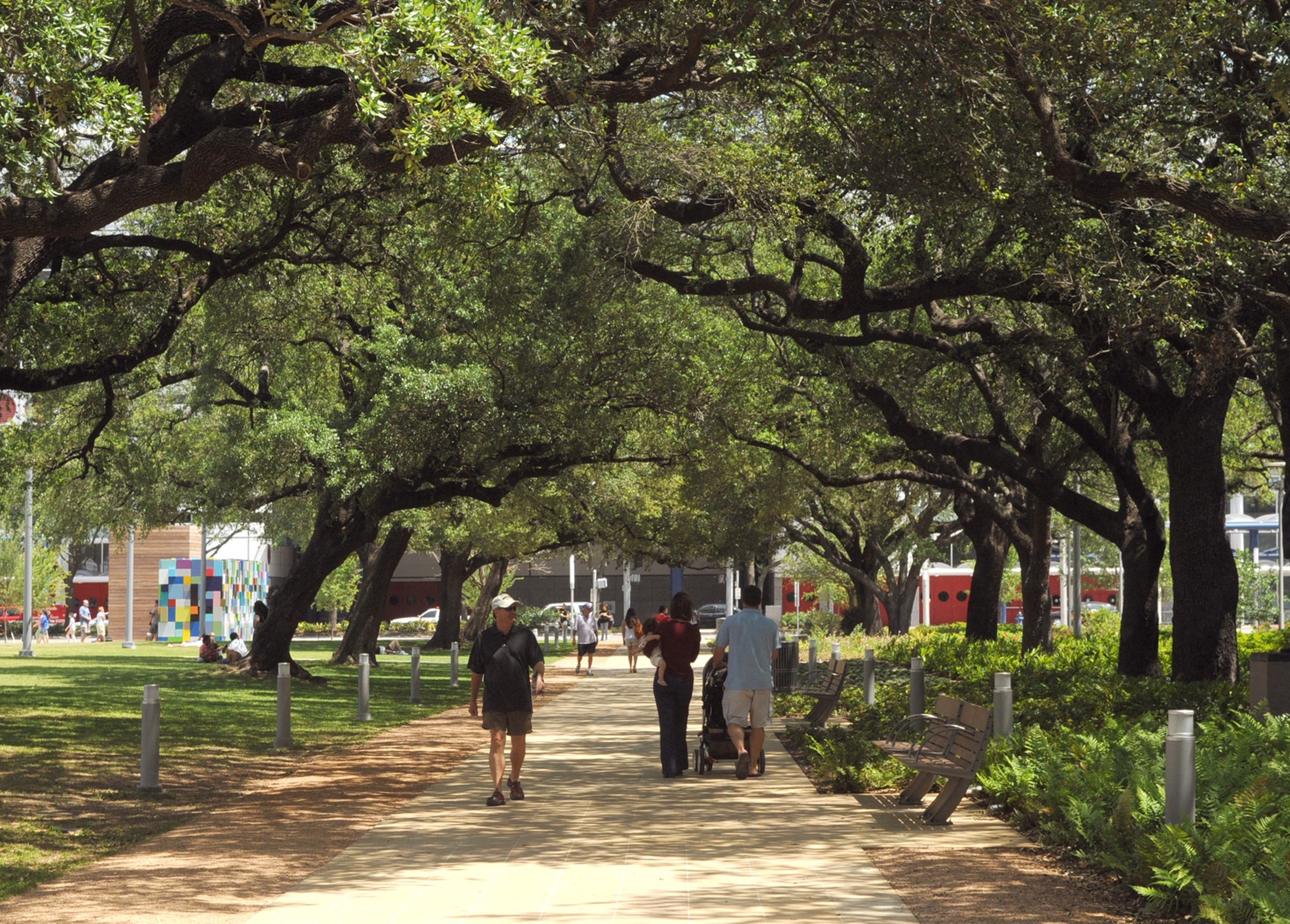
There's been some data that shows that people who aren't adapted to high heat are extra are vulnerable, so if you live in a place where you're just not used to it, you're going to be extra vulnerable. But the impact of trees are the best thing we have for reducing heat island. They one, shade. Two, they bring up water and evapotranspiration, so they're actually cooling the air around them.
They're usually in environments and surfaces like soils with planting that has a lower heat index than obviously asphalt or any kind of hard surface. So they're doing a lot to reduce heat. But we really need to respect them and we need to build for their success if we want to get the benefits from these incredible living resources in our environment, they're living in things they have living needs. There's mostly soil and water.
Soil is really the most important thing. For decades here in urban environments, we have been treating trees like weeds. They're not weeds, they need a lot of life support and life support giving things, and we stick them in little two foot by two foot holes in pavement with compacted aggregate all around them. And then we wonder why they die after ten years or shorter and why they're shrimpy.
And they have a small canopies, well, they don't have anything to live in. There's some really great technology out there that's pretty simple for elevating and creating soil volumes, even around paving. But that's a tactical solution. If we just plan for it better and plan for a little more space, we can have much more healthy urban environments.
And this is just going to become an increasingly important issue for not just the Sunbelt cities like Phoenix and Houston and large parts of Texas, but even places like the northwest, like Portland and Seattle. We're seeing these unique climatic events creating high heat events that are really dangerous and causing a lot of economic impact.
I think you alluded to this, Nico, but just to be explicit, I think within any given city, there's an equity issue, neighborhood to neighborhood of how we are protecting people from extreme events. You can map redlined areas of cities and see that there's no, or much more limited, tree canopy compared to other areas of the city.
There's less park open spaces. You know, we're talking about the outdoor room. Do they have— Do they even have an outdoor room to go to? Do they have a place to be in the shade when they're outside? And then, you know, this connectivity of spaces doesn't have to be a formal room or anything, but how are we treating the streets, as Nico saying, with the tree canopy so that I can get from one space to another in a comfortable environment without having to find air conditioning or question whether I even have access to it.
Yeah, the equity thing, it's significant. That was the case in, particularly in Portland with the heat island in 2021, was that neighborhood that was recording an extremely high heat, was a much poorer neighborhood with less infrastructure and much less tree coverage and open space, whereas, you know, neighborhoods that had historically funded or green lined had much lower heat because they have mature urban canopies, whether those are on private property or public properties.
And so managing that is an enormous thing. I mean, LA's really facing this and been trying to grapple with it over the last decade. You know, that's a huge city, very horizontal, very spread out with enormous unevenness and economic inequality and environmental inequality across its expanses. A real problem for the future that needs a lot more focus and effort from the governance standpoint, from the industry standpoint.
And and it comes down to like site level design, right? We need to make really good choices just on any individual site, because that can actually contribute to the overall success of districts and neighborhoods.
Well, I know that we're kind of nearing end of our time here together. So I wanted to ask a question kind of future looking, and I know we've been thinking about that towards the end here, but are there any new trends or philosophies that are emerging that excite you about the future of landscape and urban design?
We could say on the very surface that public space in its physical form hasn't changed all that much for centuries. You know, if you look at some of the great plazas in Rome, right, we can point to other plazas or squares that we know in a more contemporary city and say there's, you know, there's similar features, there's similar components.
But I do think that some of the nuances of how we consider more fine grained design elements or how we implement things are changing, and I, Nico’s touched on this a bit from the landscape standpoint. I think, you know, our willingness to consider native landscapes, to consider more kind of incorporation of ecology into what may otherwise be seen as formal spaces is an important one.
So we don't just think it's four bounded edges by buildings, and there's a hardscape and we put some formal landscape around the edges. It's a much more inclusive design and interactive design. And I think also thinking about where we can create the public realm, it doesn't have to be just confined to, you know, that formal plaza.
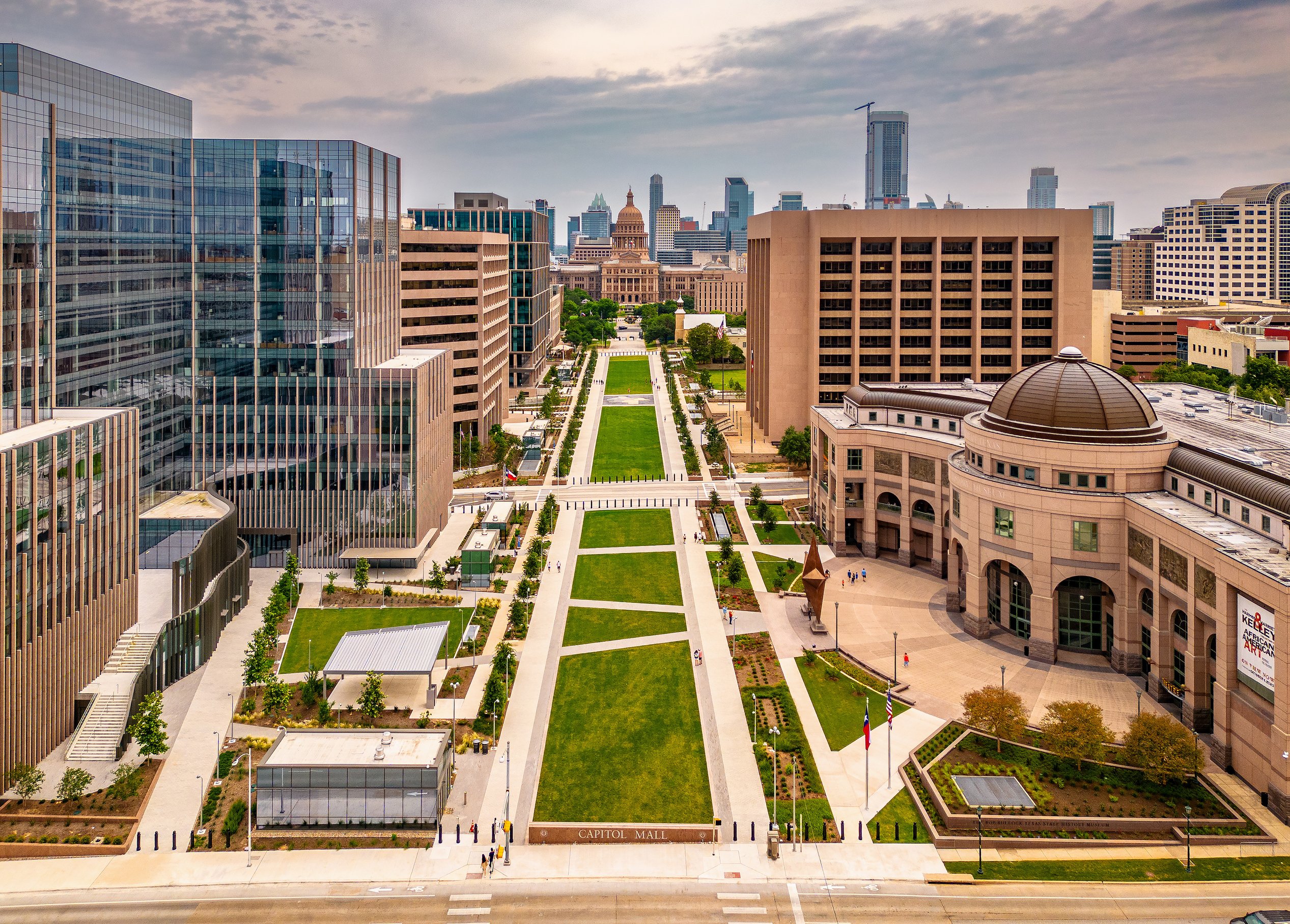
We can— We can actually start to overlap things, uses and create public space where we may not have otherwise had the opportunity to, whether it's capping a highway or the Capitol Complex in Austin, we were able to take parking and put it underground, and we had to put something on top of it, so we put a, you know, a green space. And so we can definitely think about much more of this overlapping of disciplines, overlapping of ways of thinking and create more dynamic spaces.
Whereas on the surface, when you come into them, they may seem like other spaces that have been around there forever. But, you know, actually one of the one of the greatest compliments I think I got from a colleague on the Cap Complex in Austin. It's very new. It's been open just for a couple of years, so it's not even fully completed yet.
But one of my colleagues said, you know, it looks like it just has been there forever. It was supposed to be there, but it's actually it was done in a much more contemporary way, like I say, on top of infrastructure. So I do think we're being more creative in those ways about how we create the public realm.
Yeah, I think that the way in which open space and public realm space is integrated into infrastructure from the start drives the formation and planning of infrastructure, to me, is like the most exciting space and public realm urban design, landscape design. Some fantastic examples, and I’m going to promote our own project here, at Battery Bluff in San Francisco.
And that's a capped park that covers over a highway or Caltrans highway. And it was really because of some really innovative, community-led landscape architects and planners thinking about alternate ways to deal with that highway and integrate it into one of the most kind of stunning urban landscapes in America—you know, just below the Golden Gate Bridge, looking out over the Pacific Ocean, in the headlands—that, that created the opportunity for the development of that park.
And so when that kind of, you know, really public thinking, open space evaluation and thinking goes into infrastructure planning, there's incredible opportunities. And I think for the future, our urban environments are going to undergo enormous change and mitigation and adaptation to climate change.
And not just heat island, but flood risk, coastal flood risk, all the different multi hazards that are going to come at us because of climate change are going to require significant changes to our urban infrastructure. And we're already seeing that that is often competing with public realm needs and making sure that the public realm and open spaces is, is a integral part of those designs of those infrastructures is going to be really critical for for equity, for inclusivity, and for the success of our urban environments, as you know, centers of economic, social, and cultural innovation.
Well, I really appreciate hearing how you're both thinking about what's next. And I want to thank you both so much for joining us in The Good Room to think about what makes a good outdoor room.
Hosts
With expertise in crafting compelling narratives that engage diverse audiences, Tully blends creative flair with a keen eye for detail to develop impactful content across platforms. Her work includes award-winning podcast production, content development, and copyediting large-scale documents, all while enhancing brand voices and driving audience engagement. Tully also supports data visualization efforts by transforming complex information into clear, actionable insights through engaging storytelling.

Talk with us
Complex challenges need fresh perspectives and deep expertise. Connect with our team to explore how we can help you create spaces that make a real difference.