The good sustainable room
by Tully Mahoney in conversation with Jill Kurtz and Justin Shultz
What if sustainable design were a default, not a differentiator? That's the future Jill Kurtz and Justin Shultz are forging.

What if sustainable design were a default, not a differentiator? That's the future Jill Kurtz and Justin Shultz are forging. Through the Design for Impact framework, Page embeds environmentally and socially conscious solutions into the foundation of our approach. In this episode, we explore what that looks like in practice, from lowering energy use intensity and rethinking water systems to anticipating climate shifts and supporting wellness and community.
/
Director of Building Sciences Jill Kurtz and Building Performance Director Justin Shultz join host Tully Mahoney in The Good Room.
I'm Tully Mahoney, and I'm excited to welcome you to The Good Room. Today we're thinking about The Good Sustainable Room with Jill Kurtz, the Director of Building Sciences, and Justin Schultz, the Building Performance Director. As you've both devoted your career to designing sustainable solutions and pushing this industry forward, what made you passionate about sustainable design?
I grew up with buildings. My grandpa was an electrician and my dad was a contractor. My mom a facilities manager. So I think from a young age I always gravitated towards architecture.
I also wanted to have purpose in it, and so I was struggling with designing law offices, feeling like, oh my gosh, why am I doing this? And then I spent a year working in India, actually, as a nonprofit architect. And it was there that I realized, you know, most of the world doesn't get to pick how to think about how to design with less, or how to plan for frequent power outages or what to do with your trash because no one's going to pick it up.
So for me, that was a very catalytic experience and realized there's a lot of people in this profession who are focused on incredible, beautiful work, but there's not enough of us focus on sustainability. And so I did a hard pivot to really lean into combining that love of buildings with ethical responsibility.
So I was entering college around the same time as one of the energy crises, and I thought I was going to become the next greatest scientist to create the PV panel to save the world. After joining school in a energy engineering program for a while, I realized that if I really wanted to make solar panels, I should have been a material scientist.
But I had a really great advisor tell me, you know what? Don't forget about buildings. Buildings are really big factor when it comes to energy and how much we use and all of the impacts on climate change. So I joined his lab and did a building energy modeling senior research project, and I fell in love with it. I was such a computer nerd.
I thought this was the next greatest thing. So I went did a PhD focusing on how to use building energy modeling to model cutting-edge building technologies. And it really stemmed from this basis of me loving computers and seeing it as an opportunity to solve the world's problems. And so when it became very apparent that the architectural and engineering industry isn't so good at running analytics and making projections of the future, I really gravitated towards it as a profession to bring that data driven dialog to the process, and it's really come from a belief that people make smart decisions when we have good data.
But I think more often than not, we don't have that data at our fingertips. So through the PhD and then through my early career, I've really found a lot of positive feedback in the data that we could bring to make good decisions and how that has resulted in more sustainable buildings over our portfolio. Both of you have such a great passion for this space, and it's really inspiring to see.
I know that you've also created for our firm a framework that helps guide the way that we think about sustainable design and implementing these strategies. Could you tell me more about what that looks like?
Designing for Impact really came out of a need of how how do we, as an organization, talk about our priorities around environmental and social responsibility in a way that everyone can participate in and find a way to talk about sustainability goals around water, energy resilience, community that feel authentic to the project?
So it started out as a report to talk about our public facing way of how we're driving change. It's also evolved into a way, a framework, on our projects. So we just had training internally on having a Design for Impact goal setting. And how do you do that on a project? It's also how we're organizing education. So we have people who are passionate about materials and improving best standards.
So these impact areas start to scale both in how we measure progress and how we inform process.
It allows us to have conversations that we don't always see naturally happening, even though we sit down with a client very regularly. It's not always that we get to have such a transparent conversation. Just yesterday, I was in a charrette with a client of large university client, and we brought up wellness and a facilities individual in the room actually spoke up to the wellness term. You think wellness is all wishy washy? It's touchy feely, but a facilities guy, said acoustical comfort is a really big factor when it comes to wellness for us. We have a lot of building occupants who are sensitive to acoustical noises, and we've had to deal with vibration and noise challenges associated with that. So we really want our building to be acoustically comfortable for our occupants.
And I think that that was such a valuable insight that we wouldn't have gotten otherwise in a conversation just about wellness rooms and daylight and all those other factors that go with sustainable wellness.
Part of what's nice about this is we're starting the beginning of a project thinking about what the story is we want to tell at the end.
So what is the thing? You know, you might say, oh, we got LEED Gold. Well, that's a single line item in a press release. But when you talk about what went into it and what were the things that mattered most and how we define those from the start, and then the decisions and the strategies that were implemented to make it happen?
And ultimately, how did we measure if we did it? That becomes such a richer story around impact. And I think that framework as a story telling device is a super powerful part of Performance by Design and what we know we care about.
I'd like to dive into each of those core topics in the Design for Impact report. So energy, water and ecology, resilience, materials, and community, and wellness. So starting off with energy efficiency, I think this is the topic that many of us immediately think of when we're thinking about sustainable design. So I'm curious what are you seeing that clients are most often looking for when it comes to energy efficiency in their buildings?
A number of clients have a goal related to energy savings, and so it's either a percent savings from a energy code baseline, or it might be an energy use intensity or EUI. And that is an annual energy consumption in the building divided by the square footage. It's basically a nutritional label for our buildings that we can compare them apples to apples. And that's the number one metric we look at when it comes to energy.
Everyone want to lower energy use intensity building. The lower the energy use intensity, the less energy consumes and the less PV or renewable energies or other offsets you need to make it a carbon neutral building.
Everyone wants a percent reduction from a baseline. Many of our clients actually have requirements to be 30% better than energy code, and that's a really great initiative to put that line in the sand and say, we need to do better than current energy codes. Those are the two primary metrics.
We also look at things like peak heating and cooling, especially when it comes to buildings with really large loads. Some of our clients are charged more for the peak loads than they are for keeping the lights on regularly. So we're constantly looking at various metrics to bring down loads as well as total energy consumption.
I think this is also a place that our clients are, and the industry, has evolved. So much of the energy reduction started in the energy crisis in the 70s, you know, and there was a lot of just focus on reduction, reduction, switch out your light bulbs, turn off your lights.
And now there's a lot more savviness, too, around this topic. And we're thinking not just about energy reduction but the sourcing of the energy. Where is it coming from? What's the carbon intensity? So as Justin talked about the EUI, you know, that's the intensity. Just like we all know cost per square foot. Well, do you know your energy per square foot of your buildings? That needs to be part of our vernacular and now will also be the carbon per square foot.
What's the intensity of the source of our energy? That adds another part to the mix. Because you could be using less energy, but if it's coming from a dirty source, then it might not be any better.
Recently, we were tasked to do an energy master plan for a whole new community. So this was in Colorado, but their grid only had so much capacity, and so part of our charge was to figure out how to work within the constraints of what that grid would allow, so that they didn't have to handle some of those peaks and valleys that create an unreliable grid or difficult to maintain.
But we talk about energy a lot and like, boundaries. And most of the time on projects, we're only looking at what our site is touching, because so much outside of that boundary and the sourcing of the grid is beyond our control, but in this case, we kind of got to expand the boundary and think about how people at scale were going to be using energy.
What was the impact of them charging their EV cars, which actually when you have an efficient building, suddenly your EV charging is half what you're pulling from the grid, and when were they going to do it? And so it forced us to really think about the big picture. And in this case, the best way to stay within their boundary and to manage their needs was to look at a community geothermal system.
So essentially a ground source heat pump system with a series of wells that would have a water loop that would pull heat from the restaurant and push heat into the residential building and work as a system instead of each of those buildings in isolation.
The thing that we're working right now with our clients around metrics, around energy, is not only is this a lowers energy consumption, but is it the best use of their dollars right now?
When we look at things like lifecycle cost analysis, where we're looking at the total cost of ownership of a system, and sometimes that allows us to say, you may be paying a premium now for something like a heat pump, but over the next 7 to 10 years, this system pays back in energy savings because it's three times more efficient than a boiler, and it can really have long term operational savings.
However, in some colder climates, that might not always be the case because there's so much demand on energy and we struggle to find a heat pump that can be sized appropriately. However, we're seeing new technologies show up on the market every day. There's new ways in which they're coupling together heat pumps with thermal energy storage that they can generate heating when the energy consumption and energy costs are low, and have that storage of heat when it's needed later on.
Another great opportunity for us, we're looking at passive strategies, is well can we just reduce the amount of heating in the building? Do we really need such a large boiler or a heat pump in our building? If we can use a high performance envelope, something like passive house level envelope, that can really allow us to reduce the peak heating and cooling loads, make the building significantly more thermally comfortable, less air leakage from the outside, cold weather, climate coming into the building, and really make those loads go from significantly high to less than 80% of what they were before, from a code baseline to a passive house level. And that's something that we're seeing more and more clients interested in, especially in our residential or res hall settings, where the value is so transparent in the comfort and the operations of the building.
An important thing around this reliability is how much of our systems are sized off of that very high, high and that very low, low. So as Justin was mentioning in the northeast in the winter, the middle of the night is when you need the most heat. You know, it's the hardest to generate. That's also the hardest to generate things like solar power. Right.
And so there's this kind of imbalance sometimes on when the most energy is needed and when it's able to be supplied. So part of our job is to not just look at the reduction of energy, but reducing those peaks. What is it in the middle of Texas in the summer for that air conditioning load? What can the envelope be doing to reduce the heat gain through the facade, so that that HVAC system isn't having to operate on like extreme conditions?
Because as those extremes get bigger, those peaks are going to get higher. And so part of our job is to figure out how to work within those reducing those peaks, which sometimes as he was mentioning on the on the website becomes more of an architectural decision because it's directly related to our building's relationship with the outside.
And that's our opportunity to either put a coat around the building like passive house, or figure out how to really put those windows in places they should be, and not taking on too much heat that over extends that cooling capacity.
I think that we could have an entire conversation just about energy, but I do want to just dive into, kind of, the next piece of this puzzle and think about water and ecology. So when we're thinking about water, are you seeing that we're often focusing on things like conservation or reusing our long-term resilience. What are we thinking about with the water conversation?
I would say there's a focus on responsible management. For better or for worse. Water has been historically cheap, and so it doesn't have always the same kind of checkbook cost impact on decisions.
But I do think we've done water a disservice by thinking about it's stormwater separate from plumbing, separate from process water, because water really works like a system. Things that we could be capturing here could be used over there, but they're so separated in the discipline that own it that there's often not the integration type conversation to really understand what the water balance conversation could be.
So I think from our client's perspective, obviously following requirements around stormwater, a shift from just detaining to maybe could we retain on site and reuse it for other purposes on the building side, there's always been kind of best practices on reduction of efficiency, but now we're tapping into, well, could I use that condensate to flush my toilets? That's now becoming more business as usual.
Is there an opportunity to pull from this bucket and use it for that? And I think that to me is what I get excited and where I'm seeing some evolution. But we still don't have maybe the same robustness of tools as we need, as we do with energy, to really understand those balances and opportunities right from the start.
A great use for water is on our Grinnell College Humanities and Social Studies Center. We actually installed a 30,000 gallon cistern. This system captures about 75% of all the rainwater that falls on the the roof, and some of the surrounding site. That water is then not only used for the low hanging fruit like irrigation, but it is also used to reduce the indoor water use consumption by over 75%, which is really impressive.
However, sometimes we run into challenges associated with utilizing that. You know, sometimes they say, well, that's rainwater. We don't want it in our building, but there's different filtration levels. There's simple just reuse of water, there's gray water and there's black water and there's all different filtration levels that allow us to say we can do something here with water as it becomes a relevant or important factor of the building.
And we're seeing, particularly in more of the western region, like Nevada and Phoenix, where we're having a lot more of our clients say this is very important to us due to the water scarcity in those regions, that we need systems in place to capture water not only from rainwater, but condensate and other flushing and flow and say we can recuperate this water using filtration and other bio retention systems and reuse inside of our building, creating a more of a ecological regenerative process than just throwing it to the environment and hoping it gets back to you via rain or some utility pipe.
Yeah, that's a really good point, too, of how important the landscape conversation is in this. There. They touch the site, how they think about hydrology on the site, how we're doing all of those good best practices like low impact development from the start. Before you even talk about any kind of collection of things so enriching and making things better, you know, how can a development restore some of those natural water processes on the site to work with nature and not against it?
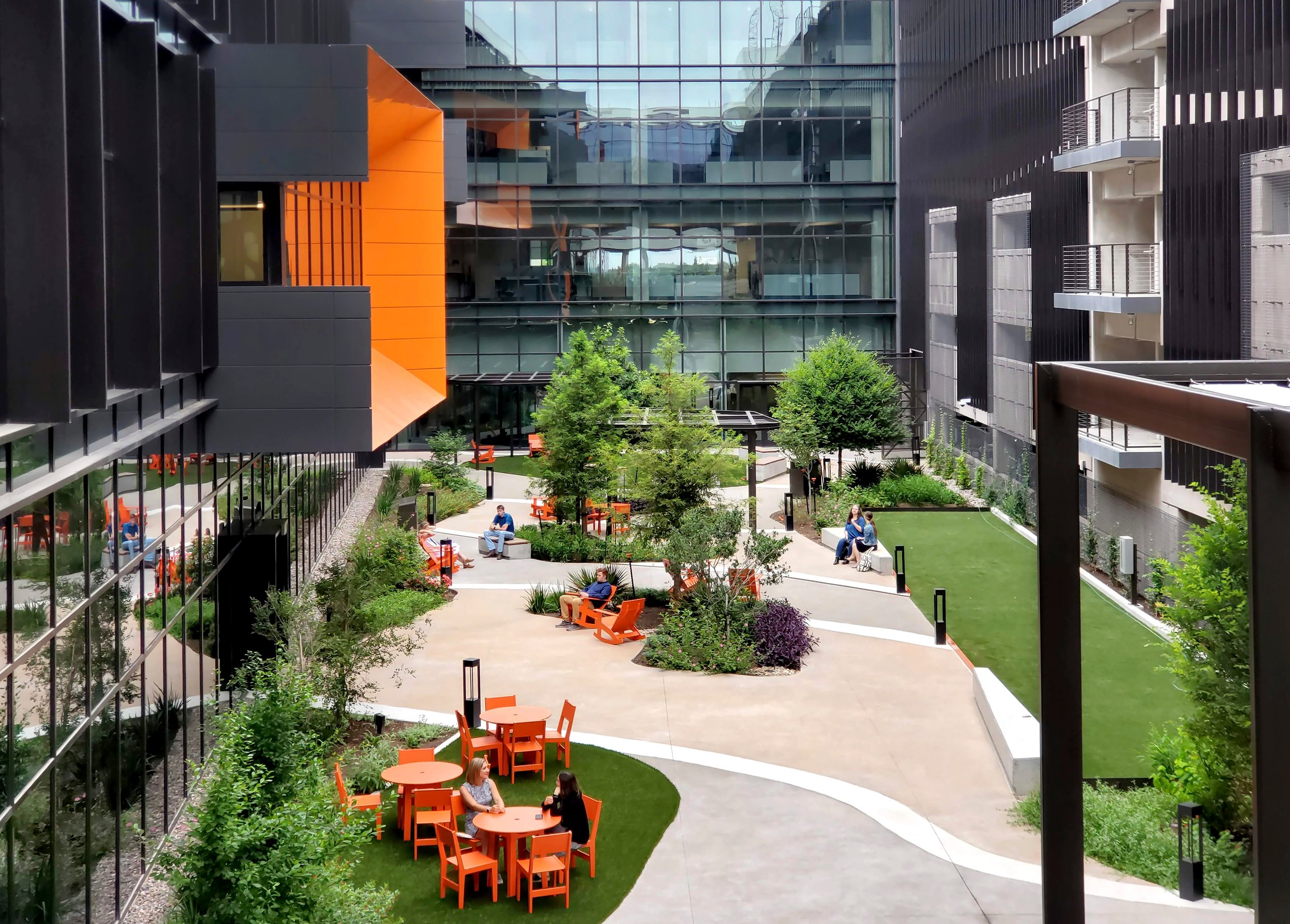
At Indeed Tower, which is an office building that we did downtown Austin, that's now our home, we had a zero lot line building, very covered site, urban zero lot line. But we were able to carve away to save an existing post office, to plant a new footprint for the tower, and still save a quarter of the site for a natural park and open space.
And while it's a great hangout place for lunch, and there's a nice patio that spills off from the lobby, it's also doing really heavy work on collecting water, to the point that this zero lot line building is retaining at least 80% of the storm water itself, and then reusing it for the fountain or using it for irrigation.
So sometimes we think of these strategies only working in places where there's a large areas and not necessarily in the dense environment, but I think it is possible, you know, we need to be leaning into those kinds of strategies.
That's interesting. I didn't realize that effect of the green space at Indeed and I didn't know about the cistern at Grinnell. So those are both interesting water stories. With the collecting the water in areas where water is more scarce, I'm curious about what are some strategies with that, you mentioned even collecting things like the condensation. What's the building's role in doing that?
You know, a lot of it depends on how the water is being consumed in the first place. Is it mostly process load? If it's a manufacturing facility, are they using water to cool their systems, and can that water be recycled and reused again? And if so, how often? So things like cooling towers are very effective as a means of cooling our buildings.
But it's a question of what's the purity of that water. So sometimes some strategies are just cleaning the water so that when we use it for cooling purposes, can it be reused multiple times rather than just one or 2 or 3. But we can use it 10, 30 times to whatever makes sense for how often and how we clean it.
If it's a lot of people in the building, is it a lot of it? Handwashing showers? That tends to be what we call gray water, something where it's much easier to clean that water. It's not necessarily inherently very, very dirty, but something like a toilet water would be black water that becomes more difficult to clean.
However, it is possible, and there are systems that we can do that for, whether it's a natural bio retention filtration system or a more physical filtration system. It's like a mini water purification system that would go in your basement.
Now, sometimes there's space constraints and cost implications, but at the same point, it's a very ecological and water balance conscious way to design your building. Say, can we take most of the water that we consume in this building and utilize it directly inside the building and, you know, at that point it's only people drinking water and taking it off site that is really the losses of water at that point. And so it's a tremendous opportunity that is not always explored, but in areas where water is so much more scarce, it becomes so much more significant as a sustainable design feature.
And resilience, which I think is a part of to me, you know, the water conversation is being elevated in some of those extreme climates because it is becoming more scarce, and it is something that people aren't necessarily doing to save costs, but to prepare for that future when they don't always have the supply they need, when they need it. You usually think of water, and rainwater is just like such a natural process that happens outside of humans.
It's an interesting point of conversation to think about how we can tap into that not only for our own benefit, but for the ecological benefit as well, and then also the relationship between water and resilience, which I think brings us into the resilience part of the conversation, but also highlights how the resilience conversation has just so many different pieces to it. I think that when we think about resilience, we could be thinking about waters or natural disasters or building for what the building might be next. So could you maybe elaborate on what we mean when we say a resilient design?
So for a little while, resilience just became the new buzzword in a lot of ways to replace sustainability. But I think it's adjacent conversation because, while sustainability is trying to think of kind of a holistic approach to building, resilience is acknowledging that things are going to happen and we need to be prepared for them.
So it's getting hotter. So we need to think about what happens when the temperature is raised and the impact on our buildings. Storms are happening more often. How am I thinking about flooding? Am I preparing for the bare minimum, or am I thinking through when that floodplain is going to change? Buildings might need to be higher. Fires. The frequency of fires have increased substantially.
So how am I thinking about this project that maybe today doesn't have requirements, but in the future will need to. And so resilience to me is really that like how do I prepare for the future? What are the threats this project's going to have? Yes, it might be a meteor shower. Is that really what this project needs to plan for?
What are the risks that are reasonable to plan for, and what are the ones that maybe we need to acknowledge that they're there, but aren't something that that project specifically needs to address?
One of the things that we're seeing pop up a lot more from client requests and otherwise is just future temperatures. Why they're so relevant is so much of our buildings are designed to what we expect to be the hottest and coldest condition.
That's the mechanical systems. It's the performance of the building envelope. It's the reliability of power under those conditions. And as we see regions of our country in the world becoming warmer and warmer, that peak cooling conditions are going to go up. And so when we're designing our buildings today, yes, the systems may only last 20 to 25 years, but the buildings themselves may last 40, 80, 100 years.
And so when they go to install future systems inside the building, they need to know that there's enough space and capacity for these new demands. So as it becomes hotter, we need bigger chillers. We need maybe larger cooling towers, we need larger ductwork, bigger air handling units. All the features of our building that keep it comfortable may need to get slightly larger.
So there's a certain safety factor we build into our mechanical designs. And we're seeing a lot more clients saying, I want you to size our building, design our building to the temperatures in the future that we're working on a project right now in Baltimore, where they said they wanted us to design it to nine degrees hotter than the current average temperature. So that's going to have an impact on system sizing, but it's one which they're looking at saying this will impact our building and we want to make this decision now.
What I love, too, back to the Designing for Impact framework is we're not defining what resilience has to be for a project. We're asking teams to define what resilience means with those clients.
And so for our core and shell and commercial mixed use, they might want resilience on being able to convert an office building to a residential tower in the future. Right. So there's a resilience from an economic perspective and ability to flex and change, maybe similarly to lab and academic planning. Well, we know today this is what's happening in this space. But ten years from now, we want to make sure we're designing a space that can adapt and change as that is needed. That's a version of resilience, right.
And then there's also, I think back to this crazy experiment we all just lived through for Covid. Right. And there's like, what is the workplace resilience look like from a people perspective? How do I make sure that we're creating environments that people love to come in and work in, and that they're enriched by and not like feeding into the burnout or the overwork? So there's a people side of resilience and that, you know, encouraging productivity and encouraging people to love to show up. So there's I think the hard and technical part of resilience and planning for those kind of extremes.
And then there's also sometimes these other definitions of resilience that become very tied to what that project is, or what those clients values are that are also they need a definition, and we need to think about design solutions for those as well.
Definitely. And you mentioned the second life of the building, or that it might last for 50 or 100 years. How are you thinking about selecting materials when it comes to such a long lifespan for these buildings? Can you tell me some about life cycle analyzes or other things that you're doing to be conscious about the material selections?
A lot of times when we look at existing buildings, one of the first things we try and evaluate is the bones of the building. How is the structure, how is the enclosure? How are those things performing in the past? How are they performing today, and how will they perform into the future? And so one of the old terms in the sustainability space is the most sustainable building is a building you already have built because it's already sunk costs. You've already made the environmental investment to construct that building.
So a way in which you can update and modernize it is so much more valuable than tearing it down and building new. That's almost never the right choice unless it's just not functional. Or there's safety concerns. And so what we've done is we've done a number of analysis comparing exactly that fact. If we took a existing building and renovated it up to modern code, how much operational energy would have produced, how much embodied carbon did it already have?
And then what if we made a brand new, shiny, very energy efficient building? We found that that existing building bringing it up would still be less of an environmental impact because of those sunk costs. So when we consider the embodied carbon, we really do see a lot of valuable investment there and modernization as a key way to appreciate those factors.
Beyond that, we see a lot of historic buildings really leveraging the existing materials they have. And when we make modifications to those buildings, we want to make sure that we do it in a very appropriate way, architecturally and aesthetically. And two performatively, we know that we need more insulation on these existing buildings to meet energy code, to respond to those climatic conditions we were just talking about to reduce energy consumption.
However, the building has been functioning just fine for the last 40, 80, 100 plus years. How does the addition of this material impact the performance of the building? And sometimes that's always positive, and sometimes it might have some negative impacts with regards to moisture transfer and other properties. So we conduct a lot of preemptive what if scenarios using computational analysis to evaluate what the impacts of our modifications are, so that we have confidence that we're making an appropriate modification to an existing building that we know will be very beneficial for the life and material of that building moving forward.
As Justin mentioned, there's a tendency to focus on embodied carbon, on the heavy things, the envelope and the structure. But the interior, depending on how often your cycling through things, can have just as much of an impact over the process. And so looking at materials for maintainability is a resilience conversation. You know, how what is the long life and how do we make sure that we're maximizing that useful life of materials so that you're not having the churn of every few years having to update things?
And that is just as much of a conversation of resiliency as some of those other climactic risks we've talked about. Because your client is looking for things to get bumped and them not fall apart, you know, so that they can fully enjoy the spaces that we've created.
An example of that is carpet is, I believe, the number three largest environmental embodied carbon emitter in our buildings beyond enclosure and structure.
The reason for that is they're replaced very frequently and they're very intensive. We're seeing a lot more carpet suppliers providing buyback programs or recycling programs where you can call them up and say, hey, we're taking out your carpet, we have a new one coming in, and they will show up, pick up their carpet, recycle and make new carpet out of it, which is a really, really great program.
When you consider how often these carpets you replace for every new tenant and every new preference that they have. And it's a way of really take that tremendous environmental impact and bring it down.
Kind of rebuild back to how we learn from nature. A more circular economy, right? That old trash of one becomes feed for the other and how do we do that more in our building systems?
I feel like materials is one of those cross-cutting topics that has a human health impact, social health inequity, ecosystem impact, climate health impact. And then like we mentioned, circular economy. And there's a tendency to just look at it through one of those lenses because it's it gives kind of overwhelming. There's lots of labels out there and something that might be good for human health might have a negative ecosystem health impact.
And so part of what I think is happening as this industry matures is we're better understanding some of those impacts. And our material selection, just like EUI’s a nutrition label for our energy use. We're getting more and more nutrition labels, so to speak, for materials called EPDs or HPD or all of these labels. And what those are trying to do is not confuse us, but to try and tell us what is good.
What can I learn from this material, and how do I make more informed decisions? When I read the label, I joked, you know, we didn't have nutrition labels on our food for a long time, and when we did, there was this huge backlash of like, fat free everything because people are like, why would I want to put that in my body? I'm trying to get rid of fat. Well, turns out maybe fat wasn't the problem. And it's sugar. And now there's that focus, I'm sure. Eat fat, but reduce sugar. But it's because we got savvier of understanding that as a population.
And I firmly believe the same thing is happening in materials, that we're becoming more transparent with what's in them and what the impacts are. And with that information, we will make better decisions. But we all need to be more informed and reading those labels so that we can prioritize the things that matter.
We've also signed the design for Freedom Pledge, which is really looking at the social impact and the equity part, because the supply chains of materials can be pretty messy, just like any of our supply chains.
If you dig far enough back, you often find things that don't feel like they support the ideals that we all carry. And so that's another part that we're really trying to explore and be responsible with our material selection and not buying or specifying materials that come from prison labor or thinking through some of those manufacturing sources. And where we know human rights aren’t as a priority regionally, or where that product manufactured because that's part of our job as a specifier, is to make sure that we're considering all of that and making the most informed and social and environmentally responsible choice.
Speaking of the social impact and how our choices can impact people, I want to think about the community and well-being aspect that we also integrate into our designs. So how might you create a building that helps tap into or encourage a healthy lifestyle for its users?
One thing I learned when I got into this field is one of our biggest predictors of health is not our genetics, which I often like to blame. It's actually where we live and who we're friends with. And so where we live has a huge impact or where we work. You know, what our commute is like? How much time are we spending indoors? Are we active? That's actually has a bigger impact on some of our health and well-being than some of those other factors that we like to to think about?
And so just the role of the built environment can't be underscored enough as it relates to how we as humans function and elevating our well-being. That kind of abstract topic translates back to building solutions in three ways. One is we want to make sure that people aren't getting sick or the negative effects of buildings. We used to have a lot of that sick building syndrome in the past, when we didn't really understand the proper ventilation and how to manage humidity and mold and all that kind of stuff.
So we definitely core to any project should be how do we make sure that that's not happening? The second is then how do we promote practices that encourage well-being, and how do we create movement within our buildings and activity? Thinking through the spaces we need for healthy daylight? You know, what are those things that then elevate well-being and the predictive strategies for that?
And then the third is how do we also make sure we connect with people? Part of our well-being is also connection to others. And some buildings encourage that more than others, you know. So what does that look like? And how do we make sure that all three of those things are happening in a really meaningful way for that project is how I like to help people understand what that looks like in our work.
One of the ways in which we implement that in our design is through the intentional planning of space for people to come together. You know, that doesn't just happen in our buildings naturally. I think we've all been to buildings where there isn't really meeting space, and it's just long hallways and doors. But a lot of our buildings are actually increasing the percentage of area that is not specifically program for classrooms or residential units or otherwise, but creating more common space or more space for interaction.
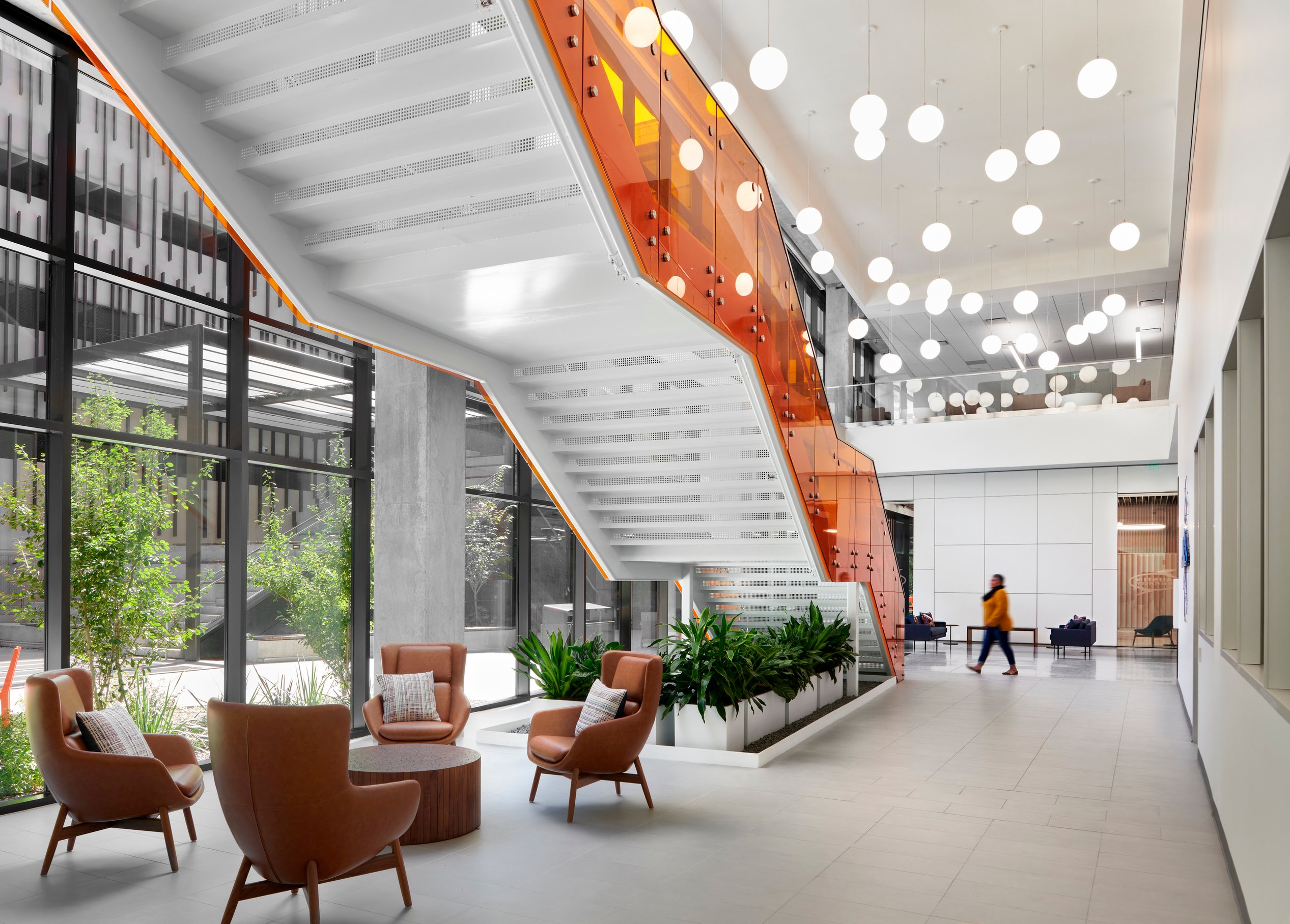
And a great opportunity for that, and as Jill mentioned, is the second step there, about creating more movement and activity is as you enter the building, if you're planning to go up a floor or 2 or 3 is the first thing you see a stairwell, or is it elevators? Because if you see a stairwell first, more often than not people will take the stairs but if they see elevators and they can't find the stairs, they will take the elevator.
And when we're creating those stairs as a central element to our design, we're really trying to leverage as an opportunity for people to run into each other and talk. As you're coming up a stairs, you see a colleague say, oh, hey, how was your weekend? You know, how are your kids doing? You just those natural collisions that can occur.
Those natural interactions happen through a lot more movement. And just coming to someone's desk all the time, especially if they have their headphones on, they're in a meeting. So really creating not only space for people to move, but also to meet within those spaces. And then even off that space to say, is there a little seating nook for someone to say, hey, let's sit down and talk about that thing.
The only other thing I'd add to the wellness conversation. Like we said, buildings are tied to people and a big focus on the comfort of them. And as we were mentioning, when you have a lot of people in a tight space, there's also that balance of acoustics.
And so one of the key things we've done as you're planning is also think about in that programing phase, what are loud spaces, soft spaces. Do we have the variability of spaces for people to work? Because some of us. I joke that I'm spatially sensitive to my engineer husband who could be oblivious to things around him, but I'm like very aware of noises and, you know, and things that are happening. And so to get in the zone, I need a certain environment.
And so I think we need to create the diversity of those spaces to reflect the diversity of our people, you know, who need different things at different time. And we're not all just robots sitting at a desk doing the thing, you know? And I think that's been a big part, too, of our sensitivity to designing for wellness and well-being is understanding the larger palette to give people what they need, when they need it.
We only have a few more minutes left of our conversation, and I wanted to ask you, what excites you about the future of sustainable design? Whether we're thinking five years, ten years down the line?
Well, I'll do, maybe the less techie answer of that, which Justin might slide into.
But from my perspective, what I've loved about being in this field for the last 20 years is just seeing how much it really has matured. We're no longer wondering, well, what should we do? We know what we should do. We know what the right solutions are, that it's not as matter of defining what are those best practices. The task now is making sure that they get implemented.
And I love this quote from James Clear that he wrote an atomic habits that you do not rise to the level of your goals, you fall to the level of your systems. And I think the challenge we have right now is a lot of our building systems and processes just don't make this a core part of decision making, and they're not core to the budgets we're setting or the goals that we define.
And so I think part of our task and what I'm excited about is this next phase where those systems, those processes that like just collective understanding of what needs to happen, also evolves along with the technology that we've seen.
And so sometimes I feel like my job is more around change management than it is always around the technical data side, because I think those sometimes end up being the things that keep a project from moving forward, is, is making sure we're all aware of what needs to happen and, and working through those barriers of familiarity of systems or how do we are we factoring in these costs from the beginning so that we can move those solutions that we know need to happen forward.
With all that groundwork established, my true passion and excitement for the future is the types of decisions that we can make with that basis. You know, we all have the fundamental understanding that this is a good thing, but how much better is it? What types of changes we want to make?
And our industry is inherently risk averse. A lot of choices that we make in architectural and engineering design is through risk aversion. And so when we propose a change, it has to come with some reward associated with it, too. What is that betterment? By making that change and through our data informed analysis, we can have a data informed dialog about system A versus system B. Yes, B is a new system. You might not be comfortable with it, but it has 20% energy savings. That's a significant amount. Let's talk about how this change to your existing infrastructure might be valuable and worth understanding and implementing on your project.
And so I have a tremendous excitement around the types of data that we're developing and the types of tools that are coming out and the conversations that's allowing us to have with our clients and design teams around smart choices that were much harder in the past.
In general, you know, it used to take days and days and days to run energy simulations and set them up. It's becoming faster and faster. AI's promising some really great things about how can we inform our designers. We're developing our own tools that would allow anyone to run energy models, which is really exciting, because then it's not a specialized skill that only people with PhDs can run and get data on.
So we're really trying to make the types of information that can lead to smart decisions more accessible, so that we can all make a data informed decision together.
I'm really looking forward to the day when sustainable building practices are just building practices that were we've moved away from this being a separate thing, and it's just part of how this work is delivered, you know, and not seen as something other or separate.
And I think that will be such a core part of making this also accessible and equitable across the communities and the buildings that we're building.
Yeah, definitely. And just a core part of making humanity in the world better. And it's so important. So I am also looking forward to that day. And Justin's data decisions will definitely help us get there. Thank you for taking the time and having this conversation.
Hosts

With expertise in crafting compelling narratives that engage diverse audiences, Tully blends creative flair with a keen eye for detail to develop impactful content across platforms. Her work includes award-winning podcast production, content development, and copyediting large-scale documents, all while enhancing brand voices and driving audience engagement. Tully also supports data visualization efforts by transforming complex information into clear, actionable insights through engaging storytelling.

Talk with us
Complex challenges need fresh perspectives and deep expertise. Connect with our team to explore how we can help you create spaces that make a real difference.