
by Robert McClure, Alison Ledwith, and Mo Elsayed
by Raffaella Montelli and Mo Elsayed
Urban development too often unfolds as a sequence of isolated projects, each building optimized for its own site but blind to the economic interdependencies and shared risks it creates. This fragmented approach may boost short-term returns, but it sows hidden costs that erode long-term value: service redundancies, infrastructure bottlenecks, and magnified losses when disruptions occur.1,2 This is especially true as urban areas densify, and extreme weather conditions become the new norm: billion-dollar weather and climate disasters in the United States averaged $149.3 billion per year between 2020 and 2024 (solid black line in Figure 1).3
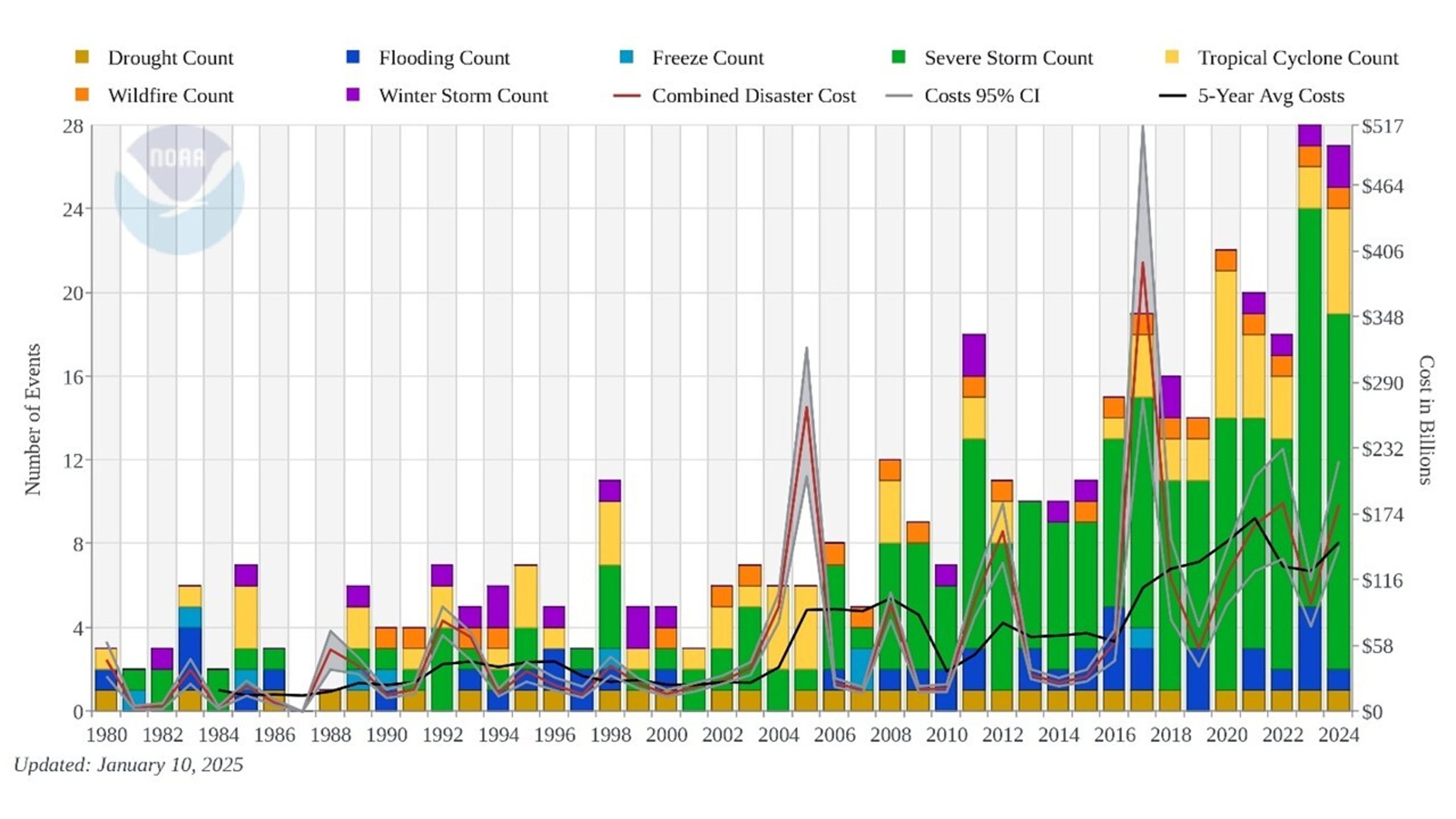
Figure 1: United States Billion-Dollar Disaster Events 1980-2025 (CPI-Adjusted) 3,4
From derechos in the Gulf Coast to intensifying hurricanes and shifting tornado patterns, cities are facing increased wind, water, and heat threats on multiple fronts. These forces are reshaping ecosystems and demanding a wholesale rethink of economic development and the built environment. Yet, most developments still follow ‘business as usual’, designed to yesterday’s conditions rather than tomorrow’s realities.
Municipalities are stepping up with comprehensive resilience strategies, such as the flood corridors and urban cooling programs in Houston or the extreme heat plan in Miami.5-9 At the federal level, the National Science Foundation is supporting the development of integrated tools for assessing interconnected infrastructure risks,10 a broad initiative that includes the University of Michigan’s study on climate-driven migration in the Lake Victoria Basin and Great Lakes region with several international partners.11 Meanwhile, the National Academies’ Gulf Research Program is catalyzing transformative projects for a more sustainable, hazard-resilient Gulf Coast.12 The global discourse on urban redesign—exemplified by Georgia Tech’s “Redesigning Cities”13 series and the February 2024 Close Up14 feature on the “15-minute city”—underscores both the promise and the retrofit challenge for U.S. metros.
These multi-scale initiatives demonstrate how coordinated planning, data-driven tools, and strategic investment can move beyond short-term fixes toward lasting economic and community resilience. Yet when development ignores its systemic impacts, the result is mounting economic drains that erode both public and private capital.15
Each new high‑rise adds vehicles to a network already operating near capacity, turning minutes of delay into millions in lost productivity annually. Congestion cost commuters in New York City over $9 billion in lost productivity last year.16 Disconnected land uses force utilities to overbuild or retrofit networks, driving up capital and maintenance costs by 20-50 percent compared to more compact development.17,18 And when extreme events strike—whether windstorms, flooding, or fire—these inefficiencies translate into business interruptions, higher repair bills, insurance spikes, and taxpayer burdens, which means billions of recurring economic losses each year. Derechos alone have cost over $33 billion since 2010,4 with record severe convective storms claims, which include derechos, exceeding $50 billion in 2024.19
Amidst these mounting pressures and the rapid maturation of analytics, sensor networks, and simulation platforms, the stage is set for a fundamentally different approach to urban planning and development.20,21 In this context, true resilience is not reactive; it demands foresight. At Page, resilience is viewed through an economic lens, designing from individual buildings to entire districts in ways that reduce future losses for people and assets and unlock sustained prosperity for all communities served.
Proactive resilience means systems that absorb, adapt, and transform under stress. It demands a shift from prescriptive codes based on historical norms toward performance-based approaches that simulate tomorrow’s extremes. This is more than engineering convenience; it’s a moral imperative. Every façade failure or rooftop blow-off can trigger weeks of disruptions, countless economic hardships, and in the worst cases, loss of lives and shattered livelihoods. These ripple effects accumulate over decades, ultimately impacting us all.22,23
To deliver on this promise, Page deploys advanced digital modeling and physics-based simulation techniques, alone or in partnership, to simulate systemic responses of the built environment. By anchoring solutions and models in real-world data and/or calibrating them against past events and experimentation, these tools and studies help translate complexity into actionable insight, ensuring every design strengthens the urban fabric while sparking speculative, bold interventions and a broader dialogue about responsible development.
Advances in computational power and technologies, including ML/AI and data integration, are closing the gap between global atmospheric circulation models and the fine-grained realities of the built environment.24 Computational Fluid Dynamics (CFD) has matured from a niche research tool into a cornerstone of performance-based design, including the modeling severe weather events.25,26,27 By numerically solving the governing equations of fluid flow, CFD allows us to visualize how wind interacts with complex urban geometries, identifying suction pockets on façades, channeling effects between towers, and debris-generating vortices at street level; enabling full-city-block simulations that account for local topography, building clustering, and evolving climate inputs.
After the May 16, 2024, derecho struck downtown Houston, home to two Page offices, high-resolution 3D fluid flow simulations of the actual high-rise cluster, shown in Figure 2a, under those gust profiles generated pressure maps that precisely reproduced documented façade failures, as shown in Figure 2b.
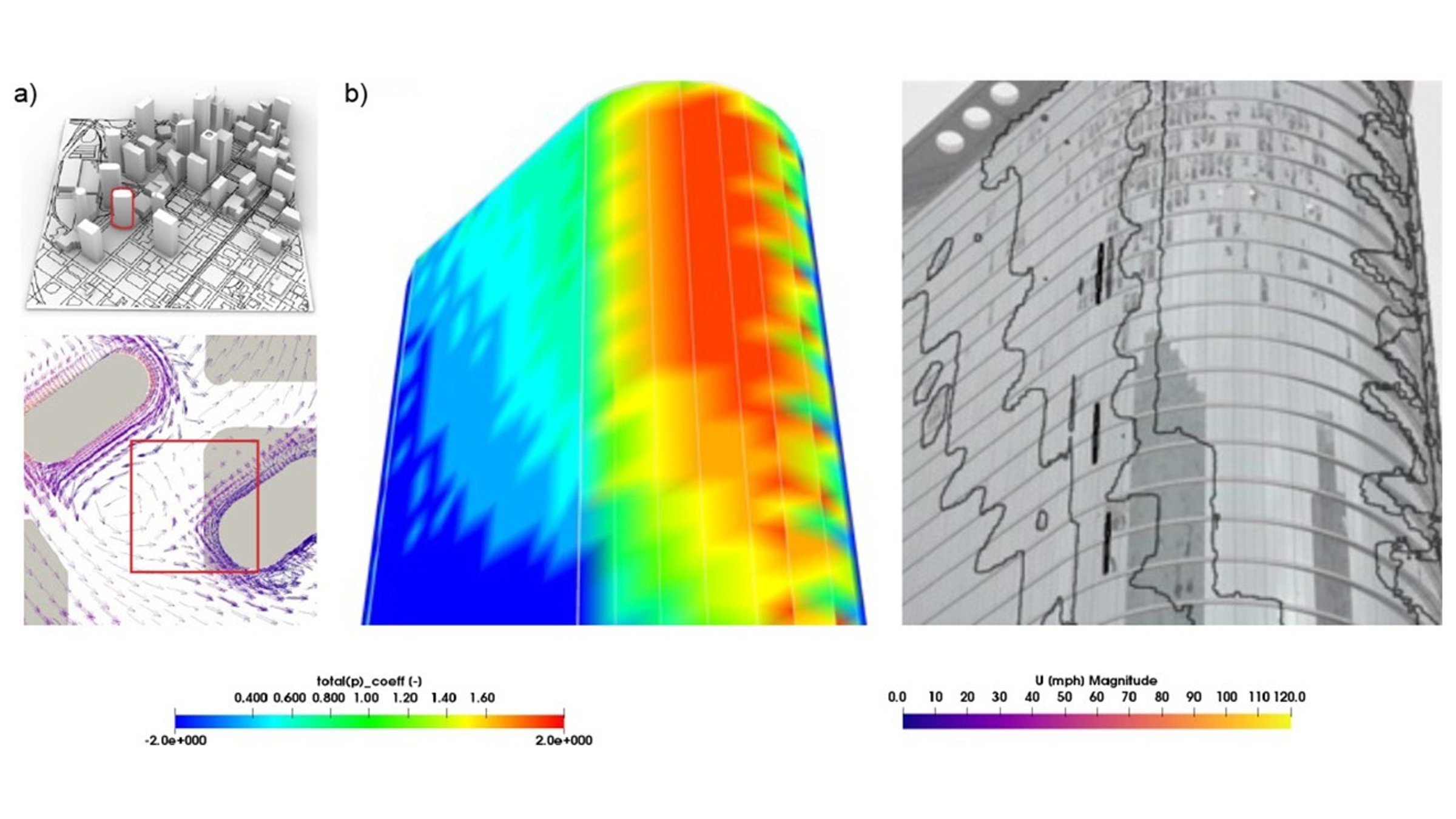
Figure 2: Chevron Global Upstream and Gas, 1400 Smith Street, Houston, Texas. a) Houston downtown high-rise cluster (Rhino generated) and wind-field b) comparison of calculated pressure differential through the total pressure coefficient (p) with real-life damages. Pressure differential describes the relative pressure exerted on the surface of the building compared to the ambient pressure. Areas of blue color (negative p) indicate extreme suction forces, while areas in red indicate extreme pressure forces. This phenomenon is amplified by the nature of derechos, where strong vertical wind shear causes different wind pressures at different heights.
These calculations, repeated in a different city for method validation, confirmed how dense urban “tectonics” amplify wind shear and localized turbulence, exemplified for the Chevron Global Upstream and Gas tower in Figure 3a, pinpointing the most vulnerable glazing areas to urban catalyzed vortexes, as shown in Figures 3b-d.28,29
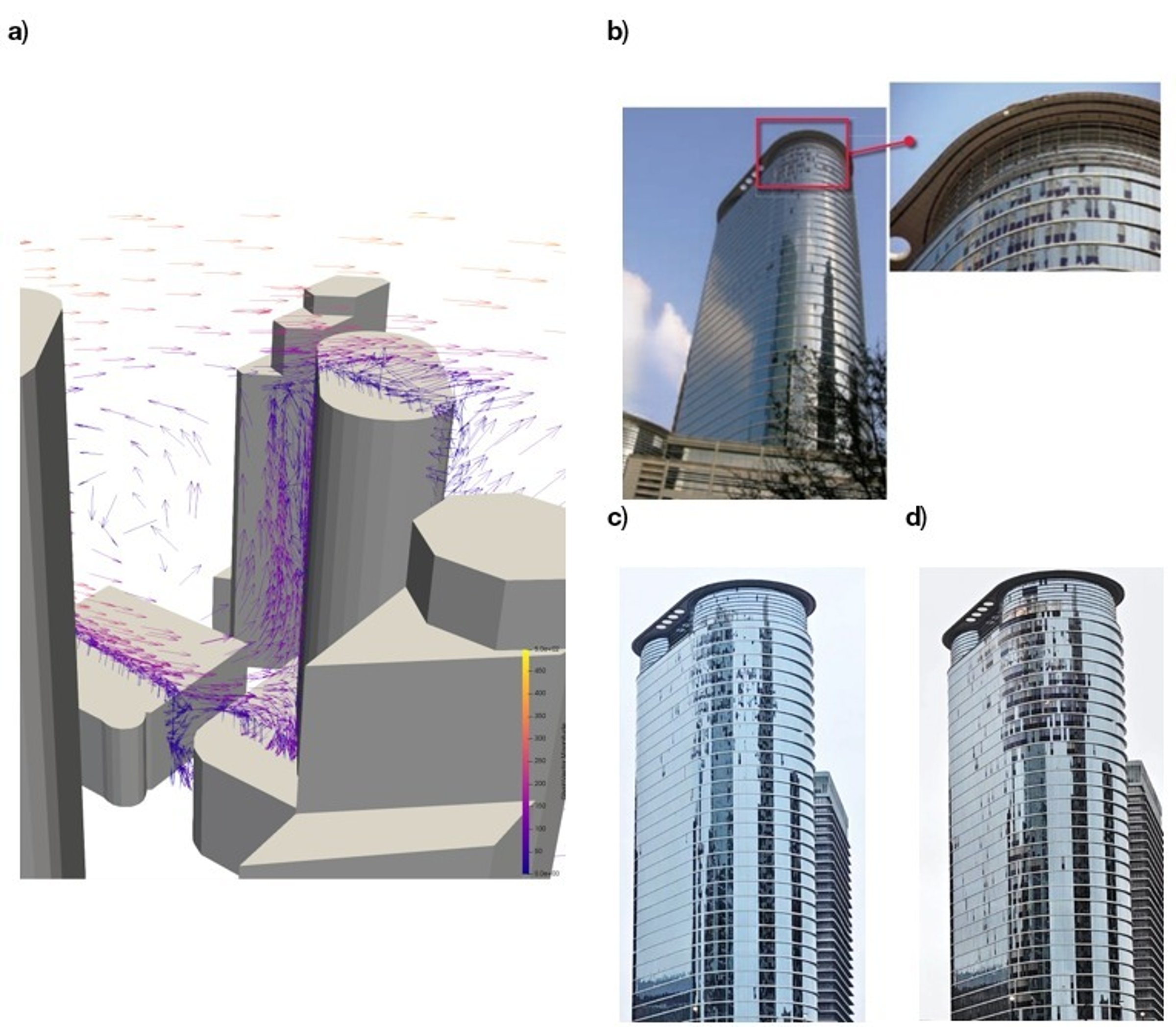
Figure 3: Urban topographic around the Chevron tower (a) creates the conditions for windborne debris to become trapped in the urban pockets between towers and travels vertically through vortical flow patterns, amplifying impacts at higher elevations independent of the event’s wind profile, consistently, event after event, as demonstrated by the damage during Hurricane Ike event in 2008 (28) (b), the May 16, 2024 Derecho (c) and the July 8, 2024 Hurricane Beryl event (d).29
The insights generated, independently corroborated by studies disseminated by the University of Houston30, 31 and by Page’s collaborators at Florida International University,32 guide ongoing explorations of optimized infill layouts, refined setback guidelines, massing strategies, and targeted façade reinforcements with the vision of finding solutions well before the next extreme event.
As smart, adaptive cities become the new norm, resilience will go beyond static simulations and piecemeal infills. City-scale Digital Twins, where scenarios can be tested and calibrated with live sensor data, are within reach. Emerging approaches couple CFD with real-time sensor networks, creating “digital twins” that monitor wind behavior during live storms and adjust façade or damping systems on the fly. Dynamic facades that morph in response to wind conditions can significantly reduce wind loads.33 Integrating these with machine-learning algorithms may soon allow buildings that learn and self-optimize as climates evolve. Aerodynamic retrofitting, such as adding tapered forms and recessed sections, minimizes wind-induced forces, as the Burj Khalifa and similar building forms demonstrate.34 Advanced damping systems, like tuned mass dampers, absorb vibrational energy,35 while strategically placed green infrastructure, including urban windbreaks, mitigate wind tunnel effects.36 Employing high-performance materials and integrating cyber-physical systems for real-time monitoring and adjustment can further enhance structural resilience.37 Mitigation and design considerations cannot be decoupled from the existing urban fabric, which significantly influences wind behavior during extreme events. Aerodynamic design and proper urban planning are critical in the design of future high rises to ensure the safety and resilience of urban environments, as it is for retrofitting interventions.
As urban markets evolve, resilience must be recast as an economic strategy, not just an operational safeguard. By modeling interactions, aligning incentives through partnerships, and financing shared and distributed infrastructure, long-term liabilities can be reduced, and thriving, adaptable cities can be fostered. Page’s ongoing research investigations set the stage for a future where economic foresight, compounded with stronger communities, becomes the bedrock of sustainable urban development, safeguarding both assets and the communities that depend on them.
American Society of Civil Engineers. (2021). Failure to act: Economic impacts of status quo investment across infrastructure systems.
Smith, A. 2024: An active year of U.S. billion-dollar weather and climate disasters. (January 10, 2025.) Climate.gov Science & Information for a Climate-Smart Nation.
NOAA National Centers for Environmental Information. (n.d.). U.S. state climate summaries: Billion-dollar weather and climate disasters.
U.S. Environmental Protection Agency. (n.d.). Climate change impacts on the built environment.
U.S. Climate Resilience Toolkit. (n.d.). Resilient Houston.
City of Miami. (n.d.). Resilience strategies. Resilience and Sustainability Department.
Resilient Cities Network. (n.d.). Resilience planning with cities.
The Rockefeller Foundation. (n.d.). 100 Resilient Cities.
University of Michigan School for Environment and Sustainability. (February 15, 2024). U-M receives NSF grant to study climate migration in Lake Victoria Basin, Great Lakes region.
National Academies of Sciences, Engineering, and Medicine. (n.d.). Gulf Research Program.
Georgia Institute of Technology. (n.d.). Redesigning Cities: The Speedwell Foundation Talks. Georgia Tech University.
Mayers, J. Close Up Foundation. (February 21, 2024). The debate about urban redesign in the United States.
Winger, A. (March 27, 2024). Houston at the epicenter of climate disasters, facing severe economic, human losses. Houston Chronicle.
Kaske, M. (June 25, 2024). NYC Has the World’s Worst Traffic Congestion, Costing $9 Billion. Bloomberg.
U.S. Government Accountability Office. (April 1999). Community Development: Extent of Federal Influence on “Urban Sprawl” is Unclear.
Litman, T. (March 15, 2015). Analysis of Public Policies that Unintentionally Encourage and Subsidize Urban Sprawl. The New Climate Economy.
Lörinc, M., et al. (October 2024). Q3 Global Catastrophe Recap. Aon.
Lu, B. (June 26, 2024). Urban digital twins: AI comes to city planning. Forbes.
OECD Observatory of Public Sector Innovation. (November 5, 2024). Enhancing urban resilience with artificial intelligence and digital twins.
Noy I, du Pont IV, W. The long-term consequences of natural disasters – a summary of the literature. (February 2016.) Te Herenga Waka—Victoria University of Wellington. Working paper.
Teles, D., Martin, C. (January 25, 2021). Why Does Disaster Recovery Take So Long? Five Facts about Federal Housing Aid after Disasters. Urban Institute.
Rampal, N., et al. Enhancing regional climate downscaling through advances in machine learning. Artificial Intelligence for the Earth Systems. 2024;3(2): 230066.
[u/Personal-Tomatillo98]. (July 8, 2024.) Mother nature @ enron [sic] round 2. [Online forum post.] Reddit.
Kalliontzis, D., Kotzamanis, V., Pham, H., Erazo, K., Capa Salinas, J., Khan, W. (2024). StEER 2024 Houston Derecho Annotated Media Repository. In StEER-2024 Houston Derecho. DesignSafe-CI.
McClenagan, K. (May 16, 2025). A year after the Houston derecho, researchers are still studying the storm’s effects. Houston Public Media.
Metwally, O., et al. Wind load impact on tall building facades: damage observations during severe wind events and wind tunnel testing. Frontiers in Built Environment. 2025;10:1514523.
Ding F., Kareem A. Tall buildings with dynamic façade under winds. Engineering. 2020;6(12):1443-1453.
Asghari Mooneghi M., Kargarmoakhar R. Aerodynamic mitigation and shape optimization of buildings: review. Journal of Building Engineering. 2016;6:225-235.
Tudu, C., Patnaik, M., Bagal, D. Assessing the efficacy of tuned mass dampers in mitigating wind-induced vibrations of tall structures. Innovative Infrastructure Solutions. 2024;9(6):pub no 193.
Hyater-Adams S., DeYoung RJ. Use of windbreaks for hurricane protection of critical facilities. NASA. 2012: TM–2012-217788.
Aktan E, Bartoli I, Glišić B, Rainieri C. Lessons from bridge structural health monitoring (SHM) and their Implications for the development of cyber-physical systems. Infrastructures. 2024;9(2):30.

Mo integrates emerging technologies into sustainable building practices, focusing on energy efficiency, decarbonization, and net-zero strategies. Mo specializes in integrating AI and machine learning into sustainable building practices, energy efficiency, daylight, decarbonization, and net-zero strategies. With a Ph.D. in Engineering from McMaster University, his work spans autonomous systems, drones, optimization, CFD, Carbon impact, digital twins, robotics, and fabrication, bridging the gap between research and industry. His work spans high-profile projects across the USA, Canada, and the Middle East.
More
by Robert McClure, Alison Ledwith, and Mo Elsayed


by Alireza Sedghikhanshir and Raffaella Montelli

Complex challenges need fresh perspectives and deep expertise. Connect with our team to explore how we can help you create spaces that make a real difference.