
Goodwin Hall
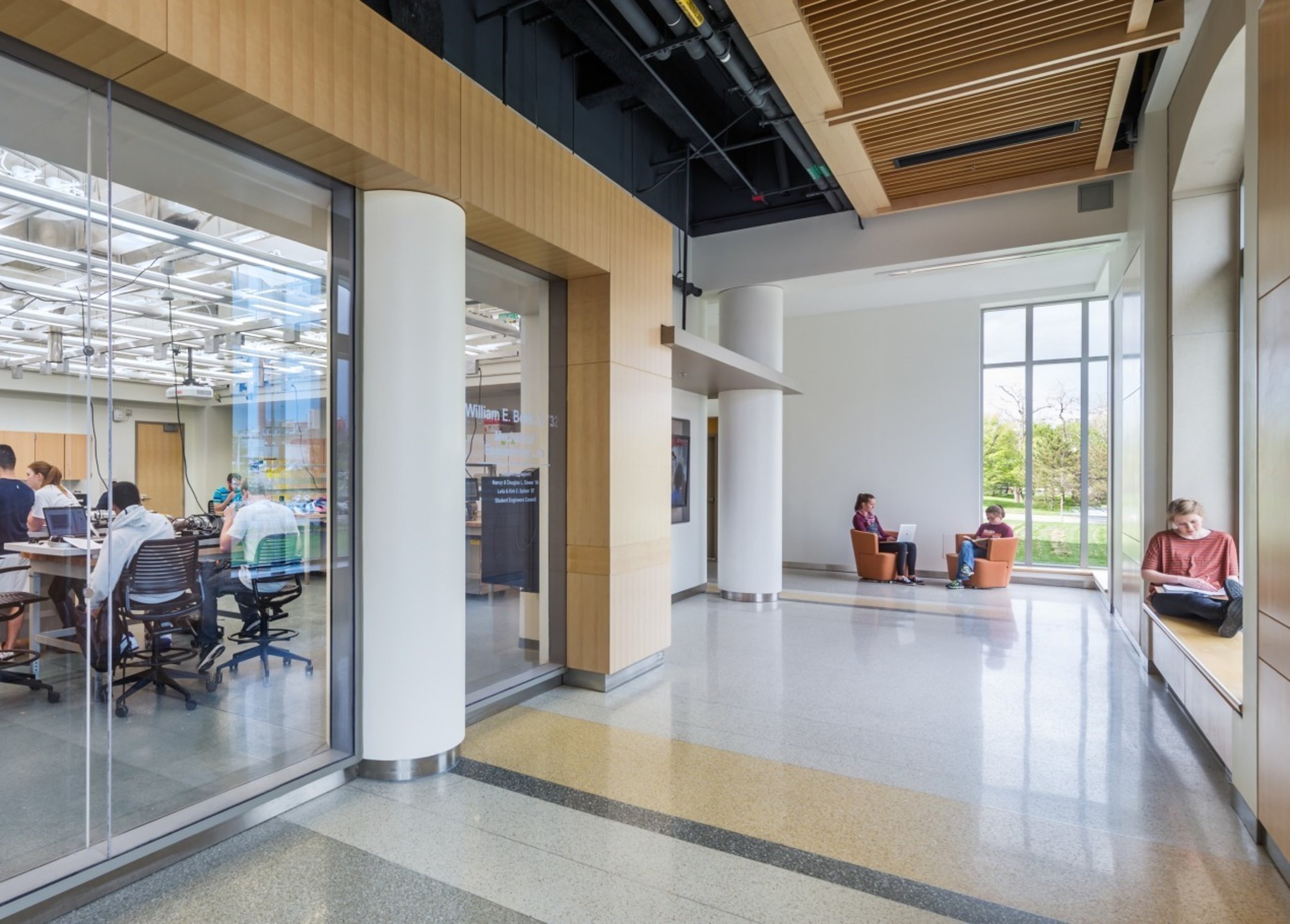
Goodwin Hall stands as Virginia Tech’s signature engineering facility, a 155,000-square-foot hub of innovation designed for flexibility, collaboration, and leading-edge research. Featuring 40 modular instructional and research labs, the building supports high-speed wind tunnels, 3D fabrication, nano characterization, materials testing, and optics—empowering faculty and students with specialized capabilities.
Home to mechanical, aerospace, and chemical engineering, the facility includes state-of-the-art robotics teaching labs, such as the Terrestrial Robotics Engineering and Control (TREC) Lab and the Extreme Environments, Robotics, and Materials (ExtReMe) Lab. Equipped with advanced instruments—including a Carl Zeiss inverted microscope, thermography imaging, and extreme environment load testing equipment—these labs push the boundaries of robotics, material science, and environmental testing.
Designed in partnership with ZGF Architects, Page’s lab planning team led the programming, planning, and lab design for this LEED Gold-certified facility, ensuring Goodwin Hall remains at the forefront of engineering education and research.
Lab planning

This signature building houses mechanical, aerospace, and chemical engineering, research and teaching labs, terrestrial robotics lab, extreme environments lab, imaging and optics labs, materials characterization labs, nano fab labs, and collaboration spaces.
Goodwin Hall at Virginia Tech is a powerhouse of engineering research, designed with a rigorously modular system to support mechanical, chemical, aerospace, and robotics engineering. With 40 adaptable lab modules, the building allows for seamless reconfiguration, accommodating high-speed wind tunnels, additive manufacturing, nano-characterization, materials testing, and optics.
At the core of the design is a scalable functional unit that balances defined capabilities with the flexibility to expand and adapt as research evolves. The modular approach provided a cost-effective construction strategy while ensuring long-term adaptability—an essential advantage in a rapidly changing research environment. Key design decisions reflected this balance: a 10’6” lab module width reduced costs, but an 11’ width would have allowed for greater flexibility in accommodating manufacturing equipment. Similarly, a deeper chemical engineering module would have improved adaptability but exceeded budget constraints. Each choice represented a strategic trade-off, optimizing functionality while aligning with project priorities.
Goodwin Hall has proven highly successful, with labs originally designed for one purpose easily evolving to meet new research demands, reinforcing Virginia Tech’s leadership in engineering innovation.




/
Similar projects


/

Talk with us
Complex challenges need fresh perspectives and deep expertise. Connect with our team to explore how we can help you create spaces that make a real difference.