
by Robert McClure, Alison Ledwith, and Mo Elsayed
by Jill Kurtz


Bright, flexible lab spaces foster collaboration while integrating design strategies that reduce energy demand without compromising performance. Photo by David Sundberg/Esto.
Across the world, geneticists are extracting DNA with sequencers, chemists are using centrifuges to separate cellular components, computational scientists are developing and running new AI engines, and engineers are performing wind tunnel tests – all in laboratories designed to cater to the discipline’s individual needs. Although each workroom’s function is unique, energy is a hidden, crucial component fueling each scientific endeavor.
From fume heads to ultra-low temperature freezers and environmental chambers, these tools are incredibly energy-hungry and can present unique challenges for facilities to meet sustainability goals. Laboratories require up to 10 times more energy per square foot than a standard commercial office building.
Innovative strategies and techniques can significantly reduce the energy consumption of laboratories without hindering the quest for knowledge or the advancement of technology. As one of the first large firms to sign the AIA 2030 commitment to pursue energy reduction and achieve carbon neutrality, this approach emphasizes the creation of high-performing and healthy buildings. These designs enable clients to lower their energy impact while increasing research opportunities.
Energy Use Intensity (EUI) indicates efficiency in a building’s design and operations, expressed as kilo British thermal units per square foot (kBTU/sf). In other words, EUI is the annual expected or actual use of electricity and natural gas, calculated by dividing total energy consumed by the gross floor area. A lower metric means a more efficient facility.
Think of EUI as miles per gallon, which is a projection of a vehicle’s expected consumption. Efficiency increases or decreases depending on the fuel type, car components, and, most importantly, how someone operates the car. For a building, an energy model helps predict the expected energy used, factoring in building systems and envelopes, temperature set points, ventilation rates, and schedules of operations. The model sets an energy target before design, benchmarks a building’s performance compared to similar building types, evaluates energy conservation measures, and improves building performance.
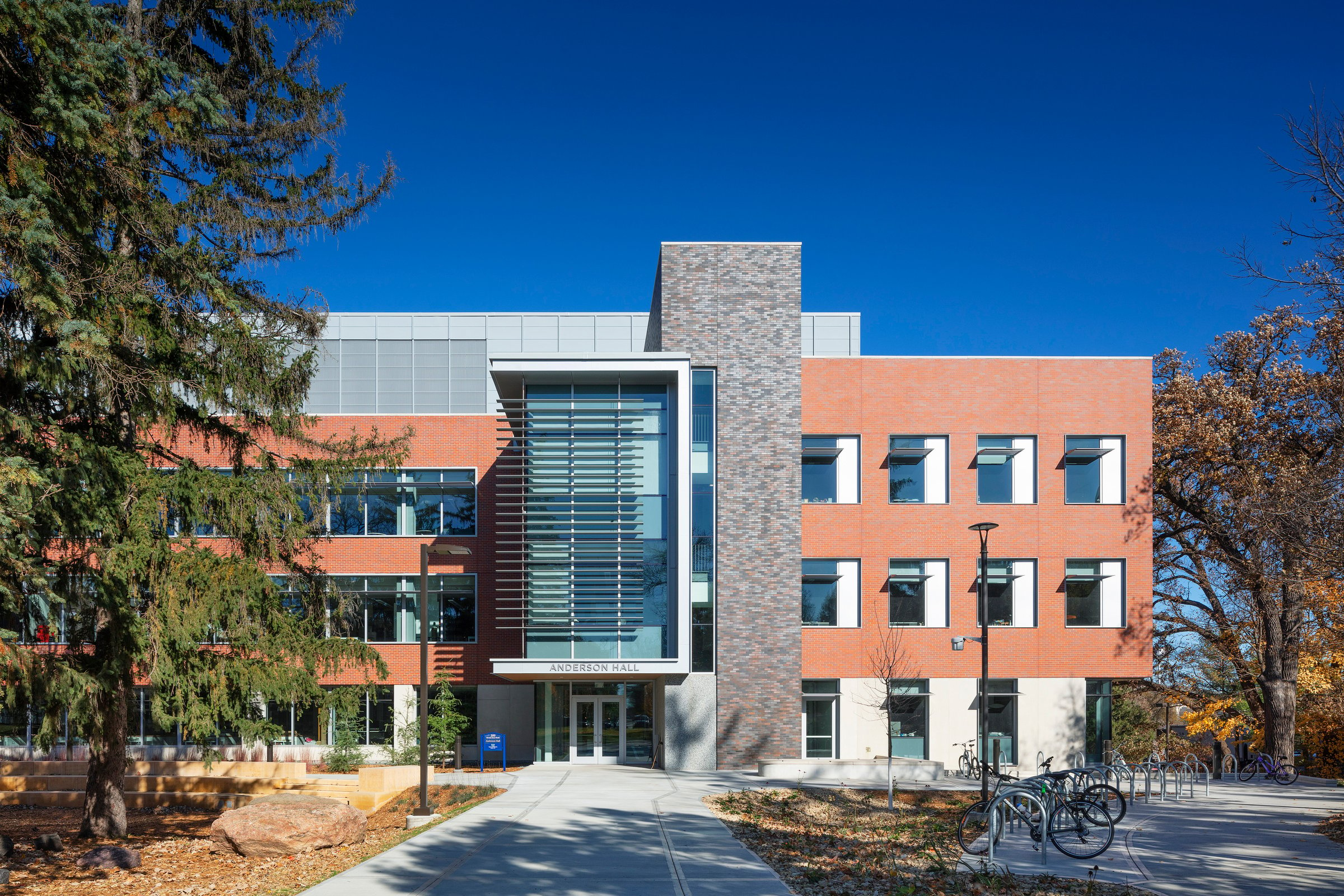
A high-performance envelope and campus energy strategies help Evelyn M. Anderson Hall achieve ambitious EUI goals while maintaining a modern academic presence. Photo/Peter J. Sieger.
To achieve net-zero carbon emissions, strategies are first implemented to reduce a facility’s energy consumption. The remaining emissions are then offset using a renewable energy source on-site, such as solar panels or geothermal wells.
The building's envelope serves as the primary barrier against energy loss. By optimizing insulation, glazing, and shading systems, while ensuring that the envelope is airtight, heat transfer through walls, roofs, and windows can be significantly reduced. The result is a more comfortable environment that requires less heating and cooling.
To keep laboratories safe and clean, outside ventilation needs to constantly replace the air inside. This continuous cycle removes potentially hazardous or contaminated air and replaces it with fresh, clean air while conditioning the incoming ventilation to meet precise temperature and humidity levels. Many experiments hinge on a meticulously controlled environment, demanding the perfect conditions for safe tests. However, the energy required to uphold these delicate balances consistently contributes to the overall energy demand of laboratory HVAC systems. High-efficiency chillers, energy-recovery ventilation, advanced control systems, and occupancy and daylight sensors can improve the energy efficiency of the HVAC systems.
After identifying strategies to reduce energy consumption from a building perspective, the next focus is on minimizing the energy use of laboratory equipment. Fume hoods, in particular, are known to be some of the most energy-intensive tools. Implementing more advanced systems with variable airflow can optimize their performance. Additionally, emerging technologies such as smart sensors and energy-efficient equipment are designed to enhance laboratory operations, helping to achieve sustainability goals while ensuring compliance with safety regulations.
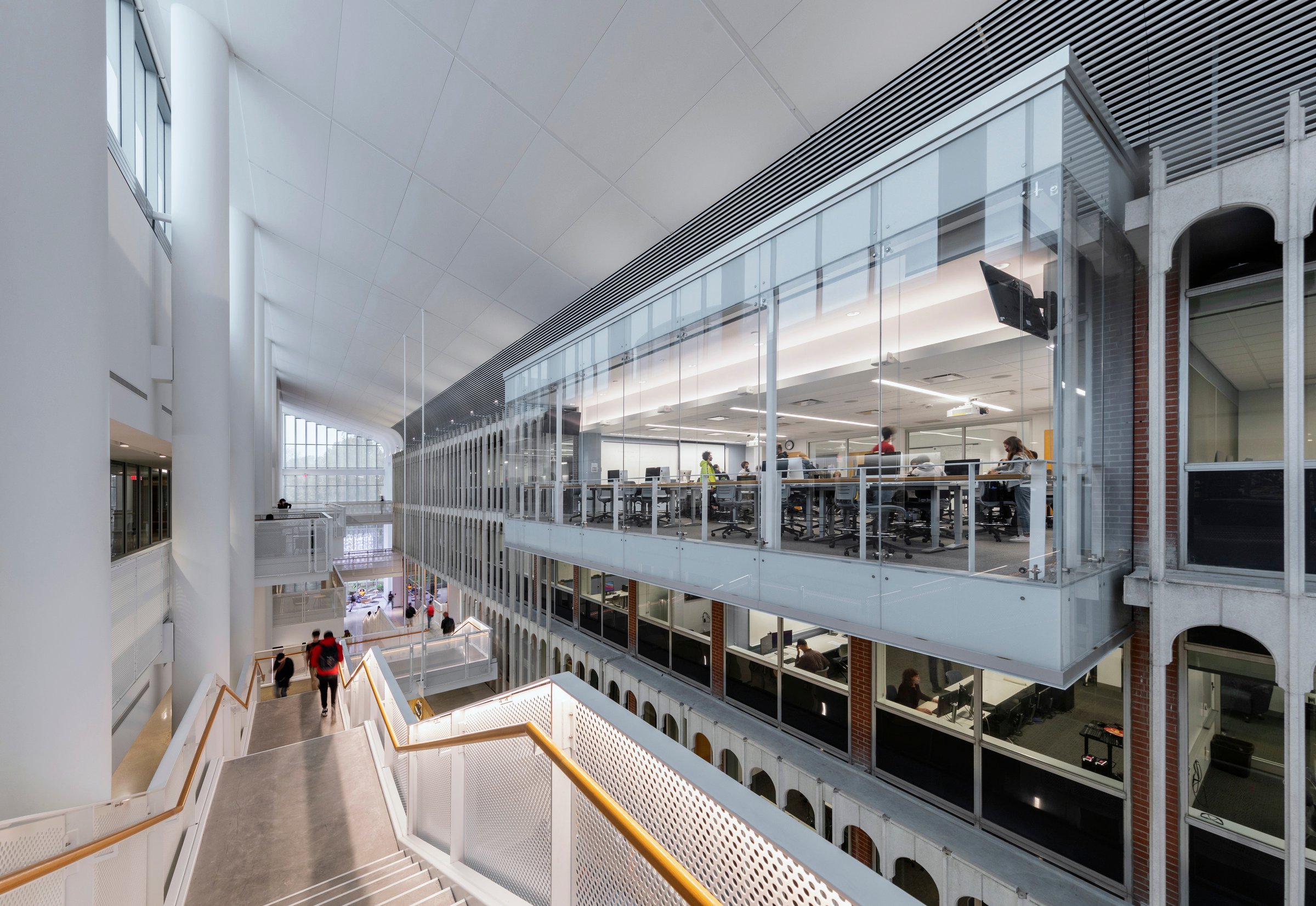
Daylit atriums and efficient systems reduce energy use while supporting transparency, connectivity and well-being in modern research environments. Photo by David Sundberg/Esto.
Carleton College’s science complex is a testament to what’s possible when modernizing a building. Adapting two existing facilities and demolishing a third to create space for a high-performance addition, the team designed a new sun-splashed atrium that unites the structures and channels light throughout the building.
To help the college achieve its mandate of not increasing campus energy consumption through new construction or renovation projects, the design process incorporated energy modeling into the project’s earliest phase. This approach reduced the predicted EUI and was coupled with a new geothermal system and the allocation of campus wind power. The project – with an EUI of 116.6 kBTU/sf – achieved a 38.4% decrease in overall energy consumption, despite the 33% increase in total square footage, and a 43.2% energy cost-savings reduction, earning a USGBC LEED Platinum certification.
Through a collective effort, architects and stakeholders can create greener, more resource-efficient environments that contribute to scientific advancement and a healthier planet.

Jill 's mantra is “intention requires rigor,” an apt phrase for someone committed to leading Page's efforts to embed sustainability into every project. Leveraging her strengths as a systems thinker and ability to work across disciplines, Jill combines 20 years of sustainable design experience and a client-centric mindset to her leadership of Page’s Building Science practice. The creator of Page's "Design for Impact" framework, Jill has led our firm-wide strategy on environmental and social responsibility, defined our project best practices, and helped design teams realize meaningful value and measurable impact towards their sustainability goals.
More
by Robert McClure, Alison Ledwith, and Mo Elsayed


Complex challenges need fresh perspectives and deep expertise. Connect with our team to explore how we can help you create spaces that make a real difference.