

Listen to this story
AI powered reader
/
How are public and private entities teaming up to provide innovative solutions for community needs? The answer: Public-Private Partnerships (P3). With P3 projects, the private sector is responsible for providing the resources for development, design, construction, and financing, while the government manages the regulatory control and holds the project accountable to the public interest.
As this contractual agreement exists between the government and private companies to deliver public infrastructure and services, where does Page, now Stantec, come in?
The P3 format is commonly used for complex, long-term public works, where the process of designing, building, and operating facilities is multifaceted and requires careful planning and coordination. Page supports stakeholders through master planning services, for example, providing a comprehensive approach to project development that considers all factors that impact the project.
Page’s talented master planning teams analyze the site, develop a conceptual design, and create a detailed plan outlining the project's scope to meet the developer’s schedule and budget. This plan serves as a roadmap, guiding decision-making throughout the design, construction, and operation phases.
Collaborating with developer partners and advisors, Page has played a significant role in planning and designing a variety of P3 project types, including academic, mixed-use office, science and technology, retail, and residential facilities. Page's ability to deliver interdisciplinary coordination, innovative thinking, and responsiveness meets the current demands of today’s complex projects, benefiting clients across various project types.
A P3 project fostering urban redevelopment
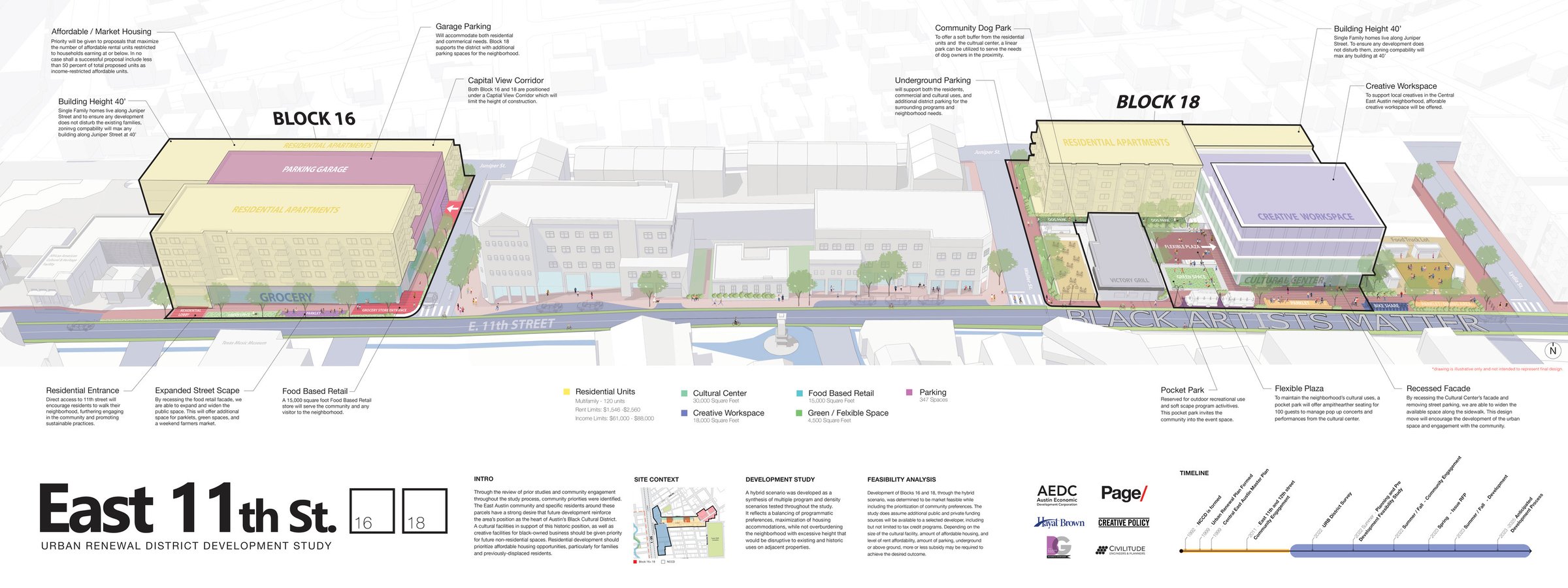
What’s possible for a P3 project at the heart of Austin’s Six Square Cultural District? The Austin Economic Development Corporation, now known as Rally Austin, and the Austin Urban Renewal Agency are collaborating to create a vibrant, community-focused center on two largely vacant parcels of East 11th Street, specifically blocks 16 and 18.
Rally Austin and Austin Urban Renewal Agency are working hand in hand, acting as a united public entity, and building on nearly 30 years of planning efforts to move the long-awaited development forward. Page’s Planning and Urban Design team, in collaboration with Hayat Brown, became integral to the pre-development process, studying the site to offer an enhanced understanding for the future P3 developer—the private partner.
Kicking off the process, Page and Rally Austin connected with residents and local businesses to identify their needs and priorities. And after weeks of knocking on doors, offering open houses, conducting surveys, and attending public forums, the team found an overwhelming urgency for affordable housing, a small grocery store, and economically feasible rental office spaces for small businesses or nonprofits.
Following a comprehensive analysis of the community’s desired use of the blocks, Page proposed a conceptual design that incorporates building densities aligned with adjacent construction, current zoning restrictions, and environmental development constraints.
Page’s team also attentively considered the history of East 11th Street to provide programming recommendations that carefully place blocks 16 and 18 in the context of the site, shaping a holistic district. This mixed-use, vibrant gateway between East Austin and Downtown will be infused with the identity of the historic African American Cultural District, with a contemporary and radiant center that pays homage to the legacy of an informal music center on the current site.
The developer chosen by Rally Austin and the Austin Urban Renewal Agency will use Page’s recommendation as an initial concept. This early identification of space constraints and potential challenges will support the developer in making informed decisions, refining the design, and effectively optimizing space, as well as helping determine the project’s cost. The P3 developer will also finance, operate, and maintain the infrastructure.
By carefully considering the needs of individuals and communities and prioritizing community interests, Page helps ensure successful outcomes that benefit both public and private entities involved in every P3 development. Imagine the possibilities for neighborhood centers and other forms of public infrastructure as this innovative project delivery method continues to gain momentum, offering a bright and transformative future for community development.
Editor’s note: This article was previously published in 2023, and some details may be missing or changed.
Contributors

Ginny ’s journey into architecture began early, learning the basics of construction under her family's drafting table and in a metal shop. With a mechanical engineer grandfather and a contractor-artist father, she was building ductwork at age 12. Inspired by her family's business and its client-centered approach, she pursued studies in engineering and architecture at Texas A&M and Universidad de Francisco Marroquín. For over twenty years, Ginny has led projects for governments, educational institutions, and healthcare clients. Known for her empathy and vision, she thrives on guiding clients and teams to bring transformative spaces to life.

Ryan has a passion for cities and the impact of the urban environment on its inhabitants. He combines his expertise in urban design, architecture, and planning to craft projects that integrate seamlessly across scales. He believes that individual projects cannot be conceived in isolation; it is their connection to the surrounding context that shapes how people receive and interact with place. His body of work includes a variety of typologies and urban conditions, from innovation districts to downtown redevelopments, public realm activation, campuses, and peripheral urban zones, each focused on a human-centered approach to urban design.
More

by Jennifer Wegner

by Ginny Chilton and Ryan Losch

Talk with us
Complex challenges need fresh perspectives and deep expertise. Connect with our team to explore how we can help you create spaces that make a real difference.