by Robert McClure, Alison Ledwith, and Mo Elsayed
by Todd Ray
Electromagnetic (EM) fields—generated by everything from power lines to smartphones—are an invisible yet pervasive aspect of the modern world. While these fields enable countless wireless devices, they can also create challenges for inclusive design by impacting the functionality of hearing aids and cochlear implants to varying degrees. Different hearing devices use distinct wireless communication methods, and their design determines their susceptibility to electromagnetic interference (EMI), including direct Radio Frequency (RF) overlap, broadband EMI, and noise from power-related sources.
Cochlear implants, for instance, rely on electromagnetic energy to transmit signals between an external processor and an internal receiver to enable real-time sound processing. If there is significant EMI in the environment, it can potentially disrupt the signals sent between these two components. Similarly, hearing aids that use wireless communication, such as Bluetooth, can also be affected by EMI. Both systems are typically designed with shielding and other measures to minimize the effect of this interference; however, they can be impacted in environments with high levels of interference.
The need for reliable assistive technology is vast. As of July 2022, more than 1 million cochlear implant procedures have occurred worldwide. In the United States alone, 7% of adults currently use hearing aids, though 28.8 million adults could benefit from them.1,2 This reliance on assistive devices underscores the importance of environments that support their functionality.
At Page, inclusive design isn’t just about addressing the minimum accessibility standards; it’s about creating environments where assistive technologies are uninterrupted and uncompromised. This philosophy drives our ultra-inclusive design approach, expanding the concept of sensory-friendly spaces to address the complex challenges of EMI in real-world applications.
Data-driven mapping: Understanding the invisible threat of EMI
Gallaudet University, a global leader in education for the Deaf and Hard of Hearing, presented a compelling case of electromagnetic interference (EMI) disrupting assistive technology. As Hansel Bauman, former Gallaudet Campus Architect and co-author of the Gallaudet University DeafSpace Design Guidelines, said, “We understand how disruptive EMI can be but are perplexed by the cause of disruption at localized areas on campus where hearing aids and cochlear implants always fail, creating significant challenges for many of our students and faculty.”
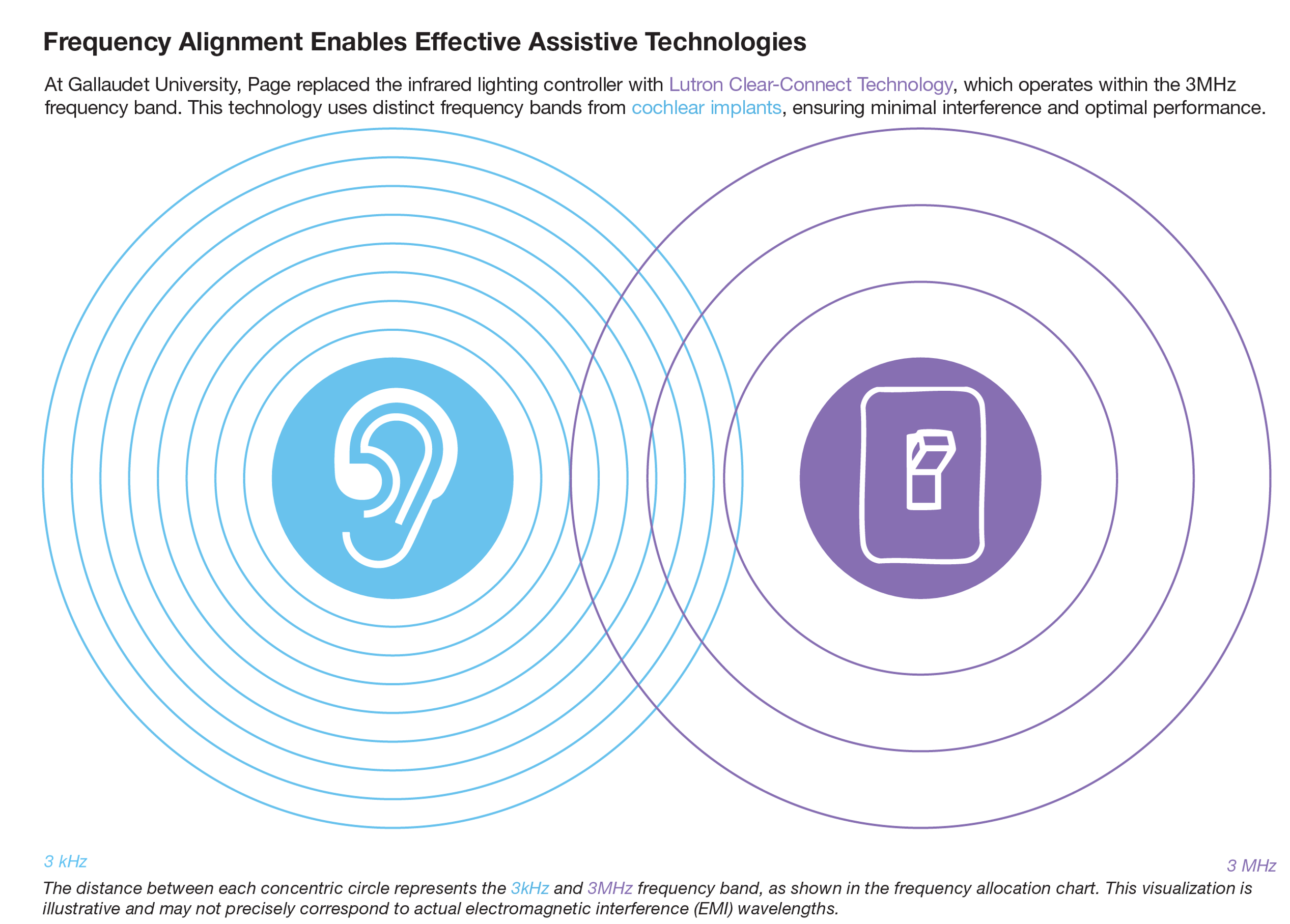
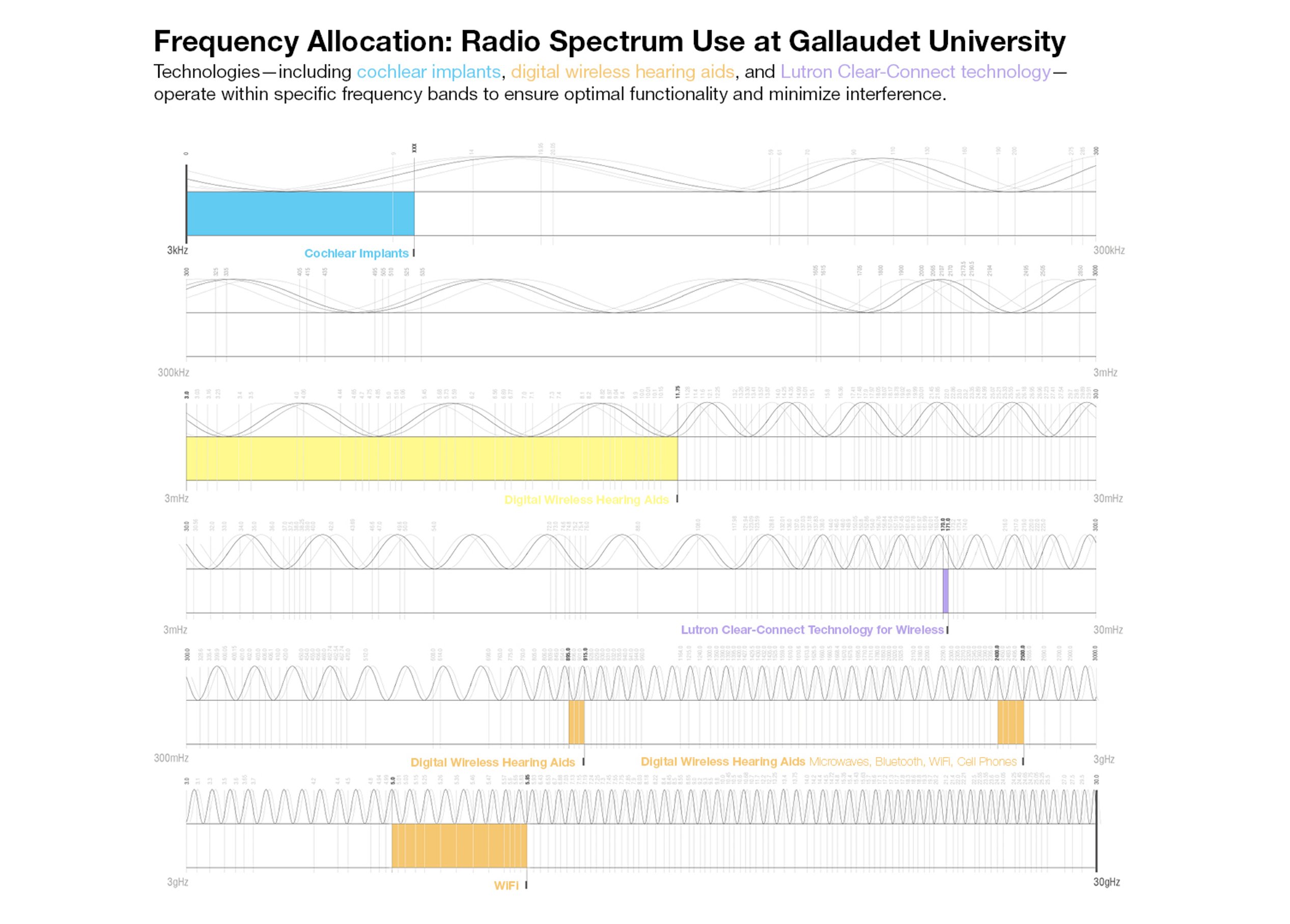
Prior to designing and building a new space for Gallaudet, we sought to address the persistent interruption of assistive listening devices across campus to improve the overall student experience in their environments. Partnering with Interface Engineering, Page conducted a detailed investigation, including electromagnetic spectrum mapping. Using annotated frequency allocation maps from the U.S. Department of Commerce, we identified a potential source of interference: an infrared lighting controller integrated during the building’s construction.3 This device was found to emit frequencies overlapping with those of assistive listening technologies, rendering them temporarily inoperative when users were nearby.
Based on interviews and observational studies, since laboratory testing or controlled studies were not practical for this project timeline to isolate the precise mechanism of disruption, the data strongly suggested a particular lighting controller was the primary contributor to the interference. This hypothesis was further supported when the controller was replaced with the Lutron Clear-Connect Technology, a system designed to operate on non-interfering frequencies with enhanced shielding and EMI mitigation, which restored seamless functionality. Our finding underscores the critical need to account for EMI in built environments and prioritize technologies that incorporate reliable mitigation measures.

/
Shielding solutions: Practical interventions in architectural design
Creating environments that support seamless functionality for hearing aid and cochlear implant users requires a multi-faceted approach grounded in rigorous research and technical innovation. By addressing electromagnetic interference (EMI) at the architectural level, designers and engineers can ensure that assistive technologies remain reliable and effective.
The following research-backed strategies outline practical interventions to mitigate EMI in modern facilities:
1. Data-driven frequency mapping:
A foundational step in addressing EMI is conducting a comprehensive electromagnetic spectrum analysis within a given environment. Using spectrum analyzers, designers can measure signal strength, frequency distribution, and potential interference zones. This process helps identify high-risk overlap areas, particularly where assistive technologies may conflict with other devices operating on similar frequency bands.
In the United States, the Federal Communications Commission (FCC) and related agencies, such as the National Telecommunications and Information Administration (NTIA) and the Office of Spectrum Management, regulate the radio frequency spectrum. The FCC reserves specific frequency bands for devices – including, 72–76 MHz and 216–217 MHz (commonly used for assistive listening systems), and 2.4 GHz (dedicated for Bluetooth and wireless audio transmission).
Research indicates that EMI can significantly disrupt cochlear implants when external devices emit overlapping frequencies or generate excessive broadband noise, particularly within the 2–500 MHz range. This range is frequently occupied by environmental sources such as lighting systems and mobile devices.4
By comparing real-time data with regulatory allocations, architects and engineers can develop targeted interventions to minimize disruptions and improve the reliability of assistive listening devices.
2. Shielding and isolation strategies:
The materials and construction techniques used in a building’s infrastructure can significantly influence EMI propagation. Various shielding technologies can be integrated into architectural design to control interference while maintaining aesthetic integrity:
These interventions are designed to mitigate EMI and maintain the aesthetic and functional integrity of the architectural design. For example, transparent shielding films for windows allow natural light while providing electromagnetic protection.
3. Spatial adjacency optimization:
The physical layout of wireless systems and user spaces is key to managing EMI risk. High-density wireless zones—such as server rooms, Wi-Fi hubs, or 5G transmitters—can create interference hotspots for assistive technologies. To reduce EMI risk, spatial adjacency optimization involves:
The intersection of wireless innovation and assistive technology calls for a forward-thinking approach to inclusivity. By integrating frequency mapping, shielding technologies, and spatial adjacency strategies, we can anticipate and mitigate EMI challenges before they arise. This holistic approach ensures that the built environment is not only compliant with accessibility standards but also aspirational in its inclusivity.
At Page, we aim to set a new benchmark for designing spaces where technology empowers everyone, proving that innovation and accessibility can—and must—go hand in hand.
Quick Statistics About Hearing, Balance, & Dizziness. (September 20, 2024.) National Institute on Deafness and Other Communication Disorders.
Focareta, D. Hearing aid statistics 2025. (March 26, 2024.) Journal of Consumer Research.
United States Frequency Allocation Chart. (January 2016.) National Telecommunications and Information Administration.
Tognola, G., et al. Electromagnetic interference and cochlear implants. Ann Ist Super Sanità. 2007;43(3): 241-247.

Todd is an accomplished architect with over 37 years of experience in the education, institutional, and commercial markets. His award-winning portfolio includes projects like the Mundo Verde Bilingual Public Charter School, recognized for its sustainable design and public impact. Throughout his career, Todd’s focus on the human experience of architecture has produced beautiful, high-performing, innovative buildings and spaces that have a long-term positive impact on communities. Todd is an AIA Fellow and the recipient of several prestigious awards, including the John “Wieb” Wiebenson Award for Architecture in the Public Interest.
More
by Robert McClure, Alison Ledwith, and Mo Elsayed


Complex challenges need fresh perspectives and deep expertise. Connect with our team to explore how we can help you create spaces that make a real difference.