
by Robert McClure, Alison Ledwith, and Mo Elsayed
by Jennifer Amster and Mark Vaughan
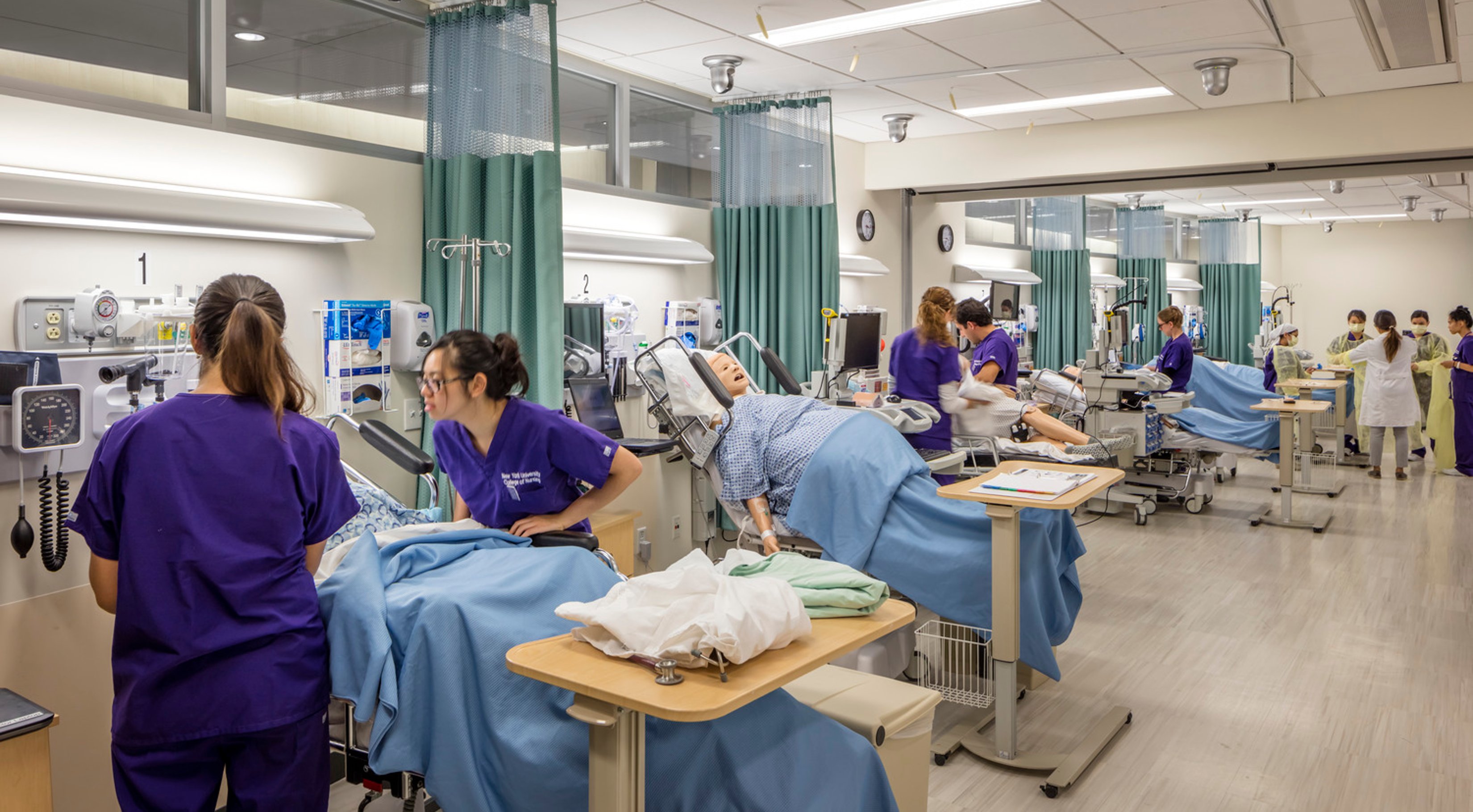
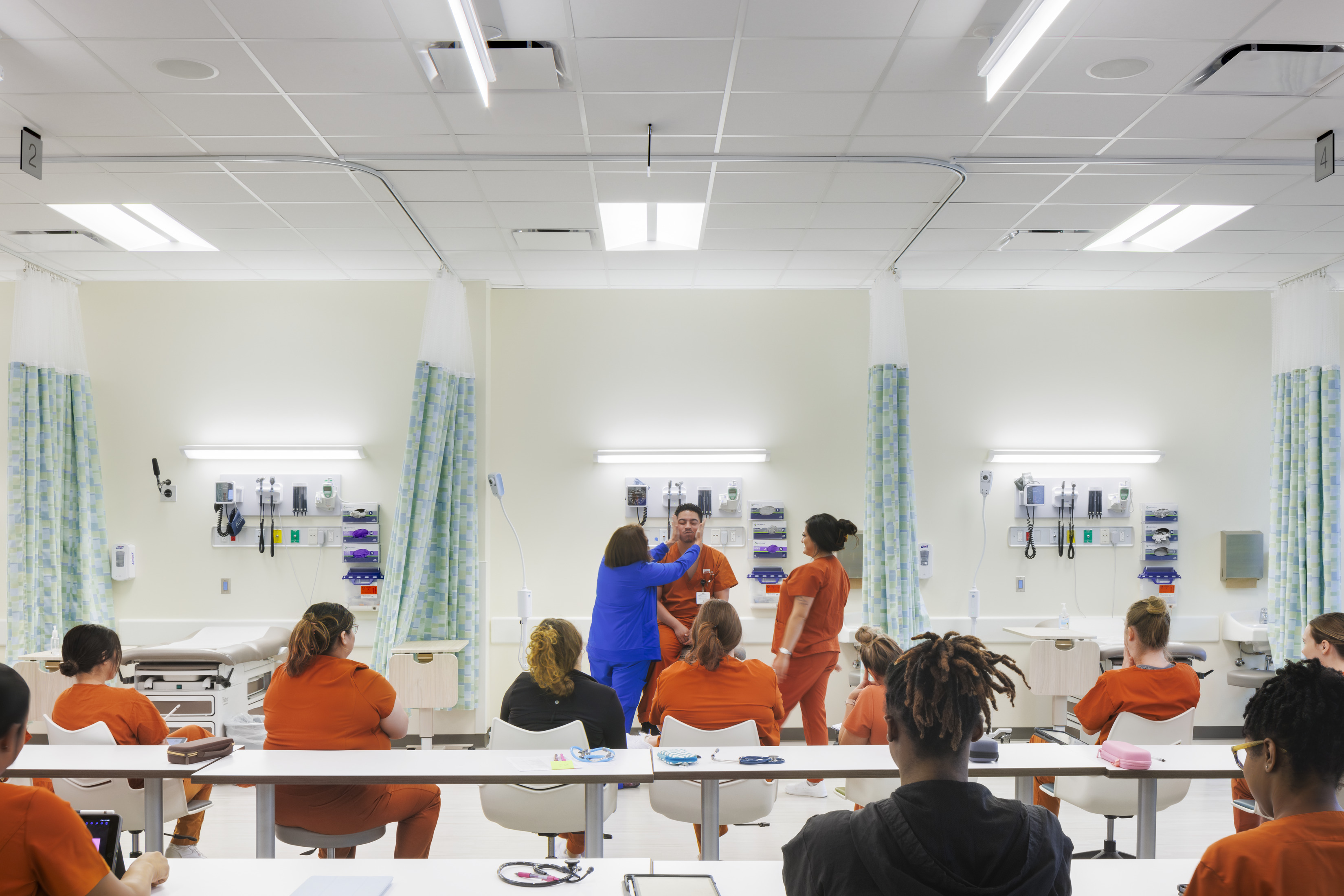
Nursing students at NYU College of Nursing practice skills in a simulation lab. Photo/Tim Griffith.
The convergence of science, engineering, and technology is dramatically transforming healthcare delivery. Increased emphasis on patient-centered care relies on the combined strength of multiple disciplines, requiring a workforce that can leverage a variety of skills for healing, care coordination, and discovery while working effectively as a team. To that end, many academic institutions are rethinking how they educate future healthcare providers by shifting the focus from lecture-based learning to providing opportunities to practice skills in realistic settings and scenarios, utilizing hands-on applications and sophisticated simulation technology. This bridge from theory to application is a rapidly developing pedagogy that yields many benefits. For instance, a recent study in The Journal of Allied Health1 found that employers noted unprepared students struggle to adapt to clinical environments, highlighting the need for training that better integrates theory with practical experience. Page architects and designers have also received qualitative feedback from frontline hospital employers that they prefer their students experience more time in simulation teaching and practice necessary skills before they enter their field.
The National Council of State Boards of Nursing also recognized this emerging trend in 2011 and set out to test the hypothesis that simulation can replace traditional clinical experience in prelicensure nursing courses. The results from that 2014 longitudinal study in the Journal of Nursing Regulation found that high-fidelity simulation can effectively replace up to 50% of traditional clinical hours in nursing education without compromising clinical competency, nursing knowledge, or readiness for practice, providing substantial evidence for nursing boards to consider simulation as a viable substitute for clinical experiences.2 Likewise, the Association of American Medical Colleges conducted a comprehensive simulation survey of medical schools, showing that simulation-based education is used by more than 90% of medical schools to introduce concepts in clinical medicine and physical diagnosis.3

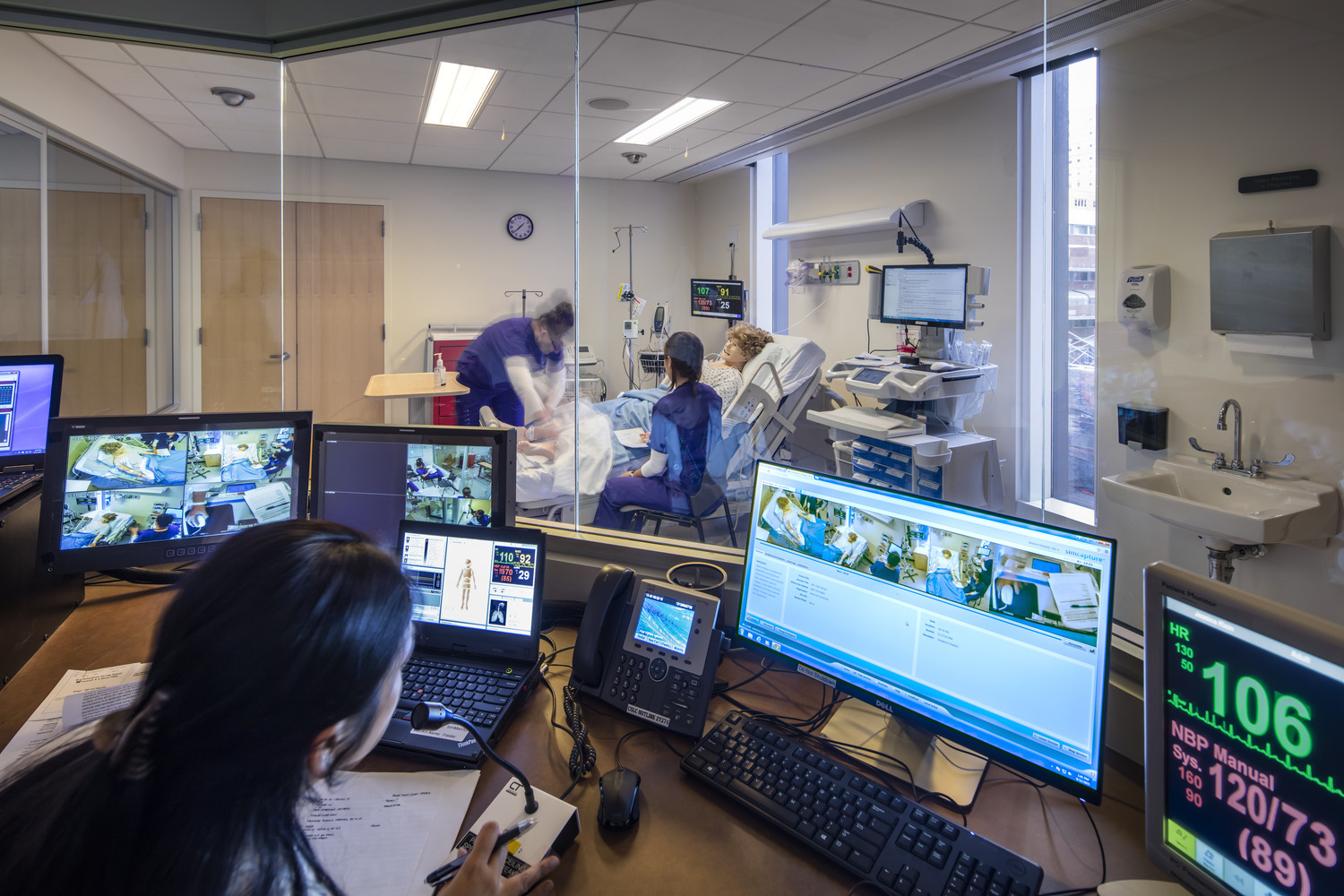
NYU College of Nursing students practice teamwork and communication in a simulation lab. Photo/Tim Griffith.
“The more realistic and effective the training environment is—one that replicates the collaborative work and the actual conditions healthcare professionals will encounter—the greater the confidence it instills in the staff,” said Mark Vaughan, Page Healthcare Planning Director, during the recording of The Good Simulation Room podcast. He reflects on the feedback he has received, “Many educators receive feedback from young graduates indicating that they feel better prepared when entering the professional realm. They express that this training has given them a deeper understanding and greater confidence to deliver the care expected of them.”
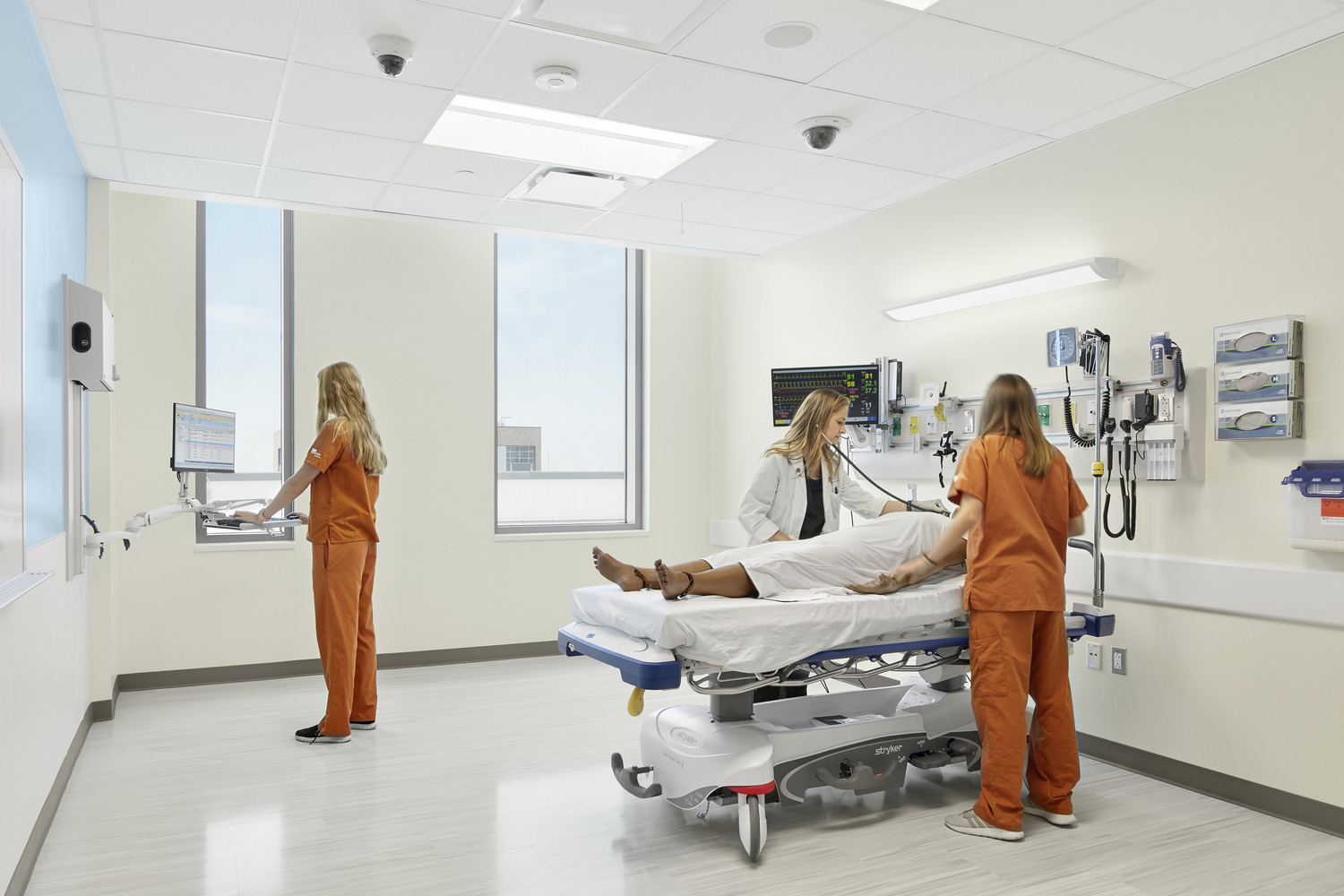
The University of Texas Medical Branch Health Education Center students engage with a manikin. Photo/Jonathan Dean.
To meet growing demand as health education program enrollment rises, colleges and universities nationwide are incorporating simulation-based learning into health education buildings to improve technical skills, foster collaboration, innovation, engagement, and confidence, reinforce identity, and attract and retain students to high-demand healthcare fields. This requires strategic planning and design of experiential learning space through dedicated simulation rooms and flexible facilities that support program growth, accommodate next-generation equipment, and allow the hands-on practice of new treatments.
The impact of simulation on learning
Simulation-based learning is particularly effective, enhancing learning by making connections between knowledge and skills. Students can integrate the information they have learned into real-world scenarios, merging their hands-on experience and technical skills with prioritization, critical thinking, and problem-solving. Controlled simulation, in contrast to clinical rotation, also provides a consistent and uniform experience for all learners.
Simulation is ideal for informal “naturalistic learning” in a social context to reinforce more formally acquired knowledge. A group studying4 the use of manikins to teach physiological principles in high school, college, and graduate school curricula concluded that the urgency, authenticity, and excitement of making translational connections to traditional classroom sessions increased students’ engagement.
Four key aspects of simulation make it powerful for health education in particular:
In addition to affecting student engagement, Page designers discovered that our clients want to use their simulation spaces as an incubator for improved teamwork between different disciplines. Their primary objective is training students in a setting that will promote enhanced collaborative behavior in their approach to clinical care – a cooperative attitude and inclination toward team-based problem-solving.
Experiential learning through simulation is not limited to traditional health education. The Health Education Center (HEC) at the University of Texas Medical Branch at Galveston (UTMB) consists of 160,000 GSF of resilient and advanced technology education space as the home of a new centralized Simulation Center for the UTMB campus. The HEC promotes inter-professional education in all UTMB schools, which includes nursing, health professions, and medicine, along with professional education for residents, nurses, physicians, and staff. It features flexible and specialized labs, including an OR/ICU Suite, a Standardized Patient Suite, and flexible simulation labs for the UTMB health education community. Large learning labs are designed to accommodate various simulation technologies and bring interdisciplinary teams together. These labs integrate simulation and debrief spaces to create an immersive experience for students. The HEC includes large flat-floor classrooms to enable “flipped classroom” pedagogy, study spaces, educational offices, and administrative space. These elements enable UTMB to better manage the growth of its health education programs and enhance exposure to hands-on simulation.
Planning effectively for simulation
As Page works with educational teams on new or renovated facilities, we examine the spectrum of potential simulation spaces through the lens of two constructs: the degree of simulation fidelity and the level of student experience. Our clients typically wrestle with the following types of questions:
Research shows6 that there is a strong relationship between learners’ experience and the fidelity of the simulation space. For example, an inexperienced student will learn more from a low-fidelity environment that teaches generic skills, but a more expert learner needs a more realistic simulation for task refinement.
Research shows that high-quality patient simulations can effectively replace traditional clinical hours, enhancing both skills and teamwork among future healthcare professionals. These simulation spaces also serve as vital hubs for interdisciplinary collaboration, significantly boosting student engagement. Starting with the earliest planning phases, designers and clients must engage in thoughtful discussions about the ultimate goals and intended experiences, guiding optimal layouts and access for immersive realism. Strategically designing these spaces maximizes the value of this significant investment and ensures transformative learning experiences that closely mirror real-world healthcare scenarios.
Citations:
O'Brien, C. W., et al. Employers' Viewpoint on Clinical Education. Journal of Allied Health. 2017;46(3): 131–137.
Hayden, J., et al. The NCSBN National Simulation Study: A Longitudinal, Randomized, Controlled Study Replacing Clinical Hours with Simulation in Prelicensure Nursing Education. Journal of Nursing Regulation. 2014;5(2): S3 - S40.
Passiment M., et al. (2011). Medical Simulation in Medical Education: Results of an AAMC Survey. Association of American Medical Colleges.
Oriol N., et al. Using immersive healthcare simulation for physiology education: initial experience in high school, college, and graduate school curricula. Adv Physiol Educ. 2011;35:252–259.
Morley, D., et al. The exploration of students’ learning gain following immersive simulation – the impact of feedback. Higher Education Pedagogies. 2019;4(1): 368–384.
Elendu, C., et al. The impact of simulation-based training in medical education: A review. Medicine. 2024;103(27):p e38813.

Jennifer is driven by a passion for how the built environment shapes human behavior and influences student success. Over her 37-year career, including 27 years at Page, she has developed a nationally recognized expertise in academic health planning, focusing on the intersection of healthcare and higher education. Her work brings together educators, caregivers, and scientists in a collaborative process to tackle complex challenges and envision spaces that advance research, teaching, and patient care. With advanced training in architecture and a commitment to thought leadership in academic design, Jennifer guides institutions toward solutions that not only achieve their goals but also create lasting impact for the communities they serve.

Mark is dedicated to aligning spatial design with clinical excellence. Known for his visionary rigor, Mark leads healthcare client engagements, balancing optimal user experience with research-informed, lean, and flexible design. With over 34 years in healthcare design, including multi-phased renovation and greenfield projects across the U.S., he has honed his empathetic listening skills, enabling him to create safer, more efficient healing environments. Mark shares his insights in articles and lectures, always focusing on improved patient outcomes with innovative planning solutions aligned with clincal process and ideal experiences.
More
by Robert McClure, Alison Ledwith, and Mo Elsayed

by Alireza Sedghikhanshir and Raffaella Montelli

Complex challenges need fresh perspectives and deep expertise. Connect with our team to explore how we can help you create spaces that make a real difference.