
Feature
December 10, 2025
Essential support: Childcare centers for healthcare workers
by Vanessa Lampe Heimbuch and Portia Ellis as interviewed by Mary Loftus

Listen to this story
AI powered reader
/
Staffing shortages in healthcare systems and hospitals are not just a temporary challenge, they are a looming crisis that will likely persist well into 2025 and beyond. An aging workforce, mounting burnout, and soaring demand are fueling this crisis, threatening the very foundation of the healthcare system.
Younger healthcare workers, especially women entering the healthcare field, who often work around-the-clock hours and 12-hour shifts, need childcare centers that accommodate their work schedules. A 7 a.m. to 7 p.m. shift, for example, could not be covered by many traditional daycare centers, let alone a night shift.
“The biggest childcare demands used to be seen in corporations. Now the asks are in manufacturing and healthcare,” says Vanessa Lampe Heimbuch, Page, now Stantec operations director, who has worked on several childcare centers for healthcare clients. “Childcare is such a good incentive for employees. It reduces turnover and shows support for staff beyond the typical benefits.”
Childcare in healthcare settings is not just a matter of convenience; it is a vital workforce strategy that directly impacts staff retention, job satisfaction, and overall care quality in terms of empathy and operational efficiency. On average, the turnover rate costs a hospital system over $60,000 for a bedside nurse.1
Supporting healthcare staff in ways that extend to family support—whether through daily conveniences such as dry cleaners and grab-and-dash green grocers or larger issues like 24/7 childcare, sick childcare, and elder respite care—might be the difference between a healthcare employee making or missing a work shift or even a work week. This support is meaningful not just to the people within the system but to the system itself. A U.S. Chamber of Commerce Foundation study found that breakdowns in childcare result in states losing an average of $1 billion in economic activity annually.2
Childcare services might be offered at the hospital, in a separate facility on the medical campus, or at a standalone center nearby that offers reduced rates to hospital employees. A 2023 study in the Journal of Healthcare Management examined the influence that in-house and emergency childcare could have on the retention, recruitment, and productivity of healthcare workers. Perceptions showed such childcare options were “very” or “extremely” important to more than half of survey respondents. Almost half (49%) of employees surveyed reported that emergency childcare needs have disrupted their work during the past year, including canceling clinics or surgical cases.3

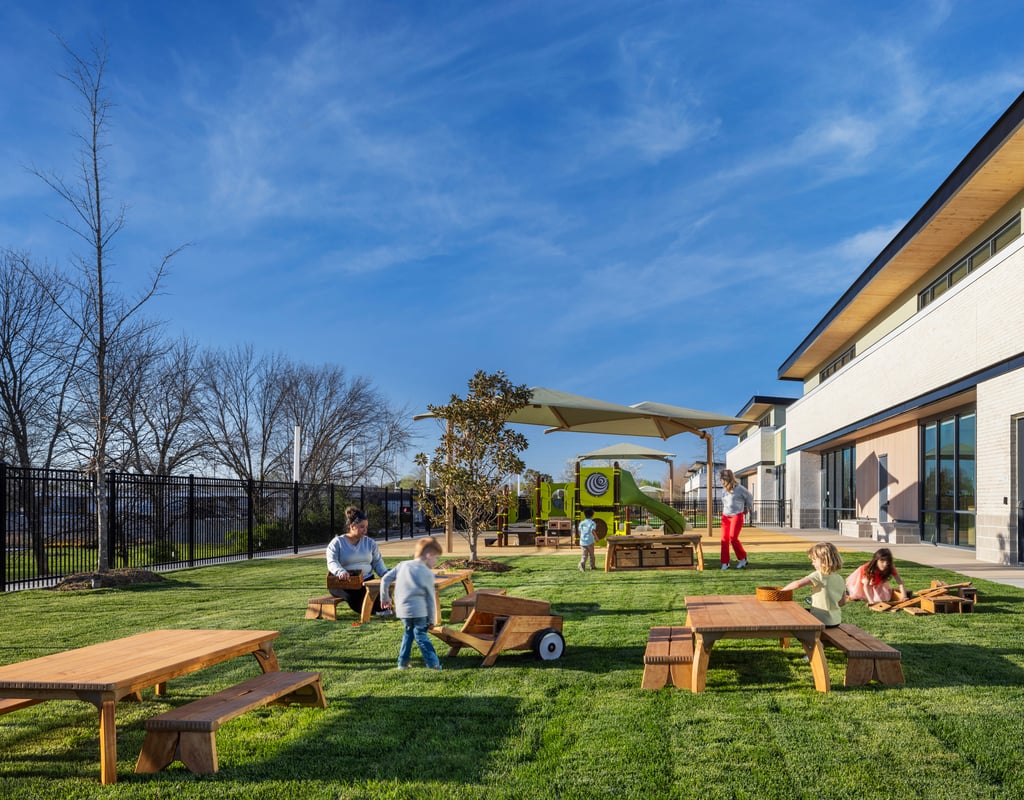
Supporting healthcare workers and their families with accessible, flexible childcare strengthens the workforce as much as any clinical investment. Photo/Jim Roof
Caring for the providers
Helping frontline staff take care of their family responsibilities—and to know that their children are safe and cared for—enables healthcare workers to show up for the rest of us.
“We are hearing from our hospital clients that nearby childcare is something they want to offer, not just as an employee perk but to support their central mission of patient care,” says Portia Ellis, Page studio design principal.
Indeed, many hospitals have come to the realization that to attract and retain workers, they need to offer support services such as childcare. “Childcare is an overlooked and underfunded essential service in our country,” Vanessa adds.
In one case where a healthcare system offered childcare, turnover dropped to 1.5 percent for workers4 who utilized the childcare center, the lowest amongst staff, compared to 18.3% turnover nationally.1
A case in point: Forbes' 2024 "America's Best Employers for Women" list features companies excelling in gender equality.5 The top seven healthcare systems on the list had on-site child care. Indeed, the top-ranked hospital had an on-site childcare center that served more than 300 children of its employees.
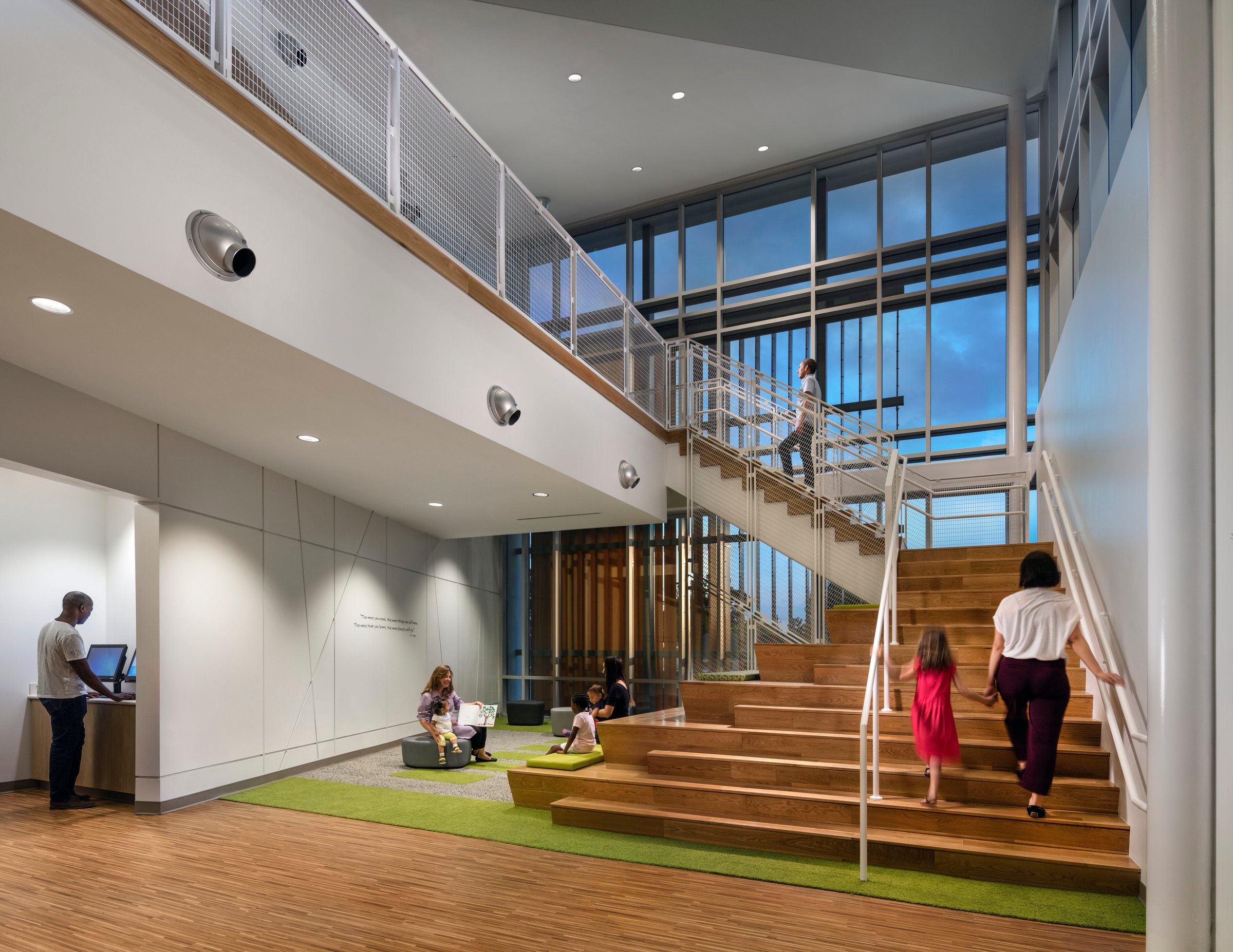
The Learning Academy features natural light and well-considered details, creating a welcoming environment for children and families of all ages. Photo/Jim Roof
Movement and creativity
Vanessa and Portia led the design of a childcare center for WellStar Health System, one of the largest hospital systems in Georgia. The Learning Academy at WellStar Kennestone Hospital in Marietta has 17 classrooms, support multipurpose spaces, and outdoor play areas. This is no mere coincidence; every design choice was intentionally crafted to enhance the emotional well-being of children and their parents.
Walking from a parking deck connected by a covered walkway, parents and children enter the center through a light-filled, two-story lobby. The space’s focal point is the “Reading Stair”—a platform for storytelling and communal activities.
“The building incorporates playful geometries and design elements,” says Vanessa. “If you drive around town, a lot of childcare centers tend to look like oversized homes. The design of this center is more dynamic. High ceilings and large windows provide natural daylight and connection to the outdoors.”
They used materials and palettes inspired by nature rather than primary colors, letting “the children and the art provide the color.” Classrooms are designed age-appropriately by year, with furniture, sink heights, and even toilets growing incrementally higher from toddlers to preschoolers.
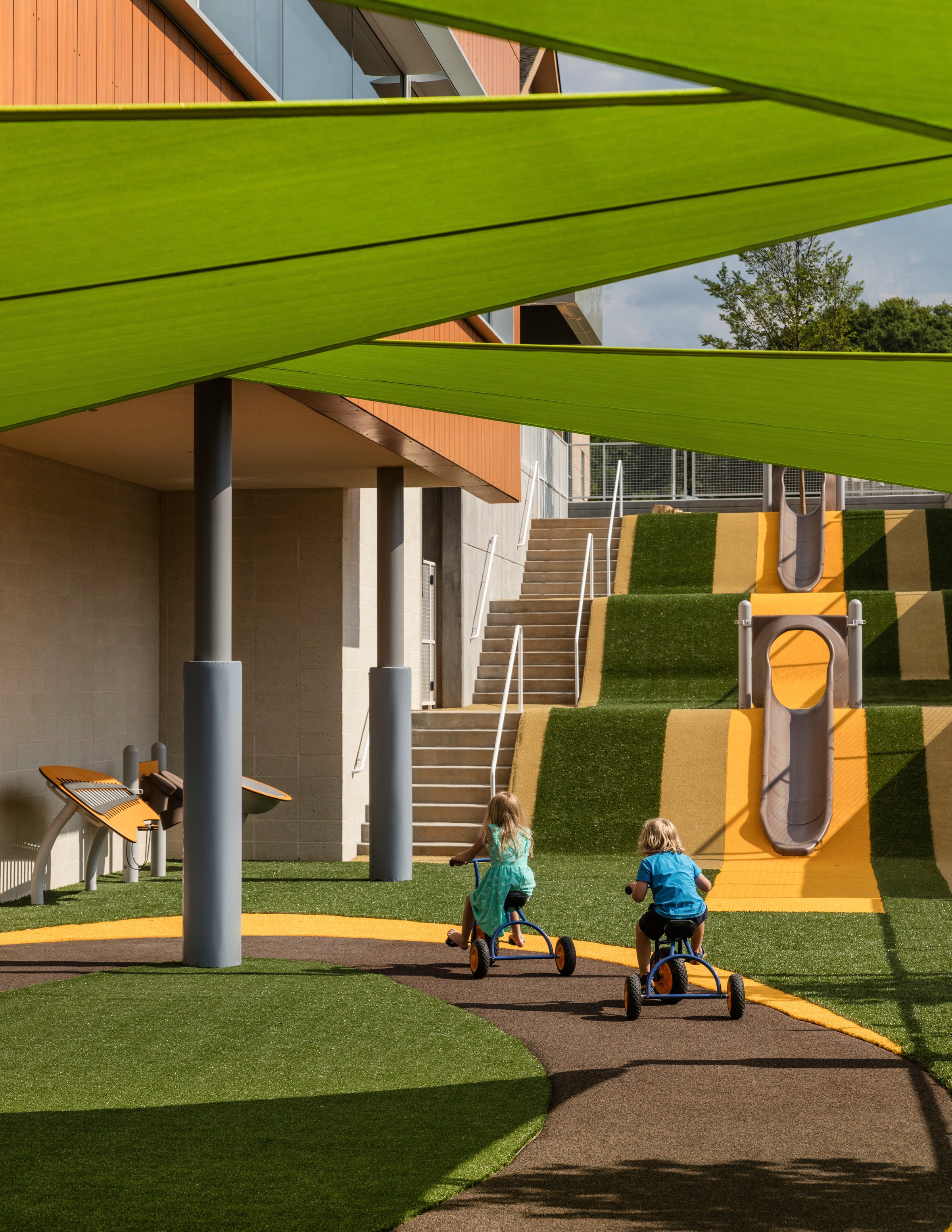
A terraced playground promotes movement and wellness, guiding children along joyful circulation paths. Photo/Jim Roof
Less clutter, more options
“I remember bringing my daughter to daycare when she was young, and I especially liked that there was flexibility in the rooms, so the teacher was able to keep things fun and recreate her classroom seasonally,” Portia says. “It let the kids be creative.”
Outside the center, a steeply sloped site gives the opportunity to terrace the playground and create playful ways to move between levels. “You can take the stairs, but the children – and even some adults – find it’s more fun to slide down,” says Vanessa.
Building adventurous choices into the environment was intentional, Portia adds: “Just getting from the upper playground to the lower playground becomes a journey, circulation and movement become play, and it all contributes to wellness.”
They even mimicked an outdoor setting inside the center, with pebble-patterned carpet and bright green turf, giving the feeling of outdoor play while providing an indoor play space during hot or inclement weather. Even inside, specific areas encourage movement, such as a ballet bar and an indoor climbing wall.
In a first for a childcare center in Georgia, WellStar requested that they design a small, restful space for children who are mildly ill, where they can be cared for by separate staff and don’t interact with the other children.
“We have a passion for designing nurturing environments so kids can simply focus on being kids,” Vanessa says. “Through thoughtful design, these spaces can foster socialization, creativity, and a love of learning—all while allowing their parents peace of mind while they work.”
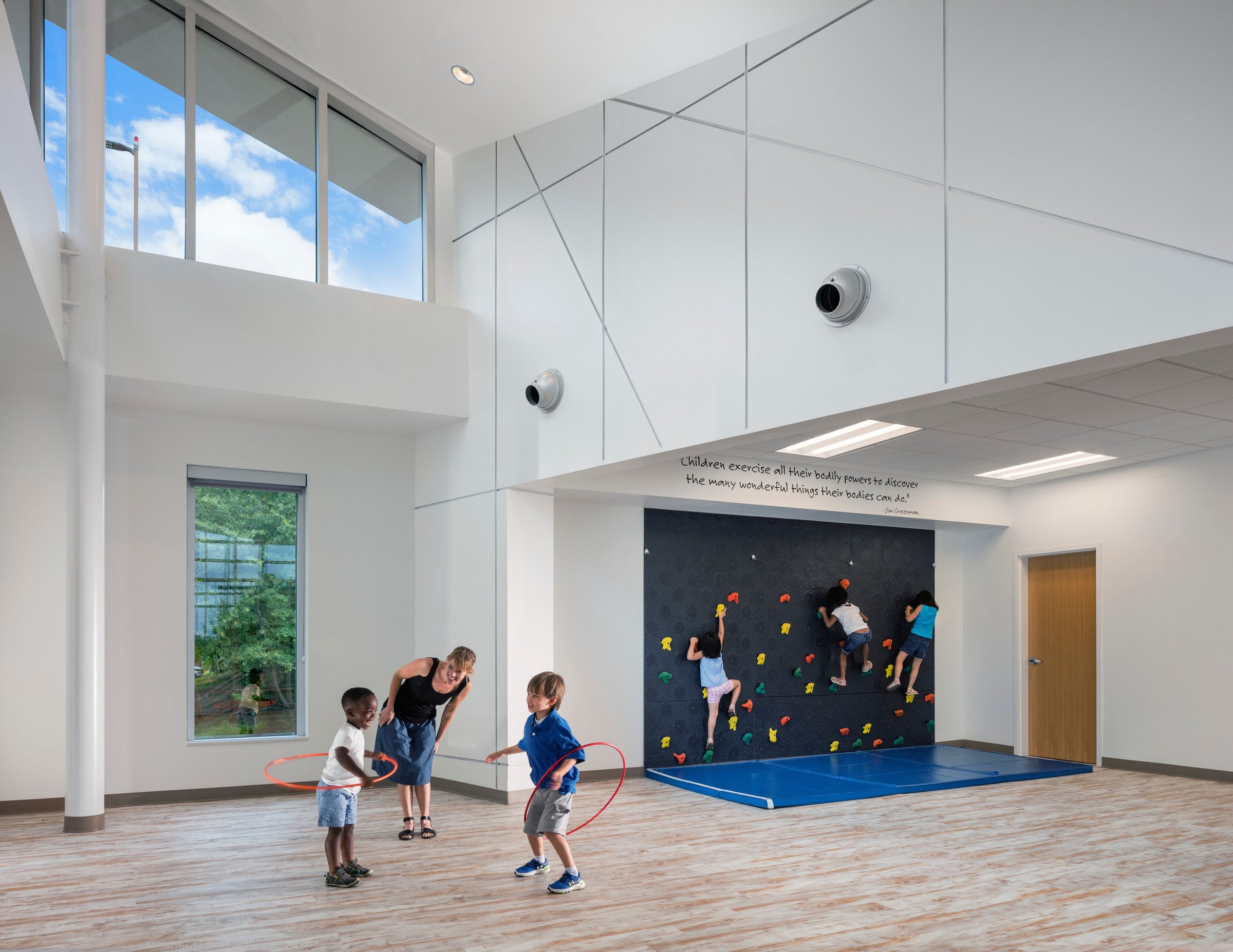
Flexible, open spaces encourage movement and activity, offering kids the ability to explore, learn, and play in a safe and stimulating environment. Photo/Jim Roof
An essential service for essential workers
As healthcare employers look for ways to support their caregivers, childcare design mirrors the ecosystem it serves. Caring for caregivers who have children provides a strong answer to the systemic issues healthcare faces. Person-centered care doesn’t always mean the patient is the one getting personalized care for better outcomes; sometimes it means the provider receives the same treatment, which benefits not only their own family but everyone involved in the healthcare system. In the next generation of childcare design, caring for staff could be the most powerful form of patient care.
References:
1.
Colosi, B. 2025 NSI National Health Care Retention & RN Staffing Report. (March 2025). NSI Nursing Solutions, Inc.
2.
Melhorn, SF. Understanding America’s Labor Shortage: The Impact of Scarce and Costly Childcare. (June 26, 2024). U.S. Chamber of Commerce.
3.
Braddock A, Malm-Buatsi E, Hicks S, Harris G, Alafaireet P. Healthcare workers' perceptions of on-site childcare. J Healthc Manag. 2023;68(1):56-67.
4.
Gale, R. More hospitals are offering child care. But they shouldn’t have to. (May 30, 2023). Stat News.
5.
Peachman, RB. America’s best employers for women. (July 30, 2025). Forbes.
Contributors

Vanessa combines her international business and marketing expertise with thoughtful, integrated design to deliver successful projects on schedule, within budget, and beyond expectations. Resourceful and diplomatic, Vanessa listens closely to clients and user groups to ensure their visions and operational goals are achieved. With a portfolio that spans healthcare, mixed-use, and adaptive reuse projects, and cultivating a passion for children’s spaces, her notable works include the award-winning Center for Advanced Pediatrics and The Arthur M. Blank Hospital, Georgia’s largest healthcare project.

Portia has worked on many pediatric hospitals, children’s clinics, and medical campuses in the past 30 years. She has learned that technology equates continually shifting medical practice and social habits. As medical organizations progress, this inevitable fluctuation has taught her to design for flexibility and strive for innovation.
More



Talk with us
Complex challenges need fresh perspectives and deep expertise. Connect with our team to explore how we can help you create spaces that make a real difference.