
by Robert McClure, Alison Ledwith, and Mo Elsayed
by Mo Elsayed, Jill Kurtz, and Justin Shultz

The Building Performance team at Page, now Stantec, launched a three-part series on overcoming a frustrating chokepoint in the design process. The first installment introduced its innovative AI-driven framework for quick energy modeling and explained its transformative impact on making building energy modeling (BEM) faster, smarter, and more performance-focused. The second installment explores further, showing how generative AI can help automate and speed up BEM, turning a once tedious task into a catalyst for real-time, performance-based decision-making.
For decades, the future of sustainable building design has depended on closing the gap between creativity and performance, but that gap has persisted–until now. Part one of this series explored how building energy modeling (BEM) has traditionally been a bottleneck in the design process.1 Architects aim to iterate quickly and test ideas for energy efficiency early, but conventional energy simulations are slow, complex, and labor-intensive.2 As a result, performance analysis often occurs late or not at all, missing opportunities for optimization. A game-changing solution has emerged: using generative AI as a creative partner to automate and accelerate energy modeling. The Building Sciences team from Page, now Stantec, created an AI-assisted framework that could instantly turn an architect’s sketch or description into a functional energy model, providing real-time feedback on energy use, carbon impact, and daylighting. This approach promises to shorten the feedback loop between design and performance, enabling rapid iteration without incurring time penalties.2 In short, it demonstrates how AI can transform energy modeling from a tedious bottleneck into a source of inspiration.
Before diving into the solution, a quick recap of why this innovation is so critical. Most buildings today do not benefit from early energy modeling at all. Over 80% of commercial buildings are small (less than 25,000 square feet), and the complexity and cost of BEM have been a big deterrent for those projects.3 When modeling is too slow or expensive, design teams often skip it, missing out on optimizations that could greatly improve efficiency. On larger projects, traditional workflows required specialist modelers and long turnaround times (sometimes hundreds of hours) by which point, the design might have already moved on. To make high-performance design the norm, not the exception, a faster, more accessible way to evaluate energy use during design is needed. Generative AI is the breakthrough that makes that possible.
To tackle this long-standing, ongoing issue, Page’s Building Sciences team sought to reimagine energy modeling by integrating it into the architect’s process, transforming it from a late-stage hurdle into a driver of performance. At its core is a large language model (LLM), an AI trained on building science knowledge that can translate an architect’s inputs, like a natural-language description of a building or of an image of a sketch, into energy simulation parameters. Simply put, the AI acts like a highly skilled translator or technician: describe a building concept (e.g., “a 10-story office tower with floor-to-ceiling glass, high-efficiency lighting, in Austin, TX”), and the AI can quickly generate a corresponding complete energy model behind the scenes.
This AI-driven process addresses the pain points of traditional methods in several ways:
“By simplifying and accelerating the modeling process, this approach fosters broader accessibility, enables greater participation from users with varying levels of experience, and ensures more precise, real-time analysis during early design phases.”Page's Building Performance teamMo Elsayed, Jill Kurtz, and Justin Shultz
An AI-assisted energy modeling session begins with either a simple prompt from the architect, such as a text description (“a five-story, 50,000 sq ft office in Dallas with floor-to-ceiling glazing and VRF HVAC”) or a rough sketch or 3D massing. This input is high-level and accessible.
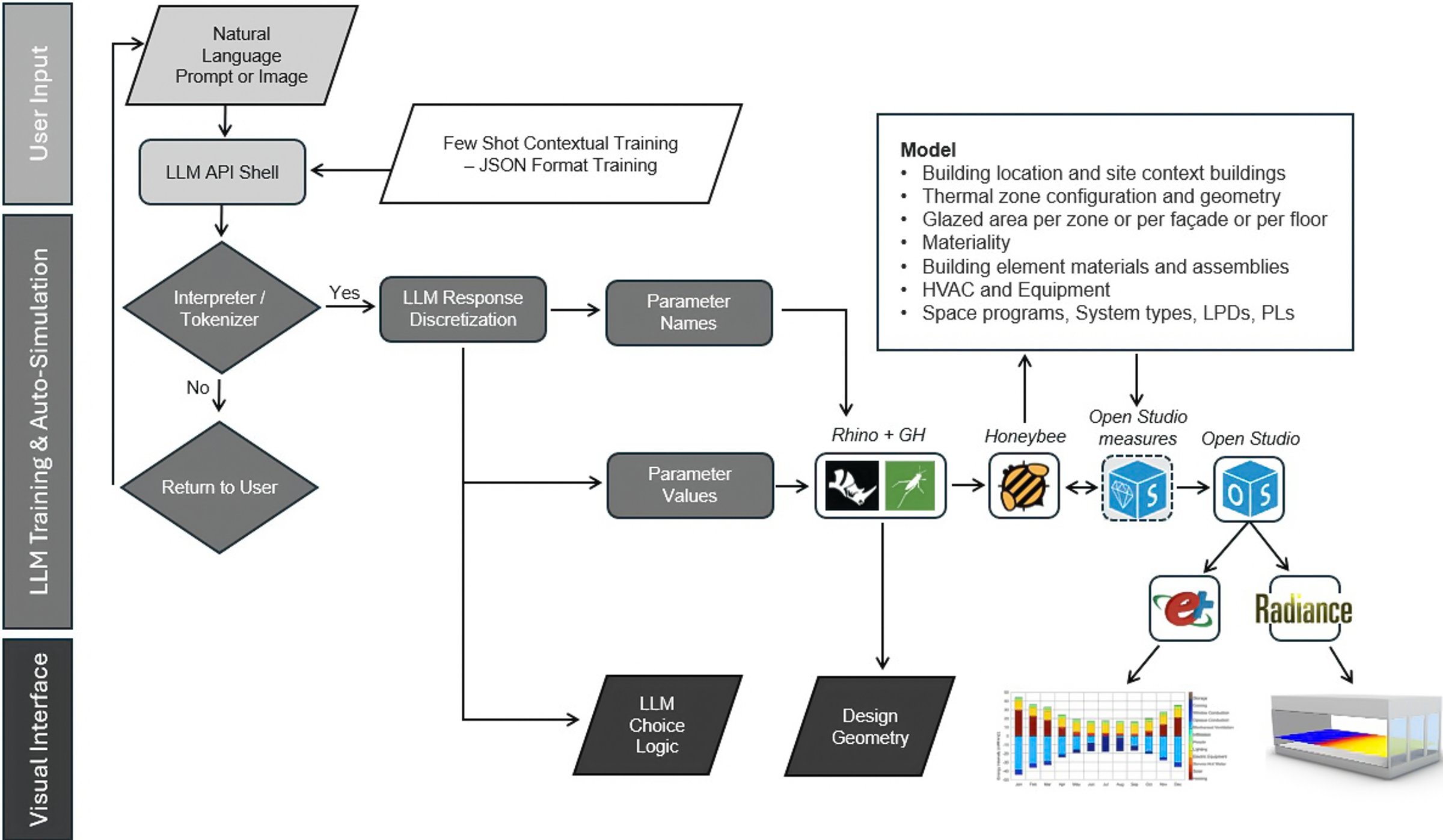
The flow of Page's AI-driven energy modeling involves natural language inputs and images, automated simulations, integration of design geometry, performance parameters, and real-time data feedback.2
AI interprets the prompt, identifying key parameters such as location, building size, number of stories, and system types. It fills in missing information using standard assumptions based on building codes and climate data. The result is a complete and simulation-ready description of the building. Using this structured data, the AI writes EnergyPlus input files for energy modeling and Radiance files for daylight analysis. These outputs are also presented in natural language, ensuring transparency and human readability in seconds.
Once the model is generated, simulations run automatically via APIs, either locally or in the cloud. Designers do not need to interact directly with simulation engines. Within minutes, outputs such as annual energy use and daylight metrics are available. This performance data is visualized in user-friendly dashboards or overlays within the design environment. The rapid feedback loop encourages immediate design iteration. For example, if a design exceeds its energy target, the architect can adjust the glazing or orientation and prompt the AI again. Multiple variations can be explored in a single session.
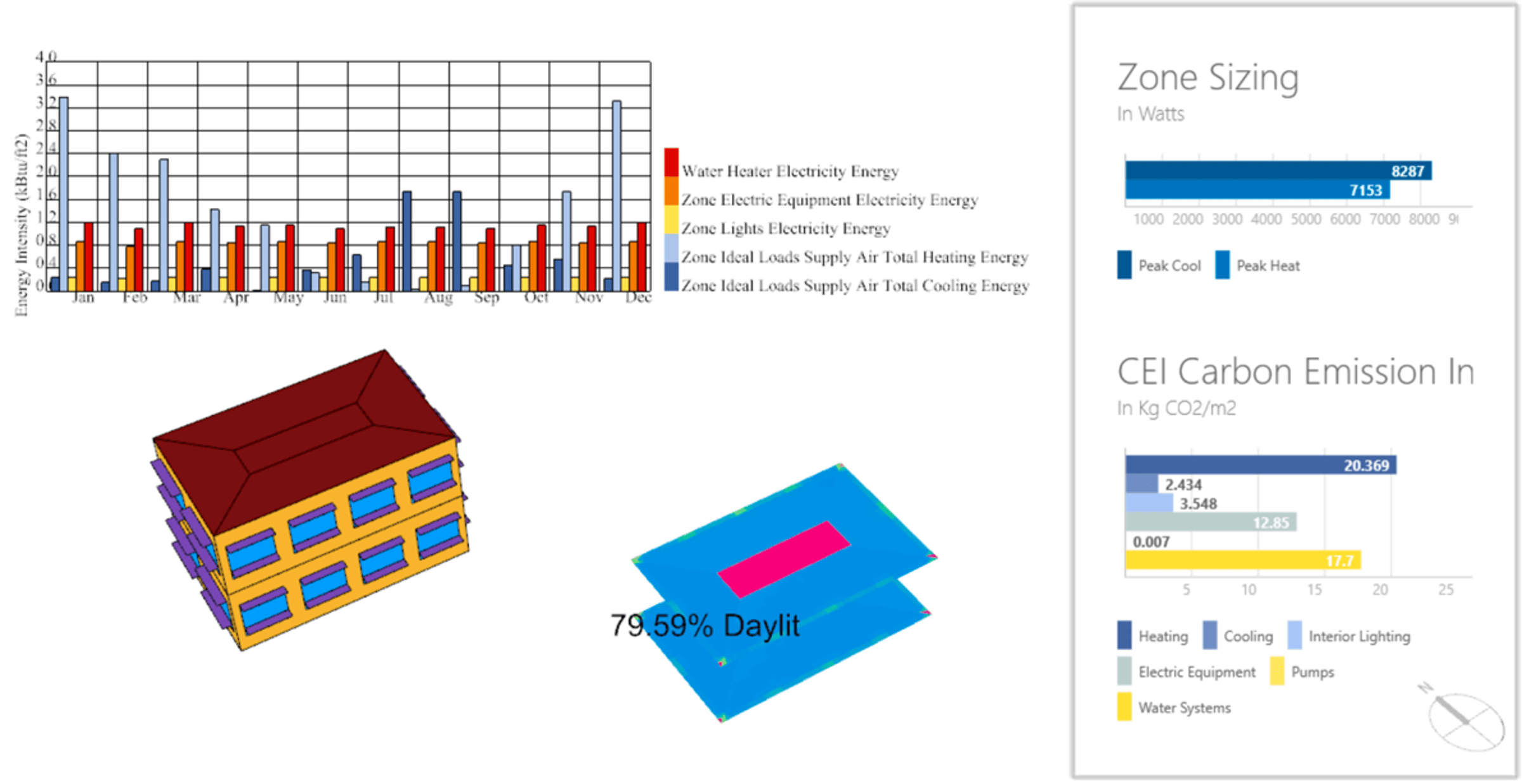
A sample output from the generative AI building energy modeling tool, demonstrating energy intensity, daylighting, zone sizing, and carbon emissions to inform performance-driven decisions designs.2
This workflow drastically reduces turnaround time, promotes experimentation, and improves consistency by generating models from the same knowledge base, reducing variability between modelers and minimizing errors. Assumptions are applied uniformly, making comparisons between options more reliable. AI enables scalability, generating and simulating multiple design alternatives, building portfolios or districts, supporting urban analysis and policy development. This automation democratizes energy analysis, embedding results in the design process and making them accessible to all stakeholders. Engineers, architects, and owners can evaluate options collaboratively, aligned around performance from the start.
With the bottleneck of slow modeling removed, a new era is emerging where every project can be a high-performance project by default. Tools like generative AI make sustainability a natural, automatic part of design, rather than a specialty service. At Page, the goal is that for any design—big or small—to be quickly evaluated for energy, carbon, daylight, and more, using those insights to improve the outcome. When every decision is performance-based, the industry can avoid missteps like oversized mechanical systems or a glare-filled glass façade, before they happen. This shift makes performance simulation an invisible guide, not an extra step. The end result is not just faster design iteration, but better buildings; buildings that meet stringent energy and carbon goals without endless back-and-forth or guesswork.
“Automating energy modeling with AI isn’t about replacing humans; it’s about removing friction. It allows design teams to pursue performance-driven design on every project, no matter the size or deadline, thereby mainstreaming sustainability.”Page Building Sciences teamMo Elsayed, Jill Kurtz, and Justin Shultz
Yu, C., Pan, W., Zhao, Y., & Li, Y. Challenges for modeling energy use in high-rise office buildings in Hong Kong. Procedia Engineering. 2015;121:513-520.
ElSayed, M., Shultz, J., Kurtz, J. User-friendly AI-driven automation for rapid building energy model generation. Energy and Buildings. 2025;345:116092.
Andrews, G., et al. Simplified Performance Rating Method. In Proceedings of the 2024 ACEEE Summer Study on Energy Efficiency in Buildings (p. 126-134). American Council for an Energy-Efficient Economy (ACEEE).

Mo integrates emerging technologies into sustainable building practices, focusing on energy efficiency, decarbonization, and net-zero strategies. Mo specializes in integrating AI and machine learning into sustainable building practices, energy efficiency, daylight, decarbonization, and net-zero strategies. With a Ph.D. in Engineering from McMaster University, his work spans autonomous systems, drones, optimization, CFD, Carbon impact, digital twins, robotics, and fabrication, bridging the gap between research and industry. His work spans high-profile projects across the USA, Canada, and the Middle East.

Jill 's mantra is “intention requires rigor,” an apt phrase for someone committed to leading Page's efforts to embed sustainability into every project. Leveraging her strengths as a systems thinker and ability to work across disciplines, Jill combines 20 years of sustainable design experience and a client-centric mindset to her leadership of Page’s Building Science practice. The creator of Page's "Design for Impact" framework, Jill has led our firm-wide strategy on environmental and social responsibility, defined our project best practices, and helped design teams realize meaningful value and measurable impact towards their sustainability goals.

Justin has a passion for problem-solving. Working alongside his design colleagues, Justin uses computational analysis to answer our most pressing sustainable design questions. In his role, he partners with clients and design teams to set bold sustainability goals and map out clear, effective strategies to achieve them. He provides performance-based recommendations through climate, building energy, building envelope, daylighting, computational fluid dynamics analyses, and more. With a Ph.D. in Arch. Sci. and a certificate in Building Energy Modeling, understanding complex problems and providing simple solutions has defined Justin’s career.
More
by Robert McClure, Alison Ledwith, and Mo Elsayed


Complex challenges need fresh perspectives and deep expertise. Connect with our team to explore how we can help you create spaces that make a real difference.