
Feature
July 11, 2025
The real cost of inclusion: Why universal design pays off
by Jennifer Wegner with Chad Johnson and Todd Ray

Listen to this story
AI powered reader
/
Spaces designed to meet the needs of every user, regardless of age, size, or ability, are more than just acts of goodwill; they are strategic investments. Universal design not only controls costs and minimizes risks but also creates inclusive, innovative environments that benefit everyone. By integrating accessibility from the start, this approach eliminates costly retrofits like ramps or elevators, future-proofing buildings, and upholding dignity and independence for all. While some may question the upfront costs of inclusion, the long-term benefits clearly outweigh the initial investment, making universal design a smart, forward-thinking choice.
The ADA National Network reports that adding inclusive features during construction increases project costs by less than one percent.1 Additional studies show that retrofitting those same features later could increase project costs anywhere from two percent to 20 percent.2 With more than one in four Americans living with a disability, the question is no longer whether universal design is worth it, but whether any project can afford to ignore it.3
Upfront vs. retrofit: The cost comparison
This past spring, the Page Foundation hosted its symposium, UniversALL, at Indeed Tower in Austin, Texas. Architects and policymakers convened to explore the complex financial landscape of inclusive design, exchanging innovative ideas and practical solutions to overcome shared challenges. Archer Archer, a wheelchair user and former member of the Texas Governor’s Committee on People with Disabilities, put it plainly: “Everyone will become disabled at some time.” Chris Hinds, Denver’s first elected official who uses a wheelchair, added, “Accessibility design has to make sense monetarily.”
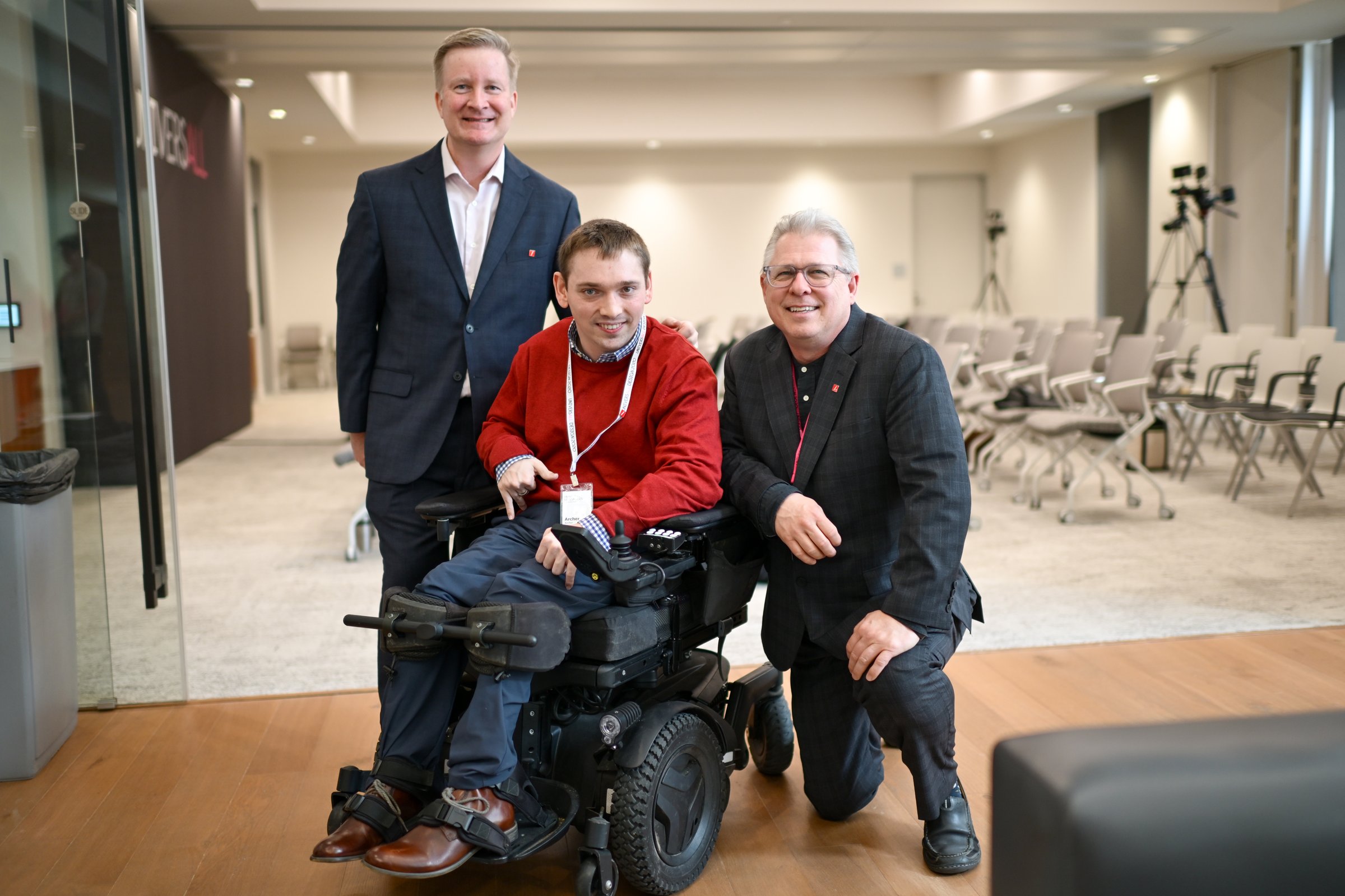
Chad Johnson (left) and Todd Ray (right), principals at Page, with disability advocate Archer Archer (center) at the Page Foundation’s UniversALL symposium in Austin, Texas. Photo/Page
Universal design principles such as curbless entries, wider circulation pathways, sensory-friendly lighting, and adaptable infrastructure are essential. They are not just theoretical constructs but practical solutions that enhance accessibility and inclusivity for everyone. At Rosedale School in Austin, Texas, Page integrated inclusive design elements throughout the campus to support students with diverse physical and cognitive disabilities. These features include ultra-accessible spatial transitions, multi-sensory wayfinding, specialized sensory rooms, nature-inspired conversation nooks, enhanced acoustics, optimized daylighting, and views to nature. These design elements foster a calm, inclusive, and empowering environment tailored to a broad spectrum of needs.
When inclusion isn’t planned early, upgrades can mean cutting into finished walls, rerouting systems, and navigating difficult code reviews. “Retrofitting is like opening Pandora’s box,” said Archer. “To fix one component, you end up redoing everything that connects to it.” The Rick Hansen Foundation’s 2023 study supports this: even modest retrofits can cost hundreds of thousands of dollars, while proactive planning reduces those costs to pennies per square foot.4
Risk mitigation through inclusion
Accessibility shortfalls can carry legal and financial consequences. Texas ranked among the top three states for ADA Title III lawsuits in 2022, many stemming from buildings that technically met code but failed in day-to-day usability.5 “If you run a business, I’d ask: Do you like money?” Archer said. “Because you’re losing it by not serving an entire population.”
Beyond compliance, inclusive spaces perform better.6 Accessible retail environments report higher customer dwell times.7 Offices that consider mobility, neurodivergence, and aging needs often see stronger staff retention and higher morale.8
Breaking the “too expensive” myth
Designing for inclusion doesn’t have to break the bank. Dr. Kristi Gaines, a professor and researcher focused on autism-friendly environments, noted that “sensory-friendly features can be implemented on a small budget using natural and recycled materials.” Budget-conscious strategies include biophilic design for stress reduction, tactile cues like textured walls for intuitive wayfinding, and modular layouts that evolve with programmatic needs.
Chris Downey, president of Architecture for the Blind, emphasized that cost-effectiveness is rooted in early planning: “Many things can be done and provided through smart universal design that, when incorporated from the beginning, will have negligible if any cost implications, while others may have notable impacts yet deliver market differentiation.”
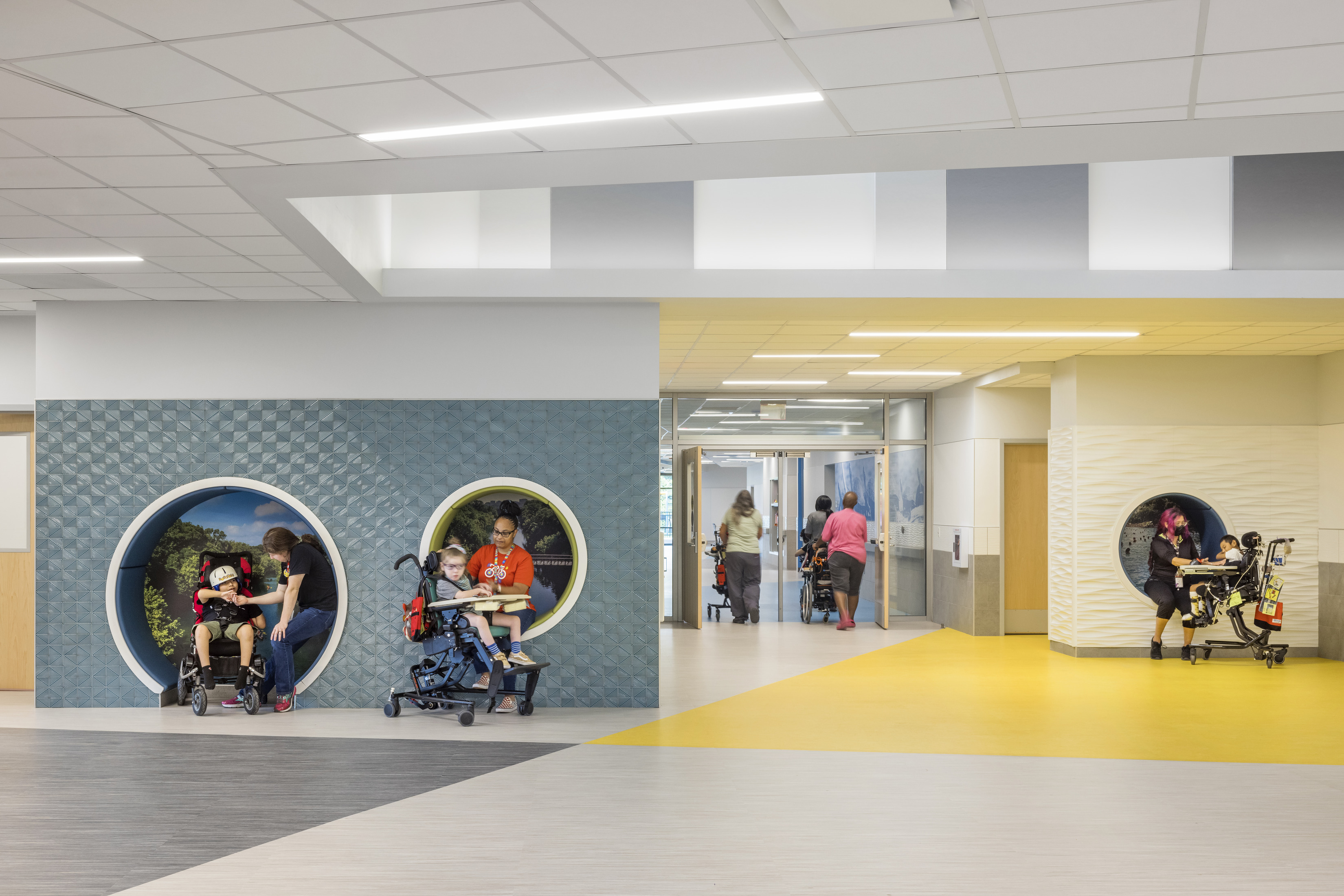
Rosedale School's design incorporates principles of universal design, including flat transitions for seamless mobility and color-coded learning neighborhoods that support orientation, autonomy, and inclusive engagement for students of all abilities. Photo by Albert Vecerka/Esto
Proof in practice
Rosedale School, Austin, Texas
- Flat curbs, no stairs, and color-coded “learning neighborhoods” enable student independence. Teachers report faster transitions and fewer behavioral incidents, saving time and improving classroom culture.
Page’s Office at Indeed Tower, Austin, Texas
- Adjustable-height desks, varied meeting room sizes, and kitchens with multiple counter heights accommodate a wide range of employee needs. Staff cite these features as key to comfort, productivity, and collaboration.
Morgan’s Wonderland, San Antonio, Texas
- As the world’s first ultra-accessible theme park, Morgan’s goes “above ADA,” says Chelsea Seal of Morgan’s Inclusion Institute. “The ADA is our starting point, not our finish line.” More than 3 million people from 120-plus countries have visited, proving that inclusion is a global draw.
Policy momentum and market advantage
Government initiatives are catching up. The proposed Universal Design Standard Tax Incentive Act (H.R. 8547) would offer refundable credits to projects that meet universal design standards. In Texas, advocates like Yulissa Chávez, a fellow at the Coalition of Texans with Disabilities, are pushing for small-business accessibility grants drawn from the state’s $185 billion surplus. “Universal design has proven to improve productivity, expand the market, and save money in the long run,” she says.
Designing for everyone pays off
Universal design isn’t just the ethical choice, it’s the practical and fiscally conservative one. It keeps upfront costs in check, prevents expensive retrofits, reduces legal exposure, and most importantly, creates places that people genuinely want to use. The data is here: build inclusively now or pay more later.
References:
1.
Is it expensive to make all newly constructed places of public accommodation and commercial facilities accessible? (2025). ADA National Network.
2.
Ielegems, E., Vanrie, J. The cost of universal design for public buildings: exploring a realistic, context-dependent research approach. Archnet-IJAR. 2024;18(4):719-736.
3.
Disability Impacts All of Us. (2024). Centers for Disease Control and Prevention.
4.
RHFAC Retrofits and Upgrades Cost Study. (2024.) Rick Hansen Foundation.
5.
Top 10 States for Federal ADA Title III Lawsuits. (2022.) Seyfarth Shaw LLP.
6.
Fuglerud, K. S., Halbach, T., & Tjøstheim, I. (2015). Cost-benefit analysis of universal design (NR Report 1032). Norsk Regnesentral.
7.
Klaus, P., et al. Inclusive servicescapes: the imperative of universal design principles. Journal of Services Marketing. 2024;38(8):1089-1098.
8.
Milchus, K., et al. The impact of equitable design on workplace outcomes. (2020). RESNA Annual Conference.
More

by Jill Kurtz and Tully Mahoney


Talk with us
Complex challenges need fresh perspectives and deep expertise. Connect with our team to explore how we can help you create spaces that make a real difference.