
Feature
May 7, 2025
Rethinking value: How prefabrication accelerated delivery and elevated quality at Nexus Health’s Multispecialty Clinic
by Robert Doane and Lisa Kincaid
Listen to this story
AI powered reader
/
In an evolving economic landscape, overall project cost is an important metric when managing a large construction project. Target Value Delivery can be essential in managing first costs during construction, and prefabrication can prove to be highly beneficial to the overall project delivery process. But cost is not the only marker of success. Speed to market has become equally essential, especially when time-sensitive healthcare services are involved. In Page’s work on the Nexus Health Multispecialty Clinic in Santa Fe, New Mexico, the firm’s use of prefabricated exterior wall panels yielded many benefits, such as significantly advancing the project’s timeline, improving quality control, and minimizing risk within a reduced labor market.
The 95,000 square-foot building, a comprehensive cancer center and multispecialty outpatient clinic, offers a wide range of services, including dermatology, medical and radiation oncology, orthopedics, imaging, lab, pharmacy, and infusion therapy. A key goal was to deliver this vital health care center in a timely manner to the growing population of northern New Mexico and the surrounding region.
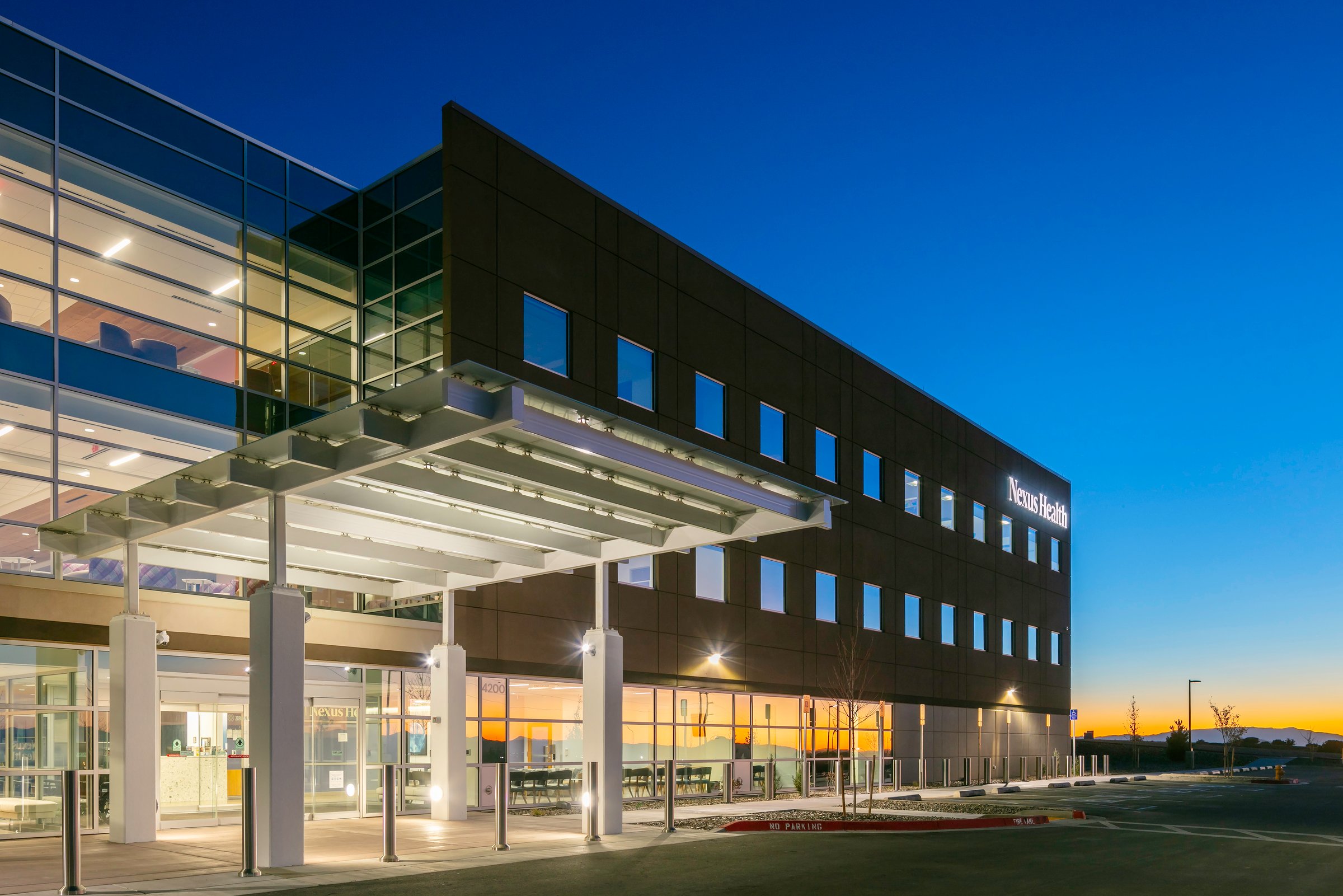
Exterior panel installation for Nexus Health in Santa Fe, New Mexico, was completed in four weeks. Photo/Patrick Coulie.
Speed-to-market as a competitive edge: Winters are cold in Santa Fe, so completing the building exterior before the onset of frigid temperatures allowed the project to get ahead of schedule. “Regardless of the season, the sooner we can get a building enclosed, the faster we can start installing the interior finishes,” says Lisa Kincaid, a Senior Project Architect and Associate Principal at Page, located in the Dallas office.
“Casework and floor finishes can be put in place without any worry about degradation from weather or high humidity.”
In this case, because the prefabricated exterior skin could be erected faster than other types of wall enclosures, the interior schedule was accelerated, which enhanced the center’s speed to market. Construction goes much more quickly utilizing this process, and at Nexus, it took about four weeks to erect the center’s entire skin assembly, saving several weeks of construction time while enhancing the quality control process as well.
In addition, the compressed schedule reduced contractor costs such as utilities and labor. Given that this was a cost-plus construction contract—in which the contractor is reimbursed for all project costs plus a fee to cover profit and overhead—the savings were reflected back to the owner.
Labor strategy through innovation: “Santa Fe is not a burgeoning construction market, so the city’s construction labor force typically comes from Albuquerque, about 60 miles away, or travels to job sites from other locations,” says Robert Doane, a Principal and Healthcare Director at Page with 40-plus years of experience in healthcare delivery. Specifying prefabricated wall panels for this project allowed the panel manufacturer, Digital Building Components, to build in a controlled environment in Phoenix, Arizona, reducing the need for hard-to-find workers. “By finishing the panel installation in four weeks, we had a very specific erection crew on site for a limited time,” Doane adds.
Controlled quality, reduced risk: In addition to solving a thorny labor problem, the fact that Page specified panels manufactured offsite in a controlled environment improved quality, ensured consistency, and limited onsite failures. Among other things, this strategy improves quality control. Just imagine: instead of workers assembling building components outside while on scaffolding three stories high, they do their jobs on an assembly line in a climate-controlled environment.
In the factory, each person repeats the same task on every panel, with quality inspections and back checking occurring before assemblies go out the door. “That makes a big difference in the uniformity of the panels,” says Doane. “In addition, once they arrive on site, the panels fit as designed and the building envelope can be constructed more rapidly.”
A regional response through modern technology: When building in Santa Fe, architects adhere to a planning and zoning code meant to ensure that buildings complement the city’s unique Pueblo-Spanish and Territorial architectural styles. Page met those requirements with an adobe-like material that respects Santa Fe’s architectural heritage while using contemporary building technology.
Known as Exterior Insulating and Finish Systems (EIFS), this exterior skin system mimics the aesthetic of the region. In this case, the outer surface material, sometimes referred to as synthetic stucco, is an earth tone that blends with the context. EIFS is known to offer several benefits, ranging from durability to maintenance. But energy efficiency is a key attribute because it provides three-and-a-half inches of insulation on the building exterior.
Collaborating for better outcomes: In a scenario where a key component of the building is fabricated miles away and trucked to the construction site, close coordination among the team members is critical. At Nexus Health Multispecialty Clinic, that teamwork relied on getting the owner, the developer (Meridian), the contractor (Skiles Group), and Page’s design team aligned early. “That helped us choose the panel fabricator and begin to tailor our construction documents to meet their constraints,” says Kincaid.
Early collaboration set the stage for how Page completed its drawings and specs with a clear understanding of what it takes to load a panel on a truck and transport it—and do so in a way that the design team could accurately control the alignments and joints on the building surface. In the end, having consensus among all parties—plus Digital Building Components, the wall system manufacturer—resulted in a successful outcome.
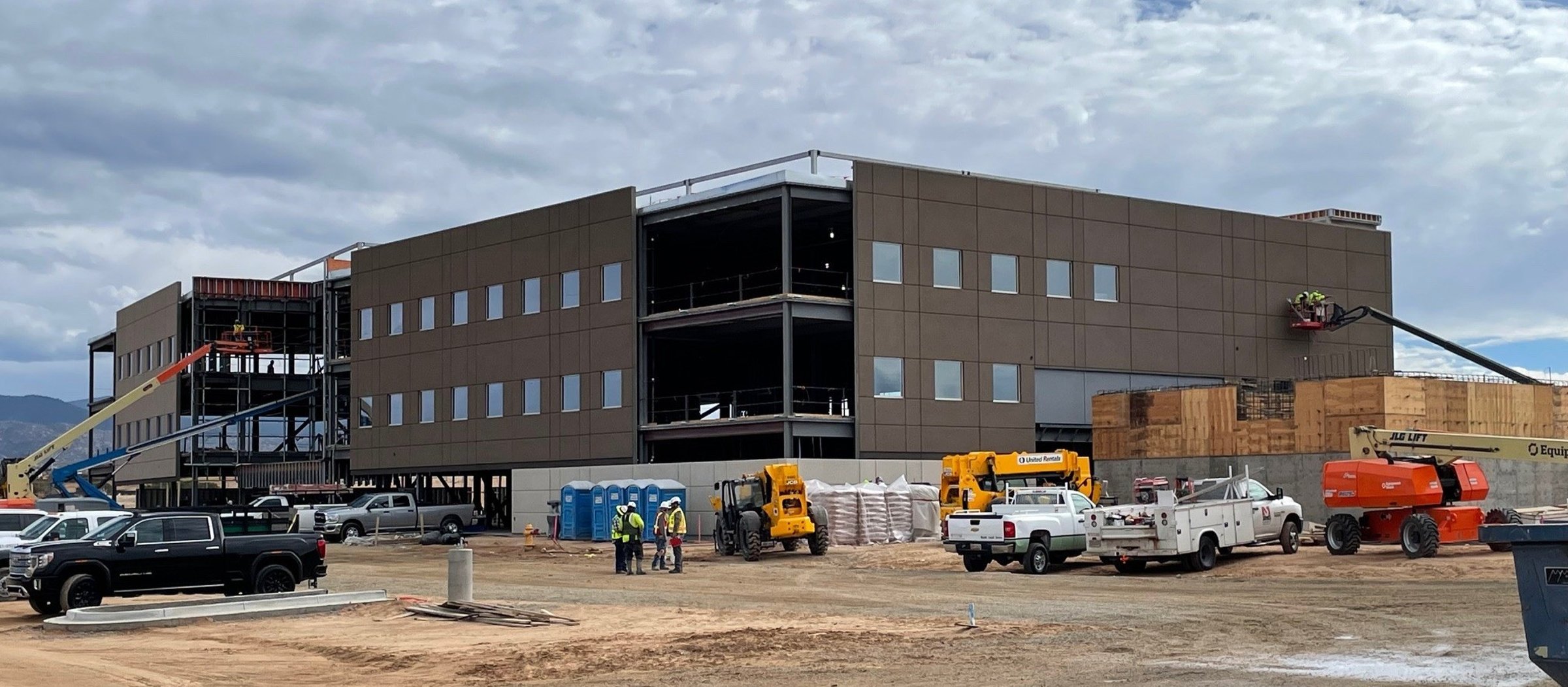
The earth-toned prefabricated exterior panels echo New Mexico’s traditional adobe architecture, blending modern construction with regional character. Photo/Page.
A design choice with many options: Whether to choose a prefabricated exterior envelope solution is one of the questions the Page team asks at the outset of schematic design on every project. “Once we get an initial sense of the look and feel of a building, we like to sit down with our owner and contractor to explore that question,” Doane says. “This is a great way to put a building together.”
There are many alternatives to prefabricated panels for envelope development beyond the EIFS solution Page used on this project. A metal panel system is ideal, as are many rain-screen product assemblies, but other possibilities include a brick veneer or glass curtain wall assembly. Whatever route is taken, Page encourages developers, clients, and contractors to consider value metrics such as schedule certainty, risk reduction, and labor adaptability when evaluating prefabrication’s potential.
Contributors

As a national practice leader and project director, Robert works with healthcare providers in leading complex teams to achieve successful project solutions in an efficient and effective manner. He is highly skilled at promoting team collaboration through LEAN project delivery and dynamic listening to achieve positive outcomes for each project. With more than 40 years of experience in healthcare design delivery, Robert has delivered patient-focused design solutions customized to each client that excite the senses and define place for the communities in which they serve.
More

by Alireza Sedghikhanshir and Raffaella Montelli

by Vanessa Lampe Heimbuch and Portia Ellis as interviewed by Mary Loftus

Talk with us
Complex challenges need fresh perspectives and deep expertise. Connect with our team to explore how we can help you create spaces that make a real difference.