
by Robert McClure, Alison Ledwith, and Mo Elsayed

For decades, the same visible markers have measured sustainability in architecture and construction: a roof covered in solar panels, a LEED certification plaque, or a net-zero announcement in a press release. Those signals are essential but obscure a more profound truth that the most transformative opportunities to cut carbon and costs often sit in the shadows, overlooked because they aren’t as glamorous or easily communicated.
In my work with universities and institutional clients, I’ve seen firsthand how those blind spots play out. Leadership teams set ambitious 2030 or 2050 carbon neutrality goals, only to collide with the complex realities of outdated infrastructure, limited budgets, and operational constraints. The typical response is to focus on what’s familiar. Yet the projects that achieve real breakthroughs tend to dig deeper, challenging assumptions about what matters most.
Four overlooked trends stand out. In these areas, clients often hesitate or dismiss the effort, only to discover that the impact is far greater than expected. Together, they show how the next chapter of sustainability will be written not by what we already celebrate but by what we’ve been ignoring.
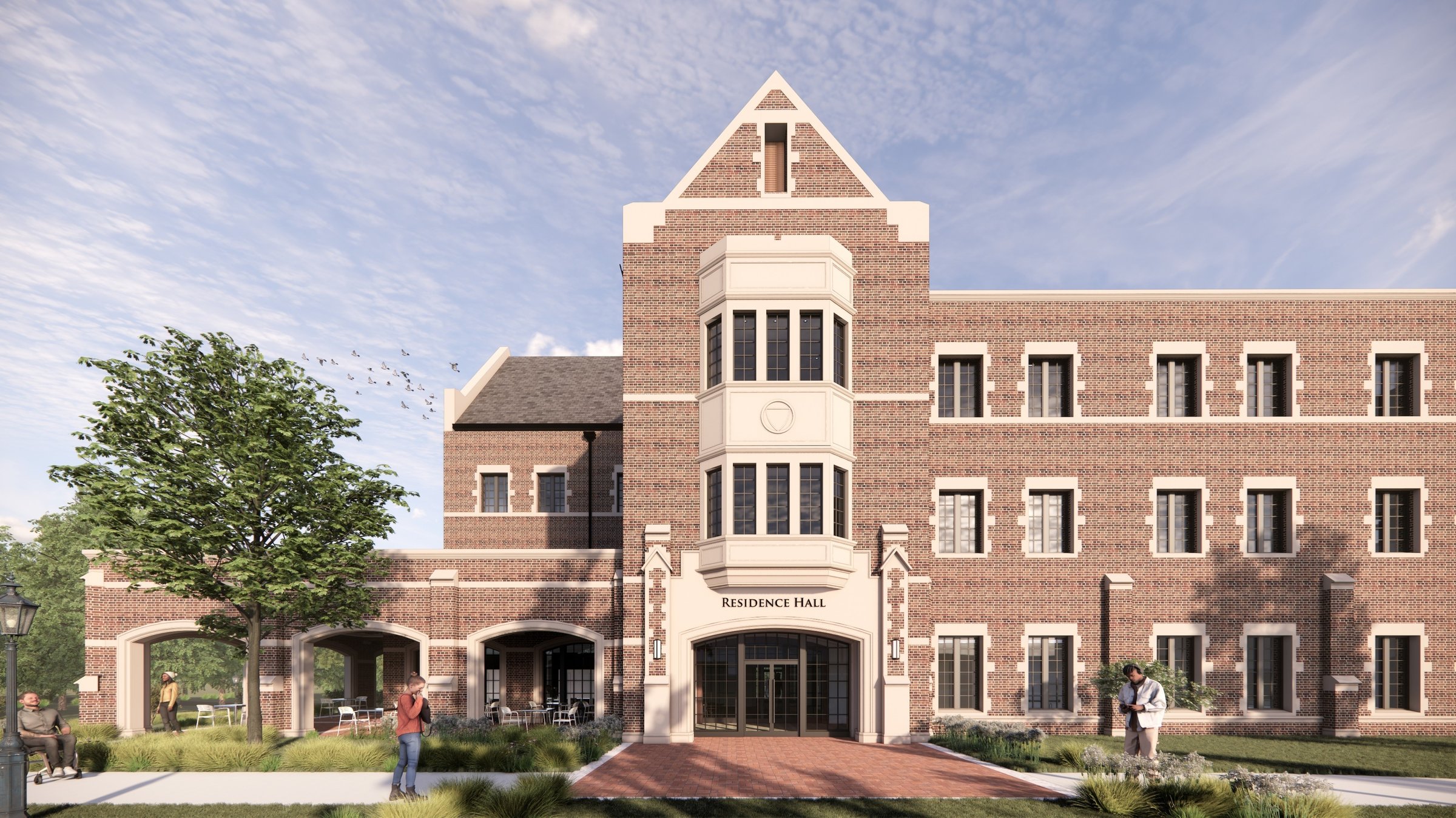
Designed to advance Catawba College’s commitment to sustainability, the new residence hall applies data-driven strategies to reduce energy use and environmental impacts, supporting a campus-wide vision for long-term performance and stewardship. Rendering courtesy of Page, now Stantec.
On-site solar has a hidden advantage that is most underestimated. Enerdynamics1 reports that utilities lose significant amounts of energy during generation and transmission, sometimes more than 60 percent, before it reaches consumers, requiring them to produce far more electricity than customers actually use.
The U.S. Environmental Protection Agency’s eGRID data2 shows that energy lost in the power grid corresponds to real emissions. To put it simply, emissions originate from primary sources. First, fuels are burned directly on-site, like natural gas for heating. Second, there’s the electricity a building buys from the grid, including the losses as power travels through transmission lines. Finally, indirect emissions are tied to everything that supports a building, such as the production and transport of construction materials, furniture, and other goods in the supply chain.
On-site generation prevents those losses, meaning a kilowatt-hour produced on your roof displaces more than one unit of energy burned upstream. This turns local solar into a high-leverage investment and positions the building as a grid partner, not just a user.
For clients, that perspective shifts the equation. Solar is no longer just a symbolic statement about renewable energy; it’s a strategy for increasing carbon reductions while reducing long-term exposure to volatile utility costs. Universities have adopted this approach to enhance resilience during peak demand or extreme weather events.
The lesson is that solar isn’t simply about energy; it’s about building independence, resilience, and leverage in the face of unpredictable energy grids.
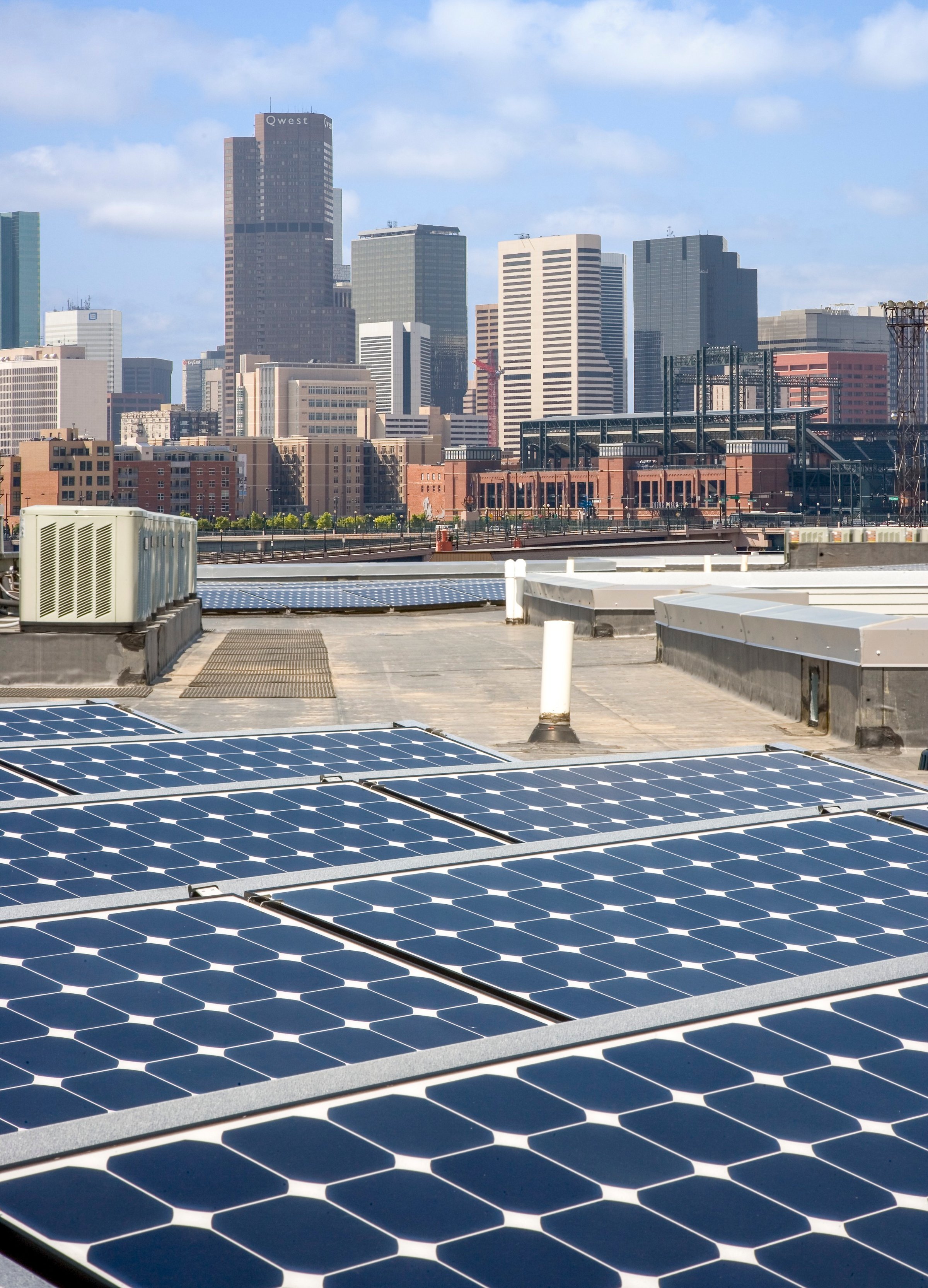
Rooftop solar panels at Renaissance Riverfront Lofts support the Colorado Coalition for the Homeless’s first affordable housing project to integrate sustainable design—combining energy efficiency, water conservation, and environmentally responsible materials in downtown Denver. Photo by Frank Ooms Photography
We tend to think embodied carbon, which is the total amount of greenhouse gases emitted throughout the entire lifecycle of a material or product, resides in concrete or finishes. Still, mechanical, electrical, and plumbing (MEP) systems often carry significant weight. RESET’s 2023 data3 shows that including MEP systems in office interiors increases embodied carbon by about 30 percent, underscoring how much these systems contribute to a project’s footprint. A 2023 white paper by the Sustainable Buildings Task Force4 goes further, estimating that MEP systems can account for as much as 70 percent of embodied carbon in retrofit projects.
For years, conversations about embodied carbon focused on steel and concrete because those categories were easiest to measure. However, as industry begins to recognize the scale of emissions tied to equipment and building services, clients now have a new opportunity to ask for transparency from their equipment providers. The MEP 2040 initiative encourages this, urging full life-cycle carbon accounting for HVAC, ductwork, and systems that often stay invisible in sustainability reports.
Owners who begin requesting Environmental Product Declarations (EPDs) or greater carbon transparency today can influence the market well before regulations mandate these disclosures. While individual requests may appear incremental, their collective impact can drive meaningful change, similar to how early LEED requirements prompted flooring and paint manufacturers to disclose volatile organic compounds (VOCs) and broader environmental impact data. Across multiple large-scale data center projects, whole-life carbon accounting has been employed to assess the carbon footprint of building materials and systems throughout their entire lifespan. This analysis has shown that certain infrastructure components, such as backup power systems, can represent a disproportionately high share of embodied carbon, highlighting clear opportunities for future reductions through design decisions and system selection informed by lifecycle and embodied carbon analysis.
Furniture, fixtures, and equipment (FF&E) are often underestimated in sustainability discussions. When the embodied carbon of FF&E is analyzed at scale, even seemingly minor items, such as desk chairs, can collectively represent a significant source of emissions. Accounting for materials, manufacturing, transportation, use, and end-of-life reveals how procurement and replacement decisions meaningfully influence a building’s overall carbon footprint.
While this level of scrutiny may initially appear excessive, its relevance becomes clear when applied across large organizations. Each chair, desk, or carpet tile carries its own carbon impact, and when those decisions are multiplied across thousands of items and multiple locations, the cumulative effect becomes impossible to ignore. This perspective encourages strategies such as repair, reuse, and extended replacement cycles as practical ways to reduce embodied carbon without sacrificing performance or functionality.
Recent research reinforces this idea. A 2024 Scientific Reports5 lifecycle assessment modeled 25 common furniture types and found that choices in material sourcing, reuse, and extending FF&E lifespan profoundly affected overall emissions. The study concluded that extending the furniture's lifespan by even a few years yields carbon reductions comparable to switching materials altogether.
This is an area where owners and operators hold immediate control. Adjusting procurement policies, prioritizing reuse, or extending refresh cycles requires no groundbreaking technology. It’s about more intelligent management of what is already in circulation, and in an era when operational carbon is declining thanks to efficiency gains, embodied emissions from FF&E are becoming proportionally more critical.
Waiting for the end of design to model energy is like checking the bank statement after overspending. By then, the decisions that matter most—the envelope, systems, and orientation—are already set. Page’s Building Sciences team is changing that. They have published their generative AI framework, demonstrated its impact through applied research, and shared its methodology with industry audiences, collectively showing how this approach removes the traditional energy-modeling bottleneck. That bottleneck, a slow and expensive process that can take weeks or months, is often performed too late or not at all. This breakthrough democratizes the energy modeling process, making it accessible to everyone. By using Page’s AI framework, architects or designers can generate hundreds of simulated design options in just a few hours with a simple prompt, turning energy modeling into a real-time design partner, improving consistency and sustainability, and enabling more precise analysis early in the design process.
Page models nearly two-thirds of projects at schematic design, about double the industry average. The payoff is clear. At Johns Hopkins University’s Applied Physics Laboratory Building 28, early energy modeling earned a $1 million utility incentive before construction began. That incentive not only covered the cost of the analysis but also set the facility up for significant long-term savings, including an estimated $1.4 million reduction in operating costs over its lifetime.
The broader industry evidence is just as compelling. Recent updates in the Journal of Construction Engineering and Management6 highlight how rework remains one of the most significant drivers of construction cost overruns. Early modeling reduces that risk, ensuring clients don’t have to redesign systems late. It also makes sustainability a proactive strategy rather than a reactive add-on.
This is more than chasing LEED points or certifications. It’s about empowering clients to make informed data-driven decisions when they matter most and capturing long-term carbon and cost savings.
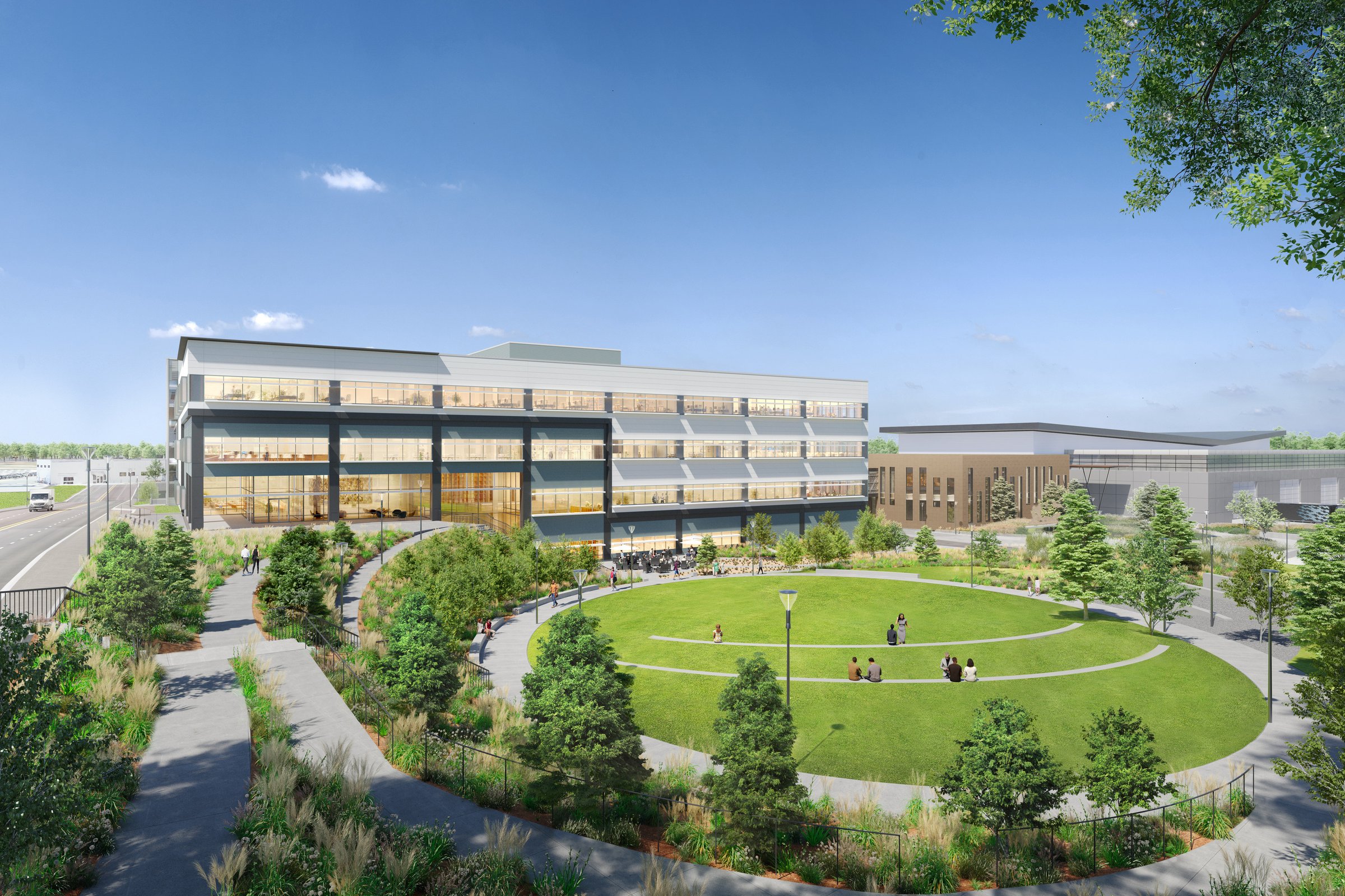
Page’s design for Building 28 at Johns Hopkins University Applied Physics Laboratory combines advanced research spaces with data-driven strategies for energy performance and long-term operational efficiency. Rendering courtesy of Page, now Stantec.
The future of sustainability won’t be decided by what we already celebrate. It will be shaped by the quiet and savvy decisions that often happen long before the project opens. That’s where the real leverage is, and clients have the most to gain.
The journey toward progress begins when we move the discussion from what a building is to exploring its potential, and the following step is to ask new questions. Ask how your building can work with the grid, not just draw from it. Ask what’s inside the systems and furnishings you specify, and how long they’ll last. Ask for performance data when the design is flexible enough to change course. Those questions rarely make it into grand opening speeches, but they enable projects that perform better, cost less, and stand up to your long-term goals.
Sustainability isn’t a checklist; it’s a mindset, and clients who embrace that mindset will be proud of their decisions decades from now.
Shively, B. How Much Primary Energy Is Wasted Before Consumers See Value from Electricity? (n.d.) Enerdynamics.
Using eGRID to Determine Emissions. (2025.) Washington, D.C.: U.S. Environmental Protection Agency.
Sustainable Buildings Task Force. (2023). Decarbonization in the Built Environment: Addressing Embodied Carbon in MEP Systems. ASHB.
Yang, D., Vezzoli, C. & Su, H. Comprehensive life cycle assessment of 25 furniture pieces across categories for sustainable design. Sci Rep. 2025;15:13968.
Hwang, B., Thomas, S., Haas, C., & Caldas, C. Measuring the impact of rework on construction cost performance. ASCE Journal of Construction Engineering and Management. 2009;135(3):187-198.

Justin has a passion for problem-solving. Working alongside his design colleagues, Justin uses computational analysis to answer our most pressing sustainable design questions. In his role, he partners with clients and design teams to set bold sustainability goals and map out clear, effective strategies to achieve them. He provides performance-based recommendations through climate, building energy, building envelope, daylighting, computational fluid dynamics analyses, and more. With a Ph.D. in Arch. Sci. and a certificate in Building Energy Modeling, understanding complex problems and providing simple solutions has defined Justin’s career.
More
by Robert McClure, Alison Ledwith, and Mo Elsayed


Complex challenges need fresh perspectives and deep expertise. Connect with our team to explore how we can help you create spaces that make a real difference.