
by Robert McClure, Alison Ledwith, and Mo Elsayed
by Mo Elsayed, Jill Kurtz, and Justin Shultz

The Building Performance team at Page, now Stantec, launched a three-part series on overcoming a frustrating chokepoint in the design process. The first installment introduced its innovative AI-driven framework for quick energy modeling and explained its transformative impact on making building energy modeling (BEM) faster, smarter, and more performance-focused. The second installment explores further, showing how generative AI can help automate and speed up BEM, turning a once tedious task into a catalyst for real-time, performance-based decision-making. This third installment reveals how Page’s AI framework transforms BEM into a scalable, equitable, and real-time instrument for decarbonization, effectively bridging the gap between code compliance and genuine performance.
As the climate clock continues to tick, the building industry stands at a pivotal crossroads. Buildings are responsible for nearly 40% of global energy-related carbon emissions, with most of that coming from operational energy use such as heating, cooling, and lighting.1 If the world is to meet its climate goals of limiting global warming to 1.5°C, buildings must become dramatically more efficient, and fast. This isn’t just a moral imperative; it’s codified in major policy frameworks. For example, the AIA 2030 Commitment asks architecture firms to deliver projects that reduce predicted energy use intensity (pEUI) by 80% or more by 2030 compared to baseline levels.2 Similarly, local regulations like New York City’s Local Law 97, California’s Title 24, and broader standards such as ASHRAE 90.1 and the IECC are tightening carbon and energy limits across jurisdictions. Globally, the World Green Building Council calls for all new buildings to be net-zero by 2030 and all existing buildings to reach that standard by 2050.3
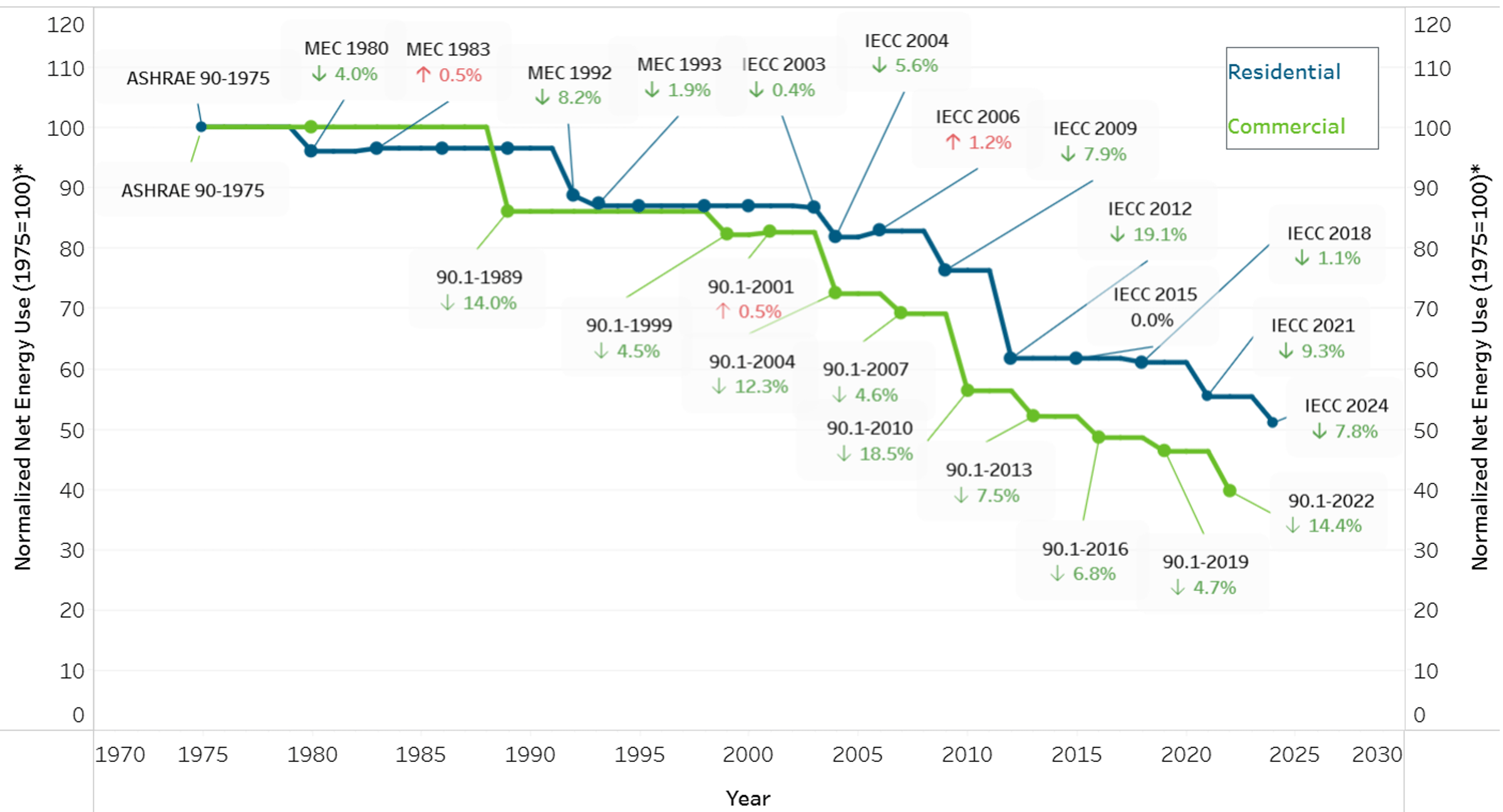
Decades of progress in energy codes have reduced energy use since 1975. Page, now Stantec’s AI-driven modeling framework, uses predictive simulation to optimize performance beyond minimum codes, bridging compliance and true efficiency.4
But the gap between ambition and implementation remains wide. While performance modeling has proven essential to reducing energy use and carbon emissions, it has historically been too time-consuming, expensive, and siloed to keep pace with early design. Even in firms with strong sustainability goals, energy modeling is often limited to select projects or delayed until late stages, well after the most impactful design decisions are made.
Page, now Stantec, acknowledges that the industry’s daily efforts to advance progress must enable everyone. Tackling climate change is a global team effort that will most benefit those with the fewest resources. Innovation kept hidden slows progress down, so Page and the framework’s creators have committed to openly presenting and publishing their methods through peer-reviewed platforms. By doing so, Page and the creators invite firms, researchers, and students to collaborate, refine, and accelerate the collective learning curve. An open dialogue and toolchain fosters faster idea development, and transparency in research builds trust. Unlike traditional energy modeling, which is bespoke, Page’s AI framework treats energy simulation as scalable infrastructure, capable of generating and simulating models in bulk, whether for 100 window configurations or 1,000 buildings in a district.5
This is a major breakthrough for cities, campuses, and large portfolio owners aiming to prioritize retrofit investments or develop new projects to achieve net-zero goals. Batch simulations that once took weeks can now be completed in hours. This isn’t theoretical: Page’s research demonstrated how the same AI that interprets a single prompt can be directed to generate dozens or hundreds of models automatically, each one code-compliant, simulation-ready, and reliable for decision making. In this context, AI becomes a policy accelerator.
“It enables planners, architects, and engineers to identify the most impactful design strategies not just for one building, but for entire portfolios, at a fraction of the traditional cost and effort. This means more informed decisions, faster deployment of decarbonization strategies, and better alignment with 2030 and 2050 targets.”Page Building Sciences teamMo Elsayed, Jill Kurtz, and Justin Shultz
What makes this tool powerful in the context of climate action is that it addresses three core barriers to decarbonization simultaneously:
Quality: AI-generated energy models use standardized, code-aligned assumptions, ensuring that results are consistent and reliable across scenarios. This enhances confidence in model output and supports better decision-making.
Equity: Smaller practices or basic projects often skip performance analysis due to budget or time constraints. This tool removes that barrier, ensuring that climate-forward design is accessible for all.
Speed: Climate action demands urgency. Designing a building that’s "on track" for net-zero performance should not add days to the timeline. With AI, energy performance becomes just as fast as drawing a new floor plan or adjusting a massing model.
“In this way, AI is not replacing the architect’s vision, it’s reinforcing the profession’s responsibility. Climate change may be the biggest design challenge of our generation. With intelligent tools and integrated workflows, the industry is finally equipped to meet it head-on.”Page Building Sciences teamMo Elsayed, Jill Kurtz, and Justin Shultz
Preparing for tomorrow’s expectations is as important as meeting today’s targets. The future of building performance will demand accountability, not just during design, but throughout operations. As more jurisdictions adopt carbon caps, EUI targets, and disclosure requirements, tools that seamlessly turn design intent into performance outcomes will be vital. Page’s AI-driven energy analysis process offers a solid foundation for this shift. By automating energy model generation, the framework can serve as a bridge to digital twins, building a pipeline from design data to operational tracking systems. Ultimately, the same platform could connect early design simulation with post-occupancy data, creating feedback loops that refine models, inform future projects, and validate real-world carbon savings.
As the industry races to decarbonize, agile tools like this are not just enhancements but enablers of systemic change. They represent a mindset shift from wondering “if we can model performance” to “how many ideas can we test today to get closer to zero?” In an era where the climate crisis demands both urgency and rigor, Page’s contribution reflects the future of high-performance practice: accessible, data-informed, and scalable. High-performance buildings must become the default, not for awards, but for survival. This requires every design decision to be grounded in feedback and every stakeholder to be equipped to understand performance. By embedding simulation deep into the design process, Page’s framework turns every idea into a measurable step toward decarbonization.
World Green Building Council. (2019). Bringing embodied carbon up front.
American Institute of Architects. (2024). 2030 By the Numbers: The 2023 Summary of the AIA 2030 Commitment.
World Green Building Council. (2023). Net Zero Carbon Buildings Commitment.
Office of Energy Efficiency and Renewable Energy. (n.d). DOE Building Energy Codes Program Infographics.
ElSayed, M., Shultz, J., Kurtz, J. User-friendly AI-driven automation for rapid building energy model generation. Energy and Buildings. 2025;345:116092.

Mo integrates emerging technologies into sustainable building practices, focusing on energy efficiency, decarbonization, and net-zero strategies. Mo specializes in integrating AI and machine learning into sustainable building practices, energy efficiency, daylight, decarbonization, and net-zero strategies. With a Ph.D. in Engineering from McMaster University, his work spans autonomous systems, drones, optimization, CFD, Carbon impact, digital twins, robotics, and fabrication, bridging the gap between research and industry. His work spans high-profile projects across the USA, Canada, and the Middle East.

Jill 's mantra is “intention requires rigor,” an apt phrase for someone committed to leading Page's efforts to embed sustainability into every project. Leveraging her strengths as a systems thinker and ability to work across disciplines, Jill combines 20 years of sustainable design experience and a client-centric mindset to her leadership of Page’s Building Science practice. The creator of Page's "Design for Impact" framework, Jill has led our firm-wide strategy on environmental and social responsibility, defined our project best practices, and helped design teams realize meaningful value and measurable impact towards their sustainability goals.

Justin has a passion for problem-solving. Working alongside his design colleagues, Justin uses computational analysis to answer our most pressing sustainable design questions. In his role, he partners with clients and design teams to set bold sustainability goals and map out clear, effective strategies to achieve them. He provides performance-based recommendations through climate, building energy, building envelope, daylighting, computational fluid dynamics analyses, and more. With a Ph.D. in Arch. Sci. and a certificate in Building Energy Modeling, understanding complex problems and providing simple solutions has defined Justin’s career.
More
by Robert McClure, Alison Ledwith, and Mo Elsayed



Complex challenges need fresh perspectives and deep expertise. Connect with our team to explore how we can help you create spaces that make a real difference.